
advisor
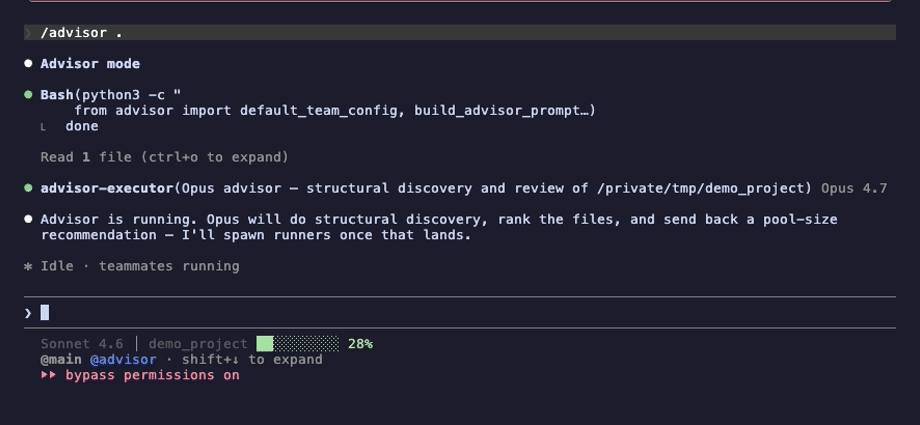
A one-command, Opus-led code review-and-fix pipeline for Claude Code. Opus goes first — does its own Glob+Grep discovery, ranks files P1–P5, and writes a unique, file-aware prompt for every agent based on what it just learned. Then it stays online and actively steers the team throughout: redirecting drift, answering questions in real time, verifying each output the moment it lands, and adjusting the plan when a finding changes the picture. Opus is the strategist that never goes idle until the final report ships. Optional fix wave applies edits the same way.
No external API calls. Runs entirely through Claude Code's native
TeamCreate / Agent / SendMessage tools.
Implementation: Rust (advisor-rs crate, advisor CLI). The Python
package has been superseded on main; see RUST_PORT_PLAN.md
and PORT_NOTES.md for migration status.
Team (three-tier, default)
| Role | Model | Agent type | Job |
|---|---|---|---|
| Advisor | Opus 4.8 (claude-opus-4-8) |
generalPurpose |
Glob+Grep discovery, P1–P5 ranking, sizes explorer + coder pools, writes per-agent prompts, dispatches explore + fix waves — stays live: redirects drift, answers questions, verifies each output, adjusts plan mid-wave |
| Explorer pool | Haiku 4.5 (claude-haiku-4-5) × N |
explore |
Read-only structural discovery on advisor-assigned file batches; reports findings to team-lead → advisor |
| Coder pool | Sonnet 4.6 (claude-sonnet-4-6) × N |
generalPurpose |
Long-lived fix workers; each gets a domain-specific prompt (with exploration context on fix assignments); reports findings + diffs to team-lead → advisor |
Priority scale: P5 auth/secrets · P4 user input/parsing · P3 handlers/DB/exec · P2 config/crypto/logging · P1 utils/tests.
Loop: Explorer discovers → Advisor reasons → Coder fixes.
Legacy two-tier mode
Set max_explorers=0 or ADVISOR_MAX_EXPLORERS=0 to skip the explorer
wave and run the original advisor + Sonnet-runner pipeline.
Install
From source (recommended)
Requires Rust 1.74+. The binary has zero runtime dependencies — only the Rust toolchain is needed to build.
git clone https://github.com/vzwjustin/advisor && cd advisor
cargo install --path .
advisor install          # wire SKILL.md + CLAUDE.md nudge (idempotent)
advisor status           # confirm what landed where
After edits, reinstall with cargo install --path . --force.
Other install methods
# Install a tagged release without cloning (needs Rust + git)
cargo install --git https://github.com/vzwjustin/advisor --tag v0.8.7

# Run without installing
cargo run -- version
cargo run -- pipeline src/

# PyPI (published releases — package name advisor-agent)
pipx install advisor-agent
pipx upgrade advisor-agent

# Plain pip / uv
pip install advisor-agent
uv tool install advisor-agent
PyPI releases may trail main during the Rust migration. For the latest
features (three-tier architecture, Rust port), build from source.
The first advisor install wires ~/.claude/CLAUDE.md and the /advisor
slash command automatically. The CLAUDE.md block also embeds a 4-rule
Behavioral Guidelines section (Think Before · Simplicity First ·
Surgical Changes · Goal-Driven Execution). Every upgrade prints a "What's
new" digest from CHANGELOG.md.
Manage the nudge / skill manually
advisor status               # install health check
advisor install              # append / update the nudge + skill (idempotent)
advisor install --check      # dry-run: print status, exit 3 if anything missing
advisor uninstall            # cleanly remove the nudge + skill
advisor install --path /x    # target a different CLAUDE.md
Opt out of auto-install with ADVISOR_NO_NUDGE=1. Suppress the diagnostic TTY spinner with ADVISOR_QUIET=1. The CLAUDE.md block is
wrapped in <!-- advisor:nudge:start --> / <!-- advisor:nudge:end -->
markers so reinstalls update in place.
Usage
Invoke from inside Claude Code:
/advisor                    # review the cwd
/advisor src/               # review a specific dir
/advisor review the auth flow      # add scope context
Or use the standalone CLI to inspect the prompts and plans:
advisor pipeline src/                  # full pipeline reference (three-tier by default)
advisor protocol                       # print the strict team-lifecycle protocol
advisor plan src/                      # rank local files, print dispatch plan
advisor plan src/ --json               # same, machine-readable for `jq` etc.
advisor plan src/ --format json        # explicit selector (alias of --json; pretty overrides)
advisor plan src/ --sarif out.sarif    # SARIF 2.1.0 output for Code Scanning
advisor audit RUN_ID [TARGET]          # post-hoc diagnostic for a completed run
advisor prompt advisor src/            # the advisor's prompt body
advisor prompt runner src/ --runner-id 1   # a coder's bootstrap prompt
advisor prompt verify src/ < findings  # verify-pass prompt
advisor status                         # install health check
advisor status --json                  # JSON-formatted health for scripting
advisor doctor                         # extended diagnostic: git/claude/codex/env checks
advisor install                        # install nudge + /advisor skill (prints What's new on upgrade)
advisor update                         # self-upgrade via PyPI, then re-runs install
advisor changelog [VERSION]            # print bundled CHANGELOG section(s); --since X.Y.Z for a digest
advisor uninstall                      # remove nudge + /advisor skill
advisor ui                             # launch local web dashboard on 127.0.0.1:8765 (Findings · Live · Plan · Run config · Cost)
advisor live tail                      # tail the live event stream (the Live tab subscribes to this)
advisor history                        # recent findings from .advisor/history.jsonl
advisor history --stats                # aggregate: confirm rate, breakdowns, top files
advisor baseline create                # snapshot current findings as baseline
advisor baseline diff                  # compare current run vs. baseline
advisor checkpoints                    # list saved plan checkpoints
advisor checkpoints --rm RUN_ID        # delete a single checkpoint
advisor checkpoints --clear            # delete all checkpoints
advisor presets                        # list available rule-pack presets
advisor suppressions --list            # list active false-positive suppressions
advisor version                        # print version + environment info
Every subcommand's target defaults to . (current directory). Piping a
long scope description is supported via --context - (reads stdin).
Flags: --team, --file-types, --max-runners (advisory — Opus may
exceed for large repos), --min-priority, --context, --advisor-model,
--runner-model. Default models: claude-opus-4-8 / claude-sonnet-4-6 / claude-haiku-4-5 (full IDs pin the version; bare aliases opus/sonnet/haiku resolve to the latest at spawn time). Mid-form IDs like opus-4-8 are auto-normalized to claude-opus-4-8.
Environment overrides (also read by default_team_config):
| Variable | Default | Effect |
|---|---|---|
ADVISOR_MODEL |
claude-opus-4-8 |
Advisor model |
ADVISOR_RUNNER_MODEL |
claude-sonnet-4-6 |
Coder model |
ADVISOR_EXPLORER_MODEL |
claude-haiku-4-5 |
Explorer model |
ADVISOR_MAX_RUNNERS |
5 |
Suggested coder pool size |
ADVISOR_MAX_EXPLORERS |
same as max runners | Explorer pool size (0 = legacy two-tier) |
ADVISOR_MIN_PRIORITY |
3 |
Minimum P-rank to include |
ADVISOR_FILE_TYPES |
*.* |
Glob filter for advisor plan |
ADVISOR_EXPLORER_OUTPUT_CHAR_CEILING |
40000 |
Explorer output budget |
ADVISOR_EXPLORER_FILE_READ_CEILING |
40 |
Explorer distinct-file-read cap |
Context-pressure knobs (reduce coder context exhaustion):
--max-fixes-per-runner N · --large-file-line-threshold N · --large-file-max-fixes M · --runner-output-char-ceiling K · --runner-file-read-ceiling L.
Automation flags: --json on status/plan/install --check,
--quiet on install/uninstall, --strict on status/install/uninstall
(exit 3 when nothing changed or the install is unhealthy).
Colors are on by default. Opt out with NO_COLOR=1 or TERM=dumb.
Excluding files (.advisorignore)
Drop an .advisorignore file into your project root to skip paths during
advisor plan and the live pipeline:
# comments begin with #
tests/            # skip directories (trailing slash)
*.md              # skip by filename glob
vendor/
generated/**/*.py # ** recursive globs are supported
Patterns follow fnmatch semantics for filename matches, and use
PurePath.match when ** is present. Bare words match any path
component (docs matches both docs/ and foo/docs/bar.py).
Rust library
The crate root re-exports the same surface the Python package exposed:
use advisor::{
    default_team_config, TeamConfig, TeamConfigInput,
    build_advisor_prompt, build_explorer_prompt, build_explorer_pool_agents,
    build_coder_prompt, build_runner_pool_prompt, build_runner_dispatch_messages,
    build_fix_assignment_message, build_verify_dispatch_prompt, build_verify_message,
    render_pipeline, rank_files, create_focus_tasks, parse_findings_from_text,
    estimate_cost, findings_to_sarif, resolve_version,
};

let config = default_team_config(TeamConfigInput::new("src/"));
println!("{}", render_pipeline(&config));
Builder functions return plain strings or JSON-friendly structs — drop them
into Claude Code Agent(...) or SendMessage(...) calls. See src/lib.rs
for the full export list.
Modules (src/)
| Module | Role |
|---|---|
config.rs |
TeamConfig, env-var assembly, model validation |
orchestrate/ |
Advisor, explorer, and coder prompt builders; render_pipeline |
rank.rs |
rank_files, keyword-signal P1–P5 ranking |
focus.rs |
create_focus_tasks / create_focus_batches, plan formatters |
verify.rs |
Finding, parse_findings_from_text, verify-pass builders |
runner_budget.rs |
Per-coder output-char budget and rotation |
install.rs |
Idempotent CLAUDE.md nudge + /advisor skill install |
doctor.rs |
Git / Claude / Codex / install health checks |
audit.rs |
Post-hoc run transcript diagnostics |
baseline.rs |
Finding baselines for drift detection |
checkpoint.rs |
Plan checkpoints for --resume |
cost.rs |
Per-tier token and cost range estimates |
git_scope.rs |
--since / --staged / --branch scoping |
history.rs |
Confirmed findings log (.advisor/history.jsonl) |
sarif.rs |
SARIF 2.1.0 serializer |
suppressions.rs |
Per-rule false-positive suppressions |
skill_asset.rs |
Bundled /advisor skill content |
web.rs |
Local dashboard (advisor ui) |
live.rs |
Ephemeral event stream for the Live tab |
Prompt templates live under src/assets/ (advisor.txt, explorer.txt, …).
Live dashboard (new in 0.8.0)
Run advisor ui and open http://127.0.0.1:8765 to watch a /advisor
run in real time without keeping Claude Code in the foreground. The
Live tab polls /api/events every 2s and renders the team-lead's
event stream as a feed: each runner spawn, every report relay, every
fix dispatch, and the final run summary. Newly-arrived rows briefly
flash; FIFO-trimmed at 500 rows; respects prefers-reduced-motion.
The team-lead emits events via advisor live record at three
checkpoints (run_start, every report_relay, run_end), instructed
by the bundled /advisor skill body. Events are best-effort: a failed
write never halts the pipeline. Users who never start advisor ui see
no behavior change — the events file just accumulates harmlessly in
<target>/.advisor/live/events.jsonl.
The event store is deliberately separate from history.jsonl:
history.jsonl— authoritative CONFIRMED findings; drives ranker boost, SARIF emission, repeat-offender analytics.live/events.jsonl— ephemeral event feed; opaque to the orchestrator, advisory to the dashboard, free-form payload.
For ad-hoc inspection from the terminal: advisor live tail --limit 50
(--json for scripting). advisor live clear removes the file; the
cursor preserves cleanly so the next run resumes the stream.
Orchestration rules
TeamCreatebefore any agent spawn;TeamDeletebefore creating a new team.- Opus goes first — no explorers or coders until Opus's first pass produces pool sizes.
- Each agent is spawned with the verbatim per-agent prompt from Opus's dispatch plan. Don't substitute a generic template.
- Dispatch agents in a single message with
run_in_background=trueso they come up in parallel. - Every agent prompt must end with a
SendMessage(...)— agents go idle silently otherwise. - Shut down teammates individually by name; broadcast shutdown does not work.
See CLAUDE.md for the full protocol.
Development
git clone https://github.com/vzwjustin/advisor && cd advisor
cargo build
make check        # clippy + fmt --check + test
cargo test        # 125+ parity tests (Linux, macOS, Windows in CI)
cargo fmt         # format
cargo clippy --all-targets
Release checklist: make release-check (prints version + tag commands).
Version lives in Cargo.toml; tag with git tag vX.Y.Z && git push origin vX.Y.Z.
GitHub Action
Reusable workflow that runs advisor plan, uploads SARIF 2.1.0 output to
GitHub Code Scanning, and (optionally) posts a PR comment. Paste this into
.github/workflows/advisor.yml in your repo:
name: Advisor

on:
  pull_request:
  push:
    branches: [main]

jobs:
  advisor:
    uses: vzwjustin/advisor/.github/workflows/[email protected]
    with:
      target: "."
      min-priority: 3
      preset: "python-web"   # optional rule-pack tuning
      post-pr-comment: false
[!NOTE] The
fail-onparameter is enforced by a SARIF-parsing step that runs afteractions/upload-sarif. Becauseadvisor plan --sarifemits an empty-results document by design, the gate is a no-op unless a downstream step replacesadvisor.sarifwith real findings (e.g. SARIF captured from a live/advisorrun). Threshold semantics matchadvisor audit --fail-on: the gate reads each result'sproperties.severity(which advisor's SARIF writer emits) socriticalandhighare correctly distinguished. For third-party SARIF that lacksproperties.severity, the gate falls back to the SARIF level field (CRITICAL/HIGH →error, MEDIUM →warning, LOW →note) which cannot distinguish CRITICAL from HIGH.
Or roll your own: any CI system can run advisor plan --sarif advisor.sarif
and upload the file to whatever scanner you use.
Presets
Curated rule-pack bundles tune file-type defaults and priority keywords for common stacks:
| Preset | Stack | Defaults |
|---|---|---|
general-python |
Generic Python codebase | *.py, no stack-specific boosting |
python-web |
Flask / Django / FastAPI | *.py, P5 auth keywords |
python-cli |
argparse / click CLIs | *.py, P3 subprocess keywords |
node-api |
Express / Fastify / Koa | *.js,*.ts, P5 JWT/session |
typescript-react |
React + TS | *.ts,*.tsx, P4 DOM sinks |
go-service |
net/http services | *.go, P3 net/http/sql |
rust-crate |
library / crate | *.rs, P3 unsafe/transmute |
advisor plan src/ --preset python-web
advisor presets            # list presets
advisor presets --json     # machine-readable
Automation flags
Findings come from advisor audit (the verify pass) — advisor plan
prints the dispatch ranking. The gating + emit flags that depend on
findings (--fail-on, --format pr-comment, --baseline) only exist
on audit. --sarif exists on both — plan writes an empty-results
document (no findings yet), audit writes the real one.
| Flag | Applies to | Effect |
|---|---|---|
--sarif PATH |
plan, audit |
Write SARIF 2.1.0 for Code Scanning |
--fail-on LEVEL |
audit |
Exit 4 if any finding ≥ LEVEL |
--format pr-comment |
audit |
Emit a PR-body-ready markdown summary |
--baseline PATH |
audit |
Suppress findings matching a baseline |
--no-history |
plan |
Ignore history for deterministic CI plans |
--json / --output FILE |
plan, audit |
Machine-readable output |
Exit codes: 0 clean · 4 --fail-on threshold tripped · 3 --strict
no-op or unhealthy install · 2 argparse / user error · 1 unexpected.
Findings lifecycle
advisor history— recent confirmed findings from.advisor/history.jsonl(--statsfor an aggregate view)advisor baseline create— snapshot current findings as an accepted baselineadvisor baseline diff— compare current run vs. baseline.advisor/suppressions.jsonl— per-rule, per-file suppressions with expiry dates (runadvisor suppressionsto list, add--expiredto filter)
Further reading
docs/architecture.md— module dependency graph, runtime flow, data contract, design invariantsdocs/prompts.md— prompt engineering notes for contributors modifying prompt templatesRUST_PORT_PLAN.md— Rust migration planPORT_NOTES.md— Python parity status
License
MIT — Copyright (c) 2025–2026 Justin Adams (@vzwjustin).


