
dxkit
Map the code. Prove each change is safe to merge. Fix the debt. Repeat.
Coding agents write more code than anyone can review by hand. dxkit covers the gap with three things: a living map of your codebase that grounds agents in real structure before they edit, a deterministic check that proves each change is safe to merge, and a repair crew of agents that bump dependencies, fix vulnerabilities, and improve tests, with every fix landing through that same check.
It works on the repo you have today. Existing debt is baselined and attributed on day one, so the gate is green immediately and every verdict after that is about what actually changed.
In controlled agent-loop runs, ungated agents stopped with a seeded regression still in the tree in 11 of 16 runs. With the gate armed: 0 of 16. (methodology and artifacts)
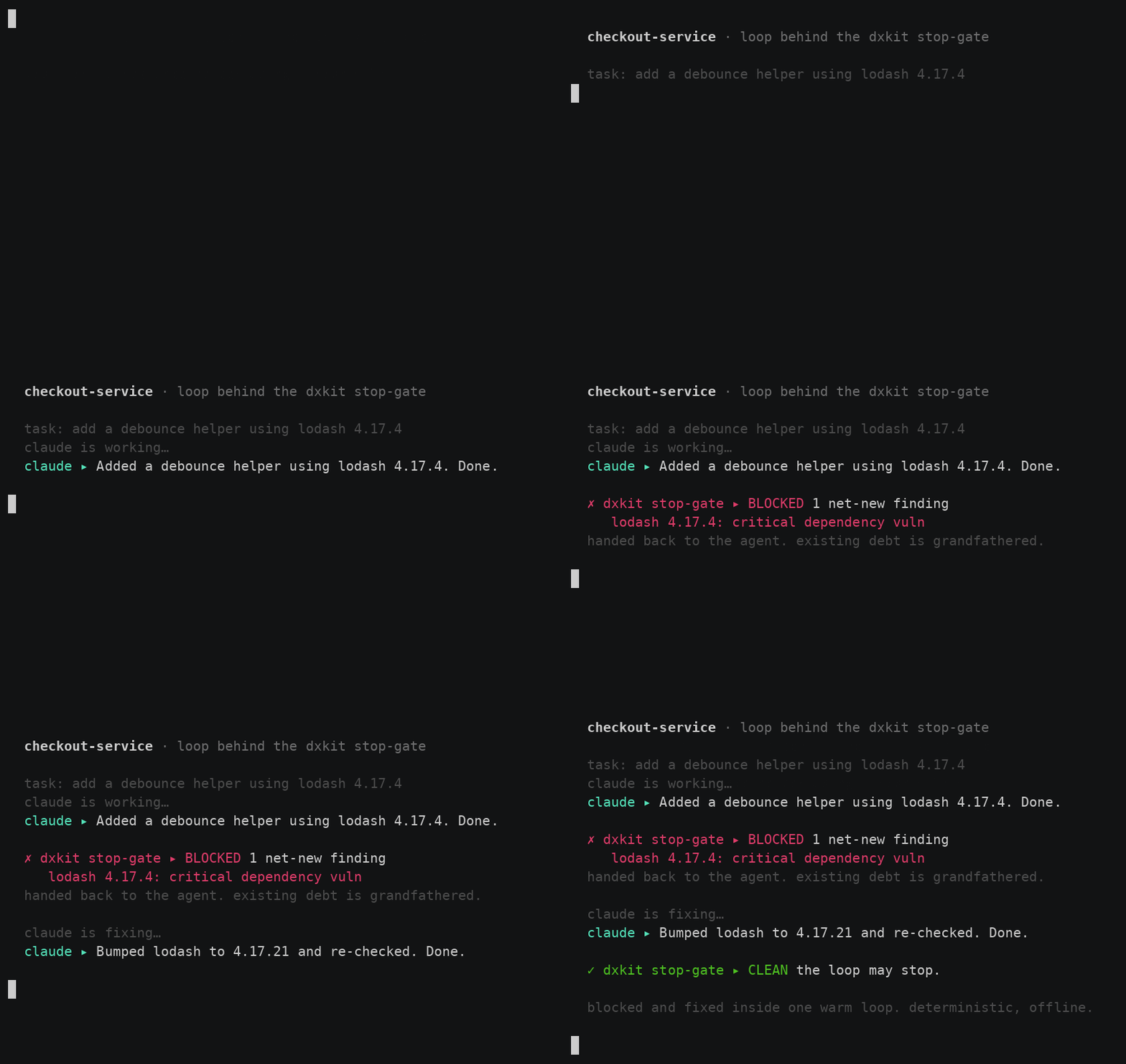
Recorded from a real run on a synthetic repository, shortened for readability. Blocked and repaired inside the same warm loop.
Sixty seconds to a verdict
Nothing to install into your project, nothing written, no git required:
npx -y @vyuhlabs/dxkit@latest gate .           # one-shot verdict on any directory
npx -y @vyuhlabs/dxkit@latest learn --serve    # the whole product on one offline page
gate judges a bare tree — code an agent just generated, an exported
package, a whole workspace of services (--workspace) — and exits 0
passed, 1 blocked (each finding named with its durable fingerprint), or 2
refused-with-reason. It is the same engine as the repo guardrail below,
pointed at a directory instead of a git history, and it is embeddable: a
codegen or conversion pipeline can call it on every tree it emits
(embedding guide,
wave gating).
On a repository you already work in, start with evaluate (below) instead:
it replays your recent merges through the gate rather than judging years of
existing debt as if it were new.
Start in one command
From the root of the repository you want to gate:
npm init @vyuhlabs/dxkit -- --claude-loop --yes
That is the whole setup. dxkit reads your stack, wires the agent context, arms
the gates, installs the scanners a baseline needs, and captures today's
baseline, so the repository is gated on the very next change. No questions, no
homework. Undo anytime with npx vyuh-dxkit uninstall.
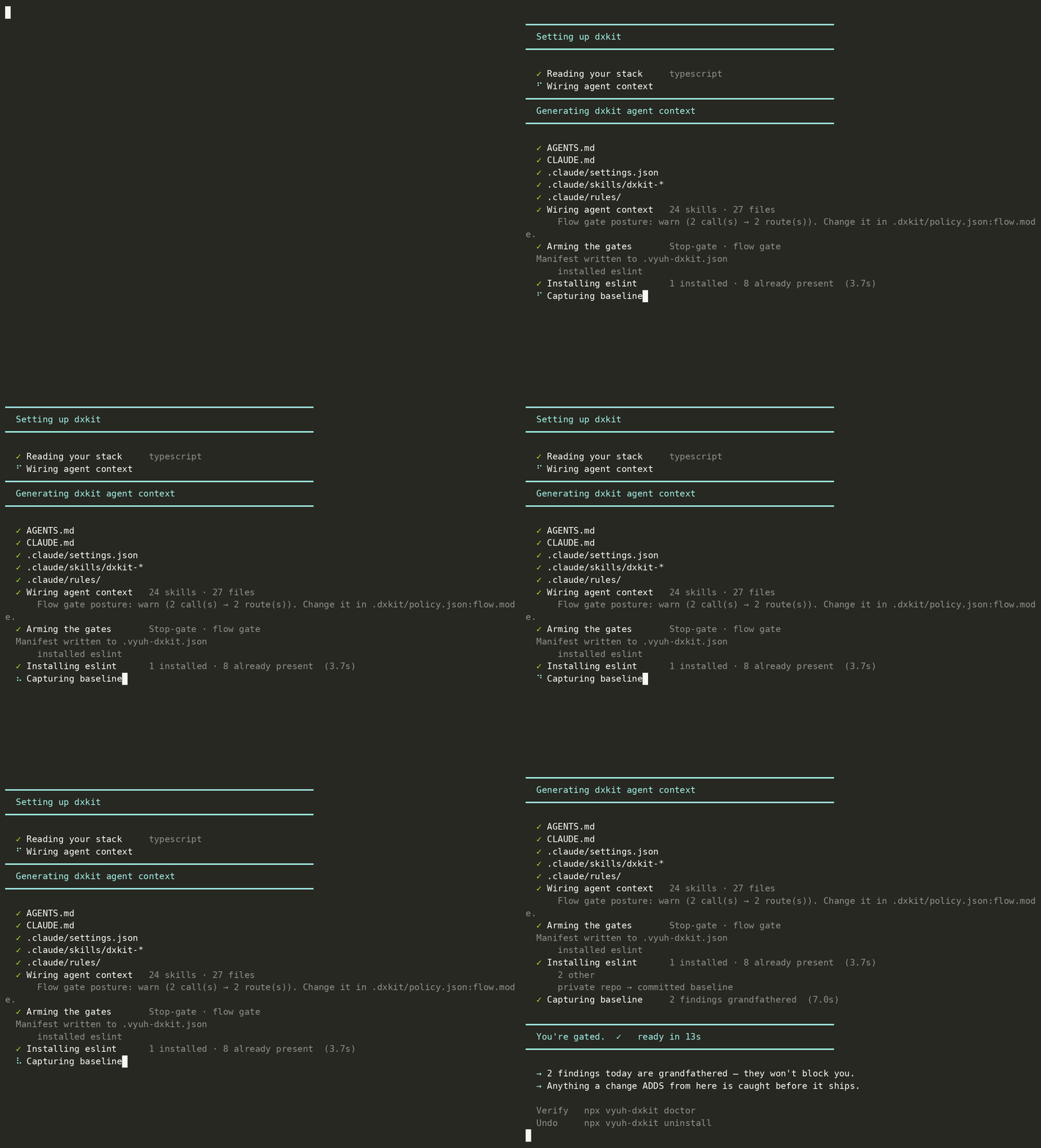
Existing findings are grandfathered, not approved. Only what a change adds
from here can block. Already have dxkit installed? init detects the version
and points you at npx vyuh-dxkit update instead of re-running setup.
One honest cost note: the first baseline also records your repo's pre-existing
build/test state, which means running your build and full test suite once
(bounded; minutes on a large repository — init names the exact commands
before they run). Add --no-floor to defer that part to CI or a later
capture.
Try it read-only on your own repository first
npx -y @vyuhlabs/dxkit@latest evaluate
evaluate writes nothing to your repository and installs nothing: it replays
your recently landed changes through the same gate init would arm and shows
what would have blocked, warned, or passed — evidence first, setup second.
Want to see the gate first, without installing anything?
npx -y @vyuhlabs/dxkit@latest demo loop-guardrail
This stages a temporary fixture repo and runs the real gate on it: baseline, introduce a net-new secret, block, repair, clean. Your repository is never touched and no API key is needed. The demo needs gitleaks; without it, it shows a clearly labelled illustration instead of pretending to scan.
What the loop-safety benchmark observed
On controlled seeded-regression tasks, ungated agents frequently stopped while configured guardrail findings remained:
| Loop condition | Dirty stops observed |
|---|---|
| Agent alone | 11 / 16 |
| Agent + self-check prompt | 9 / 16 |
| Agent + dxkit Stop-gate | 0 / 16 observed |
When dxkit blocked a stop, it returned the exact net-new finding to the active agent, and the agent repaired it before stopping clean. Methodology, claim boundaries, and reproducible artifacts. The gate and the recorded fixtures replay offline without an API key; reproducing the original agent runs requires the documented model environment.
The middle row is why guidance alone is not enough — and why dxkit is a complement to agent rulesets and prompt packs, not a replacement. Guidance makes agents write better code, and you should keep whatever guidance works for you; a self-check prompt still left 9 of 16 regressions in the tree, because advice cannot verify itself. The gate is the proof half: deterministic, outside the model, and unbribable by a confident summary.
Blocked, for real
- dxkit gates its own development. Its CI guardrail blocked PR #134 on real findings (three files past the repo's size budget and a test fixture a broken benchmark run had leaked into the tree). The failed and passing runs are in that PR's checks history. We fixed the findings, not the gate.
- A lint-cleanup agent introduced vulnerabilities; the gate caught it. In a production remediation run, an agent tasked with cleaning up lint findings shipped security regressions in its "cleanup". The guardrail blocked the PR and returned the exact findings; nothing landed.
- Advisories published the same hour. During one of dxkit's own release checks, the gate flagged two dependency advisories that had been published earlier that day — after the baseline was captured — and routed them to the decision lane instead of silently absorbing or silently blocking.




What you can rely on:
- Deterministic verdict. No model decides whether the gate passes: same input, same verdict, and the check does not grow as your baseline grows.
- Brownfield-aware. Existing detector findings are baselined; new policy findings block.
- Change-scoped. The graph identifies likely impact and helps select relevant context and tests.
- Detector-neutral. dxkit runs or ingests gitleaks, Semgrep, OSV, Snyk, CodeQL, and SARIF. It does not claim to out-detect them.
- Warm-loop repair. A blocked stop returns the exact finding while the agent still holds the task context.
- Explicit failure states. dxkit distinguishes a clean verdict from a
skipped or unavailable check. A skipped detector is never reported as
passed, and a verdict it cannot attribute is refused (
CANNOT GATE), never guessed. - Verified remediation. Lane and agent work merges the same way yours does: through the gate, via a PR, with model and spend disclosed. There is no side door.
- Deliberate releases. Minors are batched scope; patches are verified production fixes that may ship same-day; every release passes the full gate suite including dxkit's own guardrail. Policy: RELEASES.md.
See your code the way an agent should
vyuh-dxkit describe writes one self-contained HTML file: your whole code
graph (every function, what it calls, and what calls it) as a live,
draggable map. It runs read-only (nothing is written to your repository) and
needs no server or key.
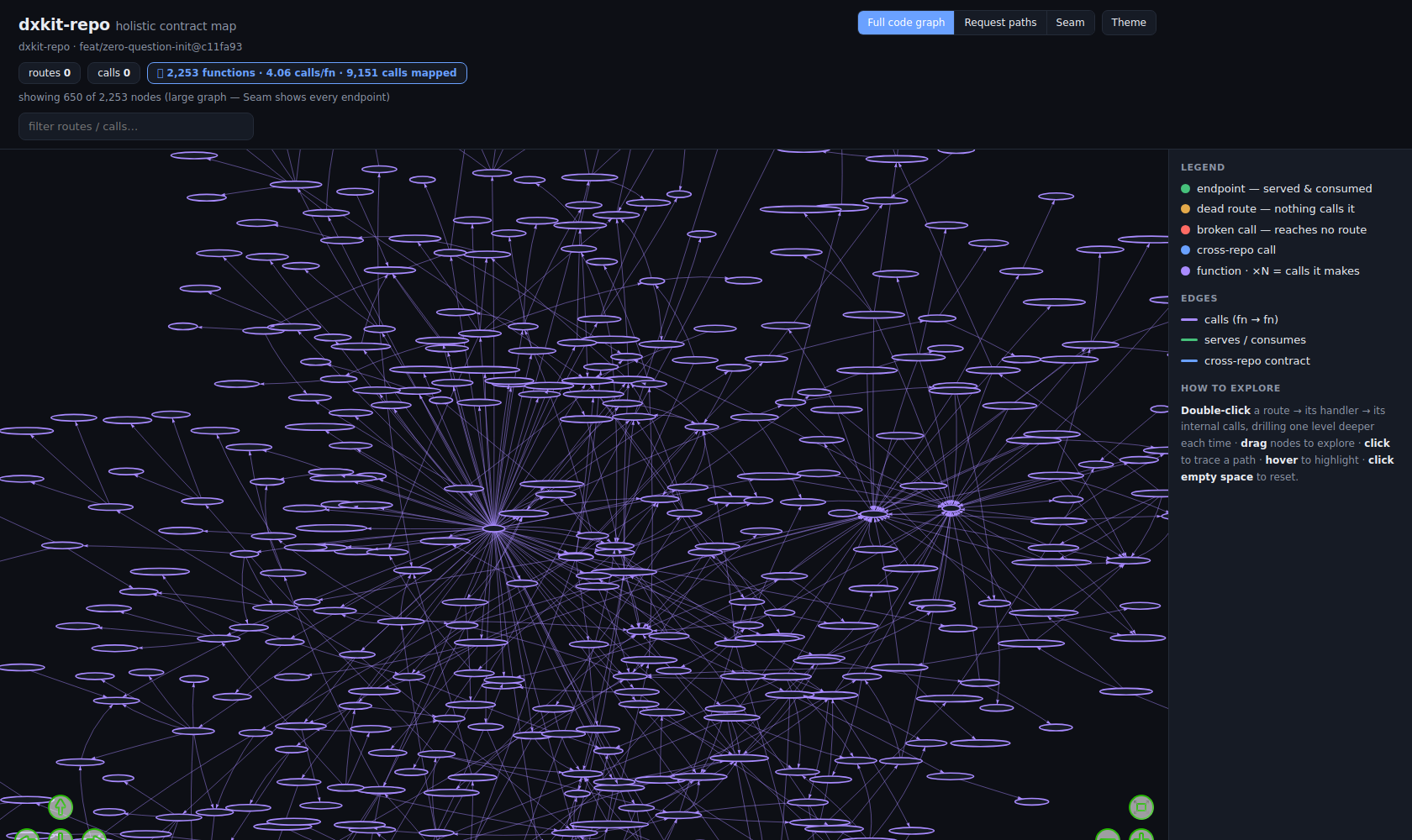
dxkit's own code graph, rendered by describe: 2,253 functions, 9,151 calls mapped. Drag, zoom, and double-click a function to drill into what it calls.
When a repository has an HTTP surface, describe joins the code graph to the
contract (every route, the calls that reach it, and the handler behind it)
and lights up the seams: dead routes nothing calls, client calls that reach
no route, and cross-repo contracts served by another repository in your
workspace. It is the map a coding agent (or a new teammate) reads to understand
a codebase and its integrations before touching it, and the same signals feed
the gate.
How the change-safety layer works
An autonomous loop runs until the agent decides it is done. The checks it runs along the way (tests, linters, CI-style commands) answer whether something is broken or flagged. They do not, by themselves, answer the loop-level question: did this change make the repository worse? dxkit adds that answer in four steps:
- Map. dxkit builds a structural code graph and hands the agent callers, callees, blast radius, and relevant files, so the change starts from structure instead of guesswork.
- Baseline.
baseline createrecords today's findings with durable fingerprints, so pre-existing issues stay visible and auditable without blocking the work. - Gate. On every unattended-loop stop attempt, a Claude Code Stop hook reruns the guardrail against that baseline: the compilation and affected-test checks it can establish (unavailable ones are reported, not silently passed), and the configured detector-backed policy.
- Repair. If the change introduced a finding, the stop is blocked and the exact finding comes back to the agent while it still holds the task context. The loop finishes only when the change is clean.
When infrastructure fails (a scanner missing, a tool timing out), dxkit reports that check as skipped rather than guessing. Real findings fail closed; broken tooling never fabricates a verdict in either direction, and CI remains the backstop.
The same deterministic core also runs outside the loop: a pre-push hook, a CI guardrail, a six-dimension health report, and a set of Claude Code skills. See the docs.
Use dxkit if you let coding agents run unattended or semi-attended, fix CI or review comments in loops, or touch brownfield repos where new debt matters more than all debt.
Install options
The one-liner above is the default: it adds dxkit as a devDependency, installs
the Claude Code Stop hook, provisions scanners, and captures the baseline.
Everything is additive, preserving your existing .claude settings. Then run Claude Code
as you normally would; the Stop-gate fires on every stop of an unattended loop
(interactive sessions are not gated — review and the CI guardrail cover those).
npx vyuh-dxkit loop doctor            # verify the wiring
npx vyuh-dxkit loop ledger summarize  # what was blocked, allowed, and repaired
Variants:
- Defer the baseline (arm the gates now, scan later): add
--no-finish, then runnpx vyuh-dxkit baseline createwhen you are ready. - Pre-push + CI instead of the loop:
npm init @vyuhlabs/dxkit -- --full --yes. - Agent context only, no gate:
npm init @vyuhlabs/dxkit -- --dx-only --yes.
What the gate checks
Two presets decide what blocks a stop:
security-only  (default)  blocks net-new secrets, critical and high code
                          findings, critical dependency vulnerabilities, and
                          known-malicious packages at any severity. Every
                          other net-new finding warns; nothing net-new is
                          ever silent. Bounded, must-fix, cheap to gate.
full-debt      (opt-in)   also blocks net-new test gaps and maintainability
                          regressions. Repairs can be expensive.
Before the finding gate, a correctness floor runs: does the change still compile or parse, and do the tests it affects still pass? A pre-existing failure never blocks; a net-new one does.
The escape-rate benchmark above used full-debt (it gated both the secret
trap and the test-gap trap). The default install starts narrower so a first
run does not trap you in expensive test-generation loops. Switch with
npm init @vyuhlabs/dxkit -- --claude-loop --loop-preset full-debt.
The proof, verbatim
Here is the gate doing its job. A block names the exact finding, its durable fingerprint, and the paved path out:
Guardrail BLOCKED — 1 new regression

Blocking (1)
  ADDED [critical] secret src/payments/stripe-sync.ts:41
  · block-rule: policy block-rule fired: newSecret
  · fingerprint: 3f9c2a51de8b4c07  (allowlist add --fingerprint=3f9c2a51de8b4c07)
And when dxkit cannot honestly attribute a finding to your change, say a scanner upgraded underneath you since the baseline was captured, it refuses to guess:
Guardrail CANNOT GATE — 3 findings on block-rule kind (secret) cannot be attributed

Cannot attribute — refusing to pass (3)
  · 3 findings covered by block rule newSecret cannot be attributed —
    secret: gitleaks 8.18.4 → 8.21.0 since the baseline was captured
  · dispatch the baseline-refresh workflow to re-capture the anchor from CI
    and restore attribution; the guardrail refuses to pass until then
That refusal tier exists because a difference between two scans has six possible causes, and just one of them is your change:
| A finding delta can mean... | dxkit rules it out with... |
|---|---|
| the change introduced it | the one cause that blocks |
| the scan didn't fully observe the current side | per-kind observation disclosures, never silent |
| the finding moved (line shift, rename) | git-aware identity matching with durable fingerprints |
| a scanner changed underneath you | per-kind recall contexts (tool + plugin + config) |
| dxkit itself changed what it can see | versioned observation epochs |
| a truncated or partial prior report | multiset-aware pair matching |
net-new means the other five were ruled out. When they can't be, the
verdict is CANNOT GATE: named cause, named remedy, exit 1. A PASSED
over an attribution gap is not constructible, and a tool upgrade is never
blamed on whoever opened the next PR.
When it blocks: the paved paths
A block is not a dead end; every verdict prints its own way out, on the record and in the PR:
- Fix it. The common case. The finding is gone from the branch, the gate passes. Nothing to clean up.
- False positive? Suppress it in your PR with a typed reason:
allowlist add --fingerprint=<id> --category=false-positive --reason="...". The entry lands in.dxkit/allowlist.json, so the reviewer sees the suppression next to the change that needed it. - Real, but not this PR? Defer it, time-boxed:
allowlist defer <fingerprint> --expires=+14d --reason="...". It stops blocking until expiry, then re-blocks. With the comment workflow installed, anyone with write access can do this from the PR conversation:/dxkit defer <fingerprint> --expires=+14d --reason="...". - CANNOT GATE? Not about your code. The baseline is stale or a scanner drifted; the remedy (re-capture from CI) is printed, and the repo admin owns it, not your PR.
allowlist audit keeps the ledger honest: stale, expiring, and
missing-rationale entries surface on a schedule, and receipt renders the
verdict + suppressions + score delta as a PR-comment block reviewers can
trust without re-running anything.
Verified remediation: agents with a budget and no side door
Detection without repair is a report; repair without verification is a risk. dxkit ships both halves, inside one frame:
- Scheduled lanes. Baseline refresh re-captures findings from CI on a cadence, and newly published dependency advisories arrive as a decision PR: merging defers them for a time-boxed window that re-blocks at expiry, upgrading the dependency fixes them. Dependency bump proposes deterministic security upgrades as ordinary PRs.
- Remediation tasks. Budget-bounded agent runs (fix-build, fix-vulns, fix-lint, improve-tests, write-docs), each starting from a pristine-tree entry snapshot under hard spend / turn / time caps. Score-hinged tasks must move their target dimension above the entry score or nothing lands.
- Dispatch campaigns. One-off runs from the Actions UI: pick a task or
write a custom prompt, override budgets within an org-set ceiling
(
remediate.maxDispatchBudget). Write-access-gated by GitHub itself.
What makes them shippable is the frame, not the model: every attempt lands only via a pull request that passes the correctness floor and the same guardrail a human change faces, with the dispatcher, prompt, model, and spend disclosed in the PR body. The agent's own claim of success is never trusted. A failed attempt lands nothing, says so, and uploads its diff as a run artifact for inspection.
npx vyuh-dxkit jobs          # what's installed: triggers, schedules, last runs
npx vyuh-dxkit policy set    # cadence, budgets, which tasks are enabled
Embed it: a verdict engine for pipelines that emit code
Everything above gates a repository over time. The same engine also ships as a one-call verdict for systems that produce code: a generation pipeline, a conversion factory, an on-prem review image.
vyuh-dxkit gate ./emitted-package --policy dod.json --json     # fresh tree: everything is net-new
vyuh-dxkit gate ./edited --baseline ./original --json          # diff a tree against its original
vyuh-dxkit gate ./wave --workspace --flows flows --json        # N services judged as one estate
The --json output is the frozen verdict.v1 schema: status, exit code,
the policy's identity (id, version, content hash), every finding with its
fingerprint, every skipped check with its cause, and a receipt your
pipeline can store as evidence. The gate never executes code from a tree it
is merely judging (--trusted is explicit consent), init --gate-only
scaffolds just the policy file, tools bom prints the scanner
bill-of-materials for image review, and --advisory-db runs the dependency
audit against an offline snapshot. The full walkthrough is the
embedding guide; judging many trees as one
composition (unresolved cross-service calls, dead routes, declared
end-to-end flows) is wave gating.
Show your team: the whole product, one page
npx --yes @vyuhlabs/dxkit learn --serve
One self-contained, offline HTML page: every command, policy field, lane task, agent skill, and documentation page, all searchable (Ctrl+K), plus an optional BYO-key assistant (Anthropic, OpenAI, or any OpenAI-compatible endpoint) grounded in exactly that content. Run it inside a repo and the assistant also answers from that repo's live truth: what is enabled, why the last PR blocked, what to adopt next. Keys stay local; by default the assistant sends summaries, never raw findings, and the page states exactly what is sent. Works in an empty directory with no repo at all — it is the fastest way to show dxkit to a teammate.
Why baseline-relative verification matters
Grandfathered does not mean accepted. It means attributed.
When an agent tries to declare done, the useful question is not "is this entire repository debt-free?" It is:
did this change make the repository worse than the baseline?
If the gate demanded zero findings repo-wide, brownfield teams could not adopt it before a cleanup project, and the agent's repair target would be unbounded: churned unrelated code, context spent on old debt, or a baseline refresh to escape. dxkit scopes the obligation to the change: fix what this branch introduced, do not touch unrelated debt, do not move the baseline. Existing findings stay visible and auditable, and paying them down is a separate, deliberate workstream. A baseline refresh is a governance action, not a repair action.
This is also what the name means. dx as in calculus: the differential. dxkit gates what a change does to your repo, not what your repo already was.
Baseline-relative verification only works if findings keep their identity while code moves. dxkit fingerprints every finding so it survives line shifts, file renames, and unrelated churn: old debt cannot masquerade as new, and new debt cannot hide as old. The identity benchmark below measures exactly this.
Supported agents and detectors
Agents. The Stop-hook integration ships for Claude Code today. The pre-push hook and the CI guardrail are agent-neutral and gate the change whatever tool wrote it. Further agent adapters are planned, starting with Codex.
Detectors, universal on every repo:
- secrets: gitleaks
- code patterns: Semgrep
- dependency advisories: OSV.dev
- size, duplication, and the code graph: cloc, jscpd, graphify
Per language, dxkit adds that ecosystem's own linter and audit tool. For
example, npm audit + ESLint (JS / TS), pip-audit + ruff (Python), govulncheck +
golangci-lint (Go), cargo-audit + clippy (Rust), dotnet list --vulnerable
(C#), osv-scanner + PMD (Java), osv-scanner + detekt (Kotlin), and
bundler-audit + RuboCop (Ruby). The full per-language matrix is in
Languages below.
For deep interprocedural analysis, dxkit ingests findings from Snyk Code and CodeQL (or any SARIF file), fingerprints them the same way as native findings, and runs them through the same baseline and gate. You keep the detectors you already have; dxkit makes their findings enforceable inside CI and inside the agent loop.
| Layer | Examples | Job |
|---|---|---|
| Detection | gitleaks, Semgrep, OSV, npm audit, Snyk, CodeQL, SARIF | Find issues |
| dxkit | baseline, fingerprint matcher, Stop-gate, loop ledger | Decide whether this change introduced something net-new |
| Agent | Claude Code or another coding loop | Repair the exact finding and try to stop again |
Where cloud scanners fit. Use them; dxkit can ingest their findings. The difference is tempo, not detection: cloud scanners run on a CI or PR cadence, while a coding-agent loop needs a local stop decision every time the agent tries to declare done.
| Loop Stop-gate need | dxkit | Cloud or CI scanners |
|---|---|---|
| Runs locally on every unattended-loop stop, in seconds | yes | usually CI or cloud cadence |
| Deterministic verdict, no model in the gate | yes | varies (some add an LLM judge) |
| Grandfathers existing debt | yes | tool-dependent |
| Feeds the exact block reason back to the warm agent session | yes | usually a human-facing dashboard or PR |
Extensions: your conventions, the same gate
Everything specific to your team plugs in as an extension, and the ladder
starts at zero code: declare a Postman collection, Pact contract, .http
file, or HAR capture in flow.sources and it joins the integration map like
extracted calls. Point a manifest at a script you already have, in any
language, and dxkit runs it at refresh time, validates its output, and routes
it through the same reporting and gating as native findings: your custom
scanner blocks PRs on net-new findings only, your screens-and-permissions
inventory trends in reports. For what only code can express, a small
TypeScript plugin (@vyuhlabs/dxkit-sdk) can teach the
flow extractor a bespoke HTTP client, read a custom contract format, or
assert over the gathered flow model. vyuh-dxkit extensions init scaffolds
either kind; extensions dev validates in seconds. See
the extension SDK docs.
Languages
dxkit covers 11 ecosystems. Detection is automatic from your manifests and source; each language brings its own native linter, dependency-audit tool, and coverage parser, layered on the universal scanners.
Each capability also declares where it can execute: the host OS and SDK it
needs, and whether it must build the project. Stacks whose build is OS-locked
(a net*-windows WinForms target today; the same model covers Swift and
Android later) get an honest answer instead of a silent gap: the parts your
machine cannot run are disclosed with a remedy, a per-host CI gate job is
generated to run them, and the committed baseline is composed from captures
across those environments. See the execution-environment notes in
init and checks.
| Language | Detected by | Native linter + audit |
|---|---|---|
| TypeScript / JavaScript | package.json |
ESLint, npm audit |
| Python | pyproject.toml, *.py |
ruff, pip-audit |
| Go | go.mod |
golangci-lint, govulncheck |
| Rust | Cargo.toml |
clippy, cargo-audit |
| C# / .NET | *.csproj, *.sln |
Roslyn analyzers, dotnet list --vulnerable |
| Java | pom.xml, src/main/java/ |
PMD, osv-scanner |
| Kotlin | *.gradle{.kts,}, *.kt |
detekt, osv-scanner |
| Ruby | Gemfile, *.rb |
RuboCop, bundler-audit |
| Swift | Package.swift, Podfile |
SwiftLint, osv-scanner |
| PHP | composer.json, *.php |
PHP_CodeSniffer, osv-scanner |
| ABAP | abaplint.json, *.abap |
abaplint (lint gate + syntax floor) |
The correctness floor (does the change still compile, do its tests still pass) runs on every pack through each language's own build and test commands. Import resolution — the check that catches a dependency change breaking module resolution — covers every interpreted pack: TypeScript/JavaScript (node_modules), Python (the project venv + declared manifests), Ruby (Gemfile.lock), and PHP (composer's autoload maps). Compiled languages don't need it; their compiler is that check. Per-test failure attribution is TypeScript/JavaScript-first (jest and vitest output); other runners compare at whole-check level, and that coarser comparison is disclosed, never silent.
Per-pack capabilities: coverage import, import-graph, severity tiers (click to expand)
| Language | Detection | Coverage import | Import-graph | Native tools | Lint severity tiers | Vuln severity tiers |
|---|---|---|---|---|---|---|
| TS / JS | package.json |
✅ Istanbul | ✅ import/require/re-export | eslint, npm audit, vitest-coverage | ✅ ESLint rule ID | ✅ npm audit native |
| Python | pyproject.toml, setup.py, *.py |
✅ coverage.py | ✅ import/from | ruff, pip-audit, coverage | ✅ ruff code prefix | ✅ pip-audit + OSV.dev (CVSS v3+v4) |
| Go | go.mod |
✅ coverprofile | ✅ import blocks | golangci-lint, govulncheck | ✅ FromLinter family |
✅ govulncheck embedded + OSV.dev |
| Rust | Cargo.toml |
✅ lcov + cobertura | ✅ use statements¹ | clippy, cargo-audit, cargo-llvm-cov | ✅ clippy group | ✅ cargo-audit native |
| C# | *.csproj, *.sln |
✅ cobertura XML | ✅ using declarations¹ | Roslyn analyzers (dotnet build) | ✅ Roslyn code family² | ✅ dotnet list --vulnerable |
| Kotlin | gradle/*.gradle{.kts,}, *.kt |
✅ JaCoCo XML | ✅ import statements¹ | detekt, osv-scanner (Maven) | ✅ detekt severity | ✅ osv-scanner + OSV.dev (Maven) |
| Java | pom.xml, src/main/java/, *.java |
✅ JaCoCo XML | ✅ import statements¹ | PMD, osv-scanner (Maven) | ✅ PMD priority tiers | ✅ osv-scanner + OSV.dev (Maven) |
| Ruby | *.rb |
✅ SimpleCov JSON | ✅ require/require_relative¹ | rubocop, bundler-audit, osv-scanner | ✅ rubocop severity | ✅ bundler-audit + osv-scanner (Gemfile.lock) |
| Swift | Package.swift, Podfile, *.xcodeproj |
✅ llvm-cov JSON | ✅ SwiftPM target dirs | swiftlint, osv-scanner (SwiftURL) | ✅ SwiftLint rule tier | ✅ osv-scanner + OSV.dev (Package.resolved)³ |
| PHP | composer.json, *.php |
✅ PHPUnit clover | ✅ use/require¹ | phpcs, osv-scanner (Packagist) | ✅ phpcs sniff tier | ✅ osv-scanner + OSV.dev (composer.lock) |
| ABAP | abaplint.json, *.abap (abapGit layout) |
— (needs live SAP) | — | abaplint (config-gated) | ✅ abaplint rule key | — (no offline dependency ecosystem) |
¹ For these packs dxkit extracts import statements without resolving them
to file-to-file links (that resolution needs per-build-system knowledge).
The only thing this affects is indirect test crediting: the Tests score can
run conservative — a file exercised only through a test's import chain may
still be listed as a gap. Gate verdicts, dependency-vulnerability
reachability, and the code graph behind describe/context are computed
from other sources and are unaffected. File-link resolution for these packs
is planned.
² C# lint severity tiers come from the Roslyn analyzer diagnostics
dotnet build emits: security analyzer families rank high,
design/compiler warnings medium, style low. A repo the SDK cannot build
(legacy .NET Framework projects) falls back to dotnet-format, whose
formatting violations count at low tier so they do not inflate the
Code Quality score.
³ Swift dep auditing covers SwiftPM (Package.resolved, OSV SwiftURL
ecosystem; needs osv-scanner ≥ 2.4.0). CocoaPods has NO advisory
database (OSV.dev carries no CocoaPods ecosystem), so a Podfile.lock
is disclosed as unaudited rather than reported clean. Xcode-project
builds (xcodebuild) are macOS-only; the correctness floor discloses
skipped-environment elsewhere and CI placement routes them to a
macos job.
Evidence and benchmarks
Three benchmark studies, one theme: dxkit makes agent work more predictable.
| Layer | What it bounds | Observed result |
|---|---|---|
| Stop-gate | net-new detector-backed debt | vanilla loops escaped 11/16 times, prompt-only checklist escaped 9/16, dxkit escaped 0/16 |
| Deterministic identity | false "net-new" findings under churn | caught all 3 seeded regressions with 0/2 false blocks on clean edits; 0 false net-new on tested line shifts and renames |
| Graph context | large-repo exploration tails | median roughly tied, but large-repo mean tokens 30% lower, worst case 57% lower, variance roughly halved |
Deferral has a re-orientation cost. A fourth arm of the loop-safety study measured the "detect on CI, fix later" model: on the test-gap task, deferring a net-new finding to a cold session cost ~49% more in equivalent cost and ~51% more turns than repairing it inside the warm loop, because the cold fixer has to re-orient in a context it no longer holds. (The secret-task premium pointed the same way but was weak (mean +19%, median slightly negative), so we lean on the robust test-gap result.) So the gate is not just safer than deferring, it is plausibly cheaper too.
And the gate is fast enough to run on every unattended-loop stop. dxkit scopes the Stop-gate scan to the active preset's blockable finding kinds and re-scans only the changed files, reusing cached results for everything unchanged. The verdict is identical to a full scan; the cost is seconds per stop, not minutes, even on large repositories.
Benchmark caveats: the loop-safety study uses controlled synthetic tasks plus real-repo validation, detector-backed findings, and Sonnet runs. It is not a CVE corpus, not a claim of better detection, and not a guarantee that dxkit catches every possible bug. The claim is narrower: for findings the detector observes, dxkit gives the loop a deterministic net-new stop decision.
The deterministic results (the net-new gate decision and the finding-identity
matcher) replay offline with no API key, so you do not have to trust our
numbers. These harnesses live in benchmarks/:
node benchmarks/bench-guardrail.mjs config.json        # block/allow on seeded findings
node benchmarks/bench-netnew-isolation.mjs config.json # net-new isolation under churn
node benchmarks/bench-matcher.mjs config.json          # false net-new on line shifts + renames
See benchmarks/README.md to point them at a repo. The agent-driven harnesses
(loop safety, cost of deferral, gate-vs-LLM, and the graph-context sessions)
require the documented model environment and are published under
benchmarks/agentic/. Full methodology, the per-study reports, caveats, and
repro steps: docs/benchmarks.md.
Graph context
The Stop-gate reacts to a change; the graph shapes it. When dxkit scaffolds a repo it builds a code graph and installs skills that drive development off it, so the agent orients by querying structure instead of grepping and re-reading whole files. The graph's job is specific to change safety:
- find the relevant code before editing,
- identify callers and dependencies,
- estimate blast radius,
- help select the likely affected tests,
- give the repair loop scoped context after a block.
Two skills drive it. dxkit-feature queries the graph for where a feature
plugs in, what patterns already exist, and what the change will touch, then
implements against those patterns. dxkit-action takes a flagged finding,
pulls its callers and blast radius, repairs it, and confirms the change did
not introduce something net-new. The agent gets the slice budget-bounded,
from the same graph, baseline, and identity contract the gate uses.
In our tested large-repository tasks, graph context primarily reduced exploration variance and the expensive tail cases; it did not consistently reduce median token usage. The worst-case session used about 57% fewer tokens, variance was roughly halved, and on a small repo the overhead was about zero. The graph scopes how the agent explores the repository; the Stop-gate bounds what the configured policy allows it to finish with.
When not to use dxkit
- A greenfield solo project with zero debt and no agents. The baseline would be empty and plain CI linting already gives you most of the value. dxkit starts paying for itself when there is existing debt to grandfather or unattended loops to gate.
- You want an LLM's opinion of your code. dxkit deliberately has no model in the verdict. AI review tools are complements, not competitors — run both; only one of them is a gate.
- You want a hosted dashboard and org analytics SaaS. Everything here runs locally and writes files into your repo. There is no cloud, which also means no cross-repo org rollups beyond what you build on the JSON reports.
- You need detection beyond the engines it drives. dxkit orchestrates and ingests detectors (gitleaks, Semgrep, OSV, Snyk Code, CodeQL, any SARIF); it does not out-detect them. If no engine can see a finding class, dxkit cannot gate it — and will not pretend to.
Contributing
Contributions that widen the floor are especially welcome: agent adapters, detector integrations, language packs, analysis fixtures, and finding-identity cases.
- Contributing guide: CONTRIBUTING.md
- Ideas and plans: GitHub issues
- License: MIT
Troubleshooting and advanced configuration
The agent-facing pieces (the skills like dxkit-onboard and dxkit-fix, the
Stop-gate, and "ask Claude to fix dxkit" guidance) activate when your agent
session is rooted in the repo, meaning it started from the repo
directory. Open your agent there, not in a parent folder.
The demo loop-guardrail command does a one-time npx download, so it is
not fully offline, though the gate itself is.
pnpm with a release-age policy? If your
pnpm-workspace.yamlsetsminimumReleaseAge, a just-published dxkit is blocked until it ages in. Add the package tominimumReleaseAgeExcludefirst so the install resolves; this is your supply-chain policy, so dxkit does not edit that file for you.Upgrading on such a repo: keep the exclusion in place across the bump. If you swap a pinned old version for the new one before installing, the stale lockfile entry violates the policy mid-install and can leave
node_moduleson the new version while your manifests still reference the old one (a broken bin). Exclude the package (not a version), run the upgrade, and you're done, no version juggling.
Credits
dxkit stands on excellent open source tools. It orchestrates them, it does not replace them. Thank you to the maintainers of graphify (the code graph), gitleaks, Semgrep, OSV-Scanner, jscpd, and cloc. Each tool is installed separately and keeps its own license.


