
/review-all



Project-agnostic code review for Claude Code. One slash command runs deterministic gates, ten parallel review agents, and an adversarial verification pass. Every finding cites file:line and is independently re-checked before the report — false positives stay out.
Demo
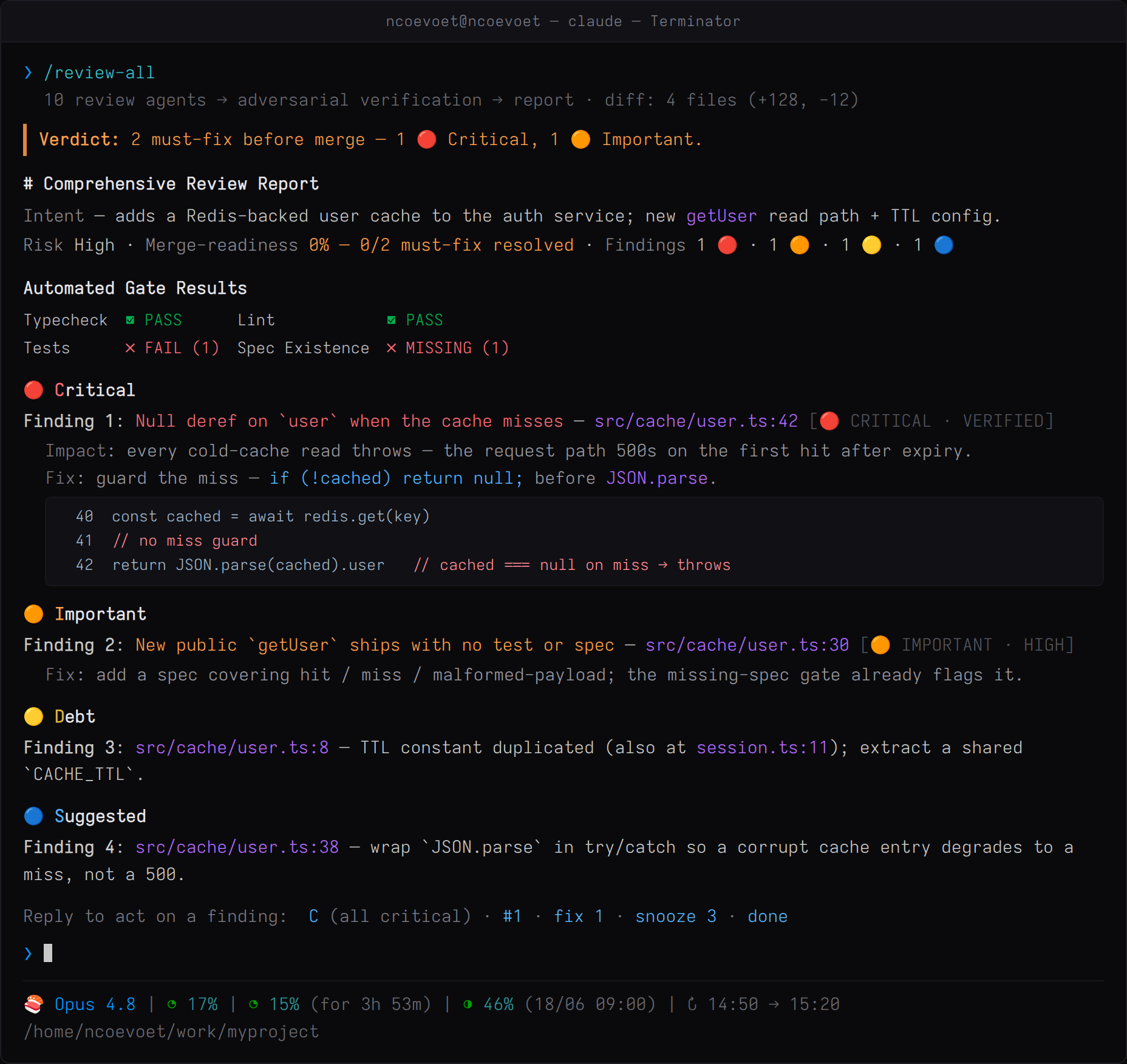
One verdict line up top, automated gate results, then findings by severity — Critical/Important carry full anatomy (impact · suggested fix · evidence), Debt/Suggested collapse to one line each. Every finding cites file:line and is independently re-verified before it reaches the report.
Severity tiers
- 🔴 CRITICAL — Breaks functionality, exposes data, crashes systems, violates requirements
- 🟠 IMPORTANT — Missing error handling, unhandled edge cases, potential bugs
- 🟡 DEBT — Code duplication, convention violations, refactoring needed within 6 months
- 🔵 SUGGESTED — Measurable improvements only. If you can't measure the improvement, don't suggest it.
- ⚪ QUESTION — Items requiring human judgment about requirements or intent
Install
Plugin (recommended)
Inside Claude Code, add the marketplace and install the plugin:
/plugin marketplace add ncoevoet/claude-review-all
/plugin install review-all@ncoevoet-review-all
/review-all is available right away. Update later with /plugin update review-all@ncoevoet-review-all, remove with /plugin uninstall review-all@ncoevoet-review-all. CLI equivalents work too: claude plugin marketplace add ncoevoet/claude-review-all then claude plugin install review-all@ncoevoet-review-all. The plugin bundles the skill's scripts/ and resolves them relative to the skill, so it works wherever Claude Code installs it.
Manual (make install)
For hacking on the skill itself, copy it straight into ~/.claude/skills/:
git clone https://github.com/ncoevoet/claude-review-all.git
cd claude-review-all
make install   # copies skills/review-all/ → ~/.claude/skills/review-all/
make uninstall removes it. make review-self installs then reminds you to run /review-all in this repo. The skill works in Claude Code only — it depends on filesystem access and bash.
Use
Inside Claude Code, run /review-all with any of these targets:
| Argument | Reviews |
|---|---|
| (empty) | Uncommitted changes if any, else current branch vs default branch, else last commit |
--staged |
Only staged changes |
--unstaged |
Only unstaged changes |
last commit |
HEAD~1..HEAD |
last N commits |
HEAD~N..HEAD |
vs <branch> |
Current branch vs merge-base with <branch> |
<sha1>..<sha2> |
A specific commit range |
PR #N or #N |
A GitHub PR (requires gh) |
| file paths | Restrict review to those files |
--paths a/b,c/d |
Filter resolved diff to these path prefixes |
--exclude x,y |
Drop these path prefixes from the resolved diff |
gate / --ci |
Headless gate mode — full review, then a machine verdict (gate-verdict.json + exit code) with no Phase 4 menu; composes with any target (gate --staged, gate PR #N) |
Examples:
/review-all
/review-all --staged
/review-all PR #123
/review-all last 3 commits
/review-all vs main
/review-all src/auth/login.ts src/auth/session.ts
/review-all PR #42 --exclude apps/legacy
/review-all gate --severity critical
How it works — exact steps
Phase 0 — Project discovery
| Step | What it does | Why |
|---|---|---|
| 0.0 Discovery (one call) | Runs scripts/discover.sh — composes the preflight tool probe (git/timeout/lsof/ss/gh/jq/curl/rsync/python3), toolchain detection, test-pattern detection, .codegraph/ check, and the rules-cache verdict in a SINGLE script call |
Phase 0 costs one round trip regardless of cache state; later phases degrade instead of crashing on a missing tool |
| 0.1 Resolve target | Parses $ARGUMENTS against the table above |
Single source of truth for "what diff is being reviewed" |
| 0.2 Load config + rules cache | Reads .claude/review-all.json; on cache HIT reuses the LLM-extracted global rules from .claude/cache/review-all-profile.json |
Only the expensive LLM work (rules extraction) is cached — toolchain commands are re-probed fresh every run, so a package.json/pom.xml change can never be served stale |
| 0.3 + 0.4 Toolchain | Folded into 0.0 — detect-toolchain.sh emits {ecosystem, framework, test, lint, typecheck, build} |
Project-agnostic gate commands; never assumes Angular vs Spring vs Rust |
| 0.5 Project rules | Reads root + nested CLAUDE.md files; the global half is skipped on cache HIT, module-level CLAUDE.md (changed dirs) always read fresh. Also reads repo-root REVIEW.md when present (never cached) |
"NEVER do X / ALWAYS do Y" steer the agents; REVIEW.md overrides what gets flagged and at what severity |
| 0.6 Test patterns | Folded into 0.0 — test-pattern-probe.sh infers location, suffix, framework |
Spec Existence Check uses this; no hardcoded __tests__ assumption |
| 0.7 CodeGraph + MCP | Probes the live MCP tool registry (skipped entirely when 0.0 found no .codegraph/); records toolchain.codegraphTools keyed by capability |
Tool names are not hardcoded — survives MCP-server renames |
| 0.8 Gather diff | Computes diff + per-file slice, applies --paths/--exclude, recent commit log |
Filter is enforced before any agent sees the diff |
| 0.9 Output dirs + cache write | Creates .claude/cache, .claude/reports, .claude/review-all; on cache MISS writes the v2 rules profile |
First run on a fresh repo never crashes on a missing dir |
The rules cache is keyed on a manifest of per-file content hashes over every repo CLAUDE.md (+ root CLAUDE.local.md), carries a schema version, and expires after 7 days — a branch switch, a CLAUDE.md edit, or a legacy cache file all force a fresh extraction. The report's gate table shows Profile cache: HIT / MISS(reason) so cache behavior is always visible (and eval-gradeable).
Phase 1 — Deterministic gates (in parallel)
| Gate | Command | Why |
|---|---|---|
| Typecheck | timeout 120 <discovered> |
Compilers find what review can't |
| Lint | timeout 120 <discovered> |
Style + simple bugs at zero token cost |
| Tests | timeout 180 <scoped> |
Smart scoping: tests that import changed files first, fallback to package, fallback to suite |
| Dev-server probe | scripts/dev-server-probe.sh |
If dev server is up, skip the build gate — it's already running |
| Spec existence | per new file vs toolchain.testPattern |
New public code without tests is automatically 🔴 |
| Dependency check | per manifest diff | New deps / major bumps / removed deps surface explicitly |
Gate-confirmed findings are tagged VERIFIED and skip the verification phase. They are real, by definition.
When a gate fails, its output is also handed to every agent and to the verifier as a <gate_results> block (failures only, truncated) — a compiler or test runner is ground truth no amount of reading matches, which is why hybrid static-analysis + LLM review outperforms either alone. Agents treat it as a lead to the underlying defect, never as a finding to restate: the failure is already on the report.
Phase 1.5 — Runtime probe (optional, self-skipping)
If a UI file changed AND a dev-server port is open AND curl exists:
- Health-check each port (3× with 2s backoff to absorb dev-server warm-up).
- If Playwright/Puppeteer is installed and a baseline screenshot exists, headless-screenshot the changed routes and pixel-diff against baseline.
Catches dead routes and visual regressions that static review cannot.
Phase 2 — Parallel agents
Ten specialized agents review the (filtered) diff slice in parallel, each on its own concern:
standards · bugs+security · DRY · consistency · simplification · security-deep-dive · performance · test-quality · API-contract · a11y/i18n
Agents share _shared.md (severity tiers, 3-question gate, quotas, auto-drop rules, codegraph-tool resolution).
Each agent receives the same diff in a different file order (scripts/agent-order.py, a reproducible sha256-derived permutation per agent). Attention isn't uniform across a long prompt, so identical ordering would give all ten agents the same weak middle; permuting decorrelates that at zero token cost. Hunks within a file are never reordered, and chunk membership is computed on the canonical order first, so it stays identical across agents.
Big diffs are auto-chunked (chunkMaxFiles=40, chunkMaxBytes=200000) and re-merged by root_cause_key.
Phase 2.5 — Dedupe → adversarial verify
- Dedupe via
scripts/dedupe.py: groups byroot_cause_key, annotatesconfirmed_byandcorroborating_agents(how many personas independently reached this root cause — the verifier uses it to prioritize re-read effort and break borderline ties, never as a substitute for verification, and the report surfaces it as "Flagged independently by N agents"), applies global caps (SUGGESTED ≤ 10, QUESTION ≤ 8). - Verify in parallel — one verifier per source agent, spawned at
verifierModeltier (default Haiku — cheap, fast, JSON-bound). Verifier stance is hostile to the finding, not the code: assume every finding is wrong until disproven. Its primary gate is a citation check — a behavior claim must be provable from a quoted source line, not inferred from naming; ungrounded claims are dropped (or kept only as a ⚪ question). Top severity (🔴/🟠) must be earned by that proof. - Score:
≥75→ main report,50–74→ appendix,<50→ silently dropped. - Claim class — every finding is classified
static/runtime/data/rendering, and must hold the proof its class demands. Reading a template proves what the template says; it proves nothing about what the server returned or what the user saw. A runtime/data/rendering claim backed only by a source read gets theunverifiedverdict — orthogonal to the score, so even a well-argued one lands there. It is neither asserted as fact nor dropped: it surfaces in the report's 🔬 section naming the exact observation that would settle it, and it never blocks gate mode. - State sweep via
scripts/state-sweep.py: appliesfixed/stale/snoozed/wontfixtransitions to.claude/review-all/state.json.
Phase 2.75 — Completion gate
Every spawned agent and every verifier must have returned with valid JSON, or be explicitly retried once, or be surfaced as ⚠️ PARTIAL REVIEW in the report. No silent drops.
Phase 3 — Unified report
Opens with a one-line Verdict (N must-fix before merge, or ✅ none) for instant triage, then: Intent · Summary · Gate Results · 🔴 Critical · 🟠 Important · 🟡 Debt · 🔵 Suggested · ⚪ Questions · 🔬 Unverified · Dependency Changes · Appendix · Scope footer (files reviewed / skipped). The Gate Results table carries a mandatory Provenance column — the exact command, its exit code, and when it ran — because a gate with no provenance may not be rendered PASS; that is what separates a build that happened from one that was assumed. 🔴/🟠 get full anatomy (failure-mode title, [severity · confidence] tag, one-sentence impact, suggested fix, ≤8-line evidence); 🟡/🔵/⚪ collapse to one line each. The Summary also reports a Merge-readiness % (a transparent resolved/total must-fix ratio that climbs as fixes apply) and change-type buckets (files Added/Modified/Deleted/Renamed). The last line is a machine-readable <!-- review-all-severity: {…} --> comment for CI parsing; the Phase 4 Export findings action additionally emits review-<ts>.json + review-<ts>.sarif for CI gates.
Heartbeat lines print at each phase boundary so the user sees forward motion on long runs.
Phase 4 — Post-report menu
Presenting the menu is a mandatory closing step — a finished report is the start of Phase 4, not the end of the turn (skipped only when every section says "None found." with no appendix). Ordering is a hard rule: the full report renders as text first, then the menu immediately after it with zero tool calls in between — so the menu can never appear before (or without) the report — and the menu's question line repeats the verdict summary in case the report has scrolled off-screen. The primary menu (AskUserQuestion, single-select, ≤4 options) offers four modes:
- Fix by scope… — apply by severity scope (critical / +important / +debt) or a Custom expression mixing severity letters and finding IDs/ranges (e.g.
I D #11,1-7, 11). - Triage one-by-one — walk each must-fix finding with a per-finding micro-menu (Fix · Ask · Create ticket · Snooze · Wontfix · Skip).
- More actions… (multi-select) — Save full report · Ask a follow-up question · Generate tests · Create a ticket/issue · Export findings (JSON + SARIF) · Deep-dive · Generate fix patches · Draft commit/PR · Post to GitHub PR · Snooze · Wontfix · Schedule re-review · Re-run on fixed code.
- Skip / done.
The two fix modes appear only when fixable findings exist; otherwise the menu leads with More actions… so the non-fix choices stay reachable (this is the fix that restored discoverability). After a clean apply-fixes (all post-fix gates pass), an auto-delta scoped review runs against the just-edited files and appends a ## Post-fix delta section.
Gate mode — headless verdict (CI / autonomous loops)
/review-all gate (or any target with --ci) runs Phases 0–2.75 unchanged, then replaces the Phase 3 report and Phase 4 menu with a machine-readable verdict — no prose, no AskUserQuestion. It writes .claude/review-all/gate-verdict.json, prints the same JSON, and exits 0 (pass) / 1 (blocked) / 2 (malformed):
{ "pass": false, "severityFloor": "critical", "partial": false, "blockingCount": 1,
  "blocking": [ {"id": "F3", "severity": "CRITICAL", "file": "src/x.ts", "line": 42, "title": "unguarded null deref"} ] }
A finding blocks only when its severity meets the floor (gateSeverityFloor, default critical → 🔴 only; --severity important → 🔴+🟠). Only main-report findings (verdict keep, score ≥ 75) gate — the appendix never blocks, and neither does an unverified finding at any score, since nobody observed the behaviour it claims. Partial review coverage fails closed. This is what lets a CI step or an autonomous loop (e.g. the goal-loop plugin's oracle) consume review-all as a hard gate. See skills/review-all/references/phase-gate.md.
How it's tested & improved
Every change to this skill is eval-driven — the same develop-tests loop Anthropic recommends for agent harnesses:
- 92 labeled scenarios (
skills/review-all/evals/*.json) across Java, TypeScript, Python, SQL, Go, and Rust. Most are recall cases (a planted real bug the review must catch: races, leaks, injections, N+1s, broken contracts…); a growing set are precision counter-cases — correct code that looks suspicious (an intentionalexcept Exceptionboundary, a consistent lock discipline, a neutralized CSV export, a TODO comment) that must NOT become a finding. Two cases exercise gate mode end-to-end; two guard the profile cache (a poisoned legacy cache must MISS, a valid warm cache must HIT and still apply its rules); two cover the repo-convention files (aREVIEW.mdthat must raise one finding's severity and suppress another in the same review, and aCLAUDE.mdclaim the diff falsifies alongside a neighbouring claim that stays true); and one carries a runnable toolchain whose test gate genuinely fails, so the failing-gate path is exercised end-to-end rather than assumed. The two convention cases were rewritten after their first A/B revealed the originals passed on the pre-feature baseline too —evals/README.mdrecords that finding and the rule it produced: a case proves nothing until the baseline arm has been shown to fail it. - Headless LLM-graded runner (
scripts/run-evals-headless.sh): each fixture is materialized into a throwaway git repo,/review-allruns there viaclaude -p, and a second LLM call grades the report against the case's rubric. Single runs flicker (LLM output is non-deterministic), so trustworthy baselines useREVIEW_ALL_EVAL_RUNS=3+and compare pass-rates. - A/B before shipping: persona or verifier edits are measured against the relevant eval subset with and without the change — a change that doesn't move recall without hurting precision is reverted.
scripts/eval-scorecard.pyturns the runner's per-caseRESULT/SCORElines into a suite-level recall % / precision % / F1 / SNR scorecard, so an A/B diffs an aggregate precision number, not just per-case PASS rates (the SNR is an honest suite-derived proxy, not a CR-Bench per-comment metric). - No-API CI gates on every push (
tests/run.sh): anonymization check (no real project names in fixtures), eval-schema validation, shellcheck on all scripts, Python unit tests, and a static doc-invariant gate per instruction-only feature — the Phase 4 menu, verifier votes, the dismissed digest, claim classes,REVIEW.md, diff ordering, and<gate_results>(tests/check-*.sh). Instructions can't be exercised headlessly, so their load-bearing sentences are grepped from the published docs instead, and each gate is proven non-vacuous by deleting the sentence on a scratch copy and confirming it fails.tests/check-config-sync.shgoes further and set-diffs SKILL.md's config schema against the documented key table, so that pair cannot drift again. - Every real-world escape becomes a case: a missed bug or a false positive observed in actual use is converted into a new eval before the fix lands, so it can never regress silently.
See skills/review-all/evals/README.md for the schema, the full scenario list, and the iteration loop.
Pros / Cons
| Pros | Cons |
|---|---|
| No false positives by design — every finding survives adversarial re-read | Two-pass model (agents + verifier) costs more tokens than a single-shot review |
| Project-agnostic — discovers conventions from the repo, never assumes them | Discovery probes run on every review (one script call, ~1s); only the CLAUDE.md rules extraction is cached — by design, so toolchain data is never stale |
Filtered scope — --paths/--exclude and interactive workspace pruning honor the user's actual focus |
The multi-workspace prompt only fires above 50 files / multiple roots — adjust expectations on small repos |
Deterministic ops in scripts — preflight, toolchain, test-pattern, dev-server, dedupe, state-sweep all live in scripts/. Reliability + token savings + auditable |
Requires bash + Python 3 on the developer machine (default on macOS/Linux; fine in WSL) |
| Hostile verifier on Haiku — cheap, fast, no confirmation bias | Verifier mis-scoring on truly novel patterns can hide a real finding in the appendix — escape via verifierModel: "sonnet", or verifierVotes: 3 to majority-vote 🔴/🟠 across independent passes |
Lifecycle-aware — snoozed/wontfix/stale tracked in state.json; dismissed findings are fed back to the agents as a <previously_dismissed> digest so the team's own wontfix decisions aren't re-derived; recurring findings auto-escalate after 3 sightings |
State file is per-repo; not shared across team members. Intentional — comments are the team-wide channel |
Plugin-free install — make install and you're done |
Not portable to claude.ai uploads or the Claude API runtime (uses git/gh/bash/filesystem). Claude Code only |
Review instructions (REVIEW.md)
Drop a REVIEW.md at the repository root to change what this review flags, at what severity, and where. It is read fresh on every run (never cached) and injected verbatim into all ten agents and the verifier as the highest-priority instruction block — where it conflicts with a persona or with the shared rules, REVIEW.md wins. No configuration key is involved: the file is the interface.
# Review instructions

## What CRITICAL means here

Reserve 🔴 for findings that break behavior, leak data, or block a rollback:
incorrect logic, unscoped queries, PII in logs, non-backward-compatible
migrations. Style and naming are 🟡 at most.

## Raise the bar per path

- In `scripts/`, only report if near-certain and severe.
- In `src/payments/`, treat any missing error handling as 🔴 CRITICAL.

## Do not report

- Anything CI already enforces: lint, formatting, type errors
- Generated files under `src/gen/` and any `*.lock` file

## Always check

- New API routes have an integration test
- Database queries are scoped to the caller's tenant
Notes:
- Verbatim means verbatim — the file is never summarized or truncated, and
@-imports are not expanded (unlikeCLAUDE.md). Write the rules you want enforced directly in the file. Keep it focused: a longREVIEW.mddilutes the rules that matter, and it is injected into eleven-plus prompts. Soft guideline ≤150 lines; over 10 KB the review warns. - It steers what is reviewed, never how it is proven. Severity recalibration, skip rules, and per-path bars are honored. The 3-question gate, claim classes,
file:lineevidence, and Phase 2.5 verification are not overridable — a severityREVIEW.mdpromotes still has to be earned by proof at that tier. - In gate mode it moves findings across the blocking floor in both directions — a promotion to 🔴 becomes CI-blocking under the default floor, and a demotion can un-block a real defect. Same trust model as
CLAUDE.md: text committed to the repo is authoritative. WhenREVIEW.mdis itself modified in the reviewed diff, the gate summary says so.
Optional configuration
Drop a .claude/review-all.json into any project to tune behavior. All keys optional; documented defaults apply when absent. See skills/review-all/references/config-keys.md for the full table with per-key rationales.
Common keys:
{
  "devServerPorts": [4200, 5173, 3000],
  "verifierModel": "haiku",
  "verifierVotes": 1,
  "extraAgents": [],
  "skipAgents": []
}
verifierVotes defaults to 1 (single hostile pass). Set it to an odd N>1 (e.g. 3) to majority-vote the 🔴/🟠 findings across N independent verifier passes — a finding reaches the main report only if ⌈N/2⌉ verifiers keep it. Voting is scoped to top severity (🟡/🔵/⚪ stay single-pass) and adds verifier cost only when 🔴/🟠 survivors exist; see references/config-keys.md.
Finding-count caps
Two layers trim a report. Both are config-driven — set the relevant keys to 0 for a complete verified list. 🔴 CRITICAL / 🟠 IMPORTANT are never capped at any layer.
| Key | Default | Caps |
|---|---|---|
quotaDebt |
5 |
🟡 DEBT findings per agent (dropped pre-dedupe) |
quotaSuggested |
3 |
🔵 SUGGESTED findings per agent |
quotaQuestion |
2 |
⚪ QUESTION findings per agent |
suggestedGlobalCap |
10 |
🔵 SUGGESTED findings globally, after dedupe |
questionGlobalCap |
8 |
⚪ QUESTION findings globally, after dedupe |
To get every verified finding, zero out both layers for the tier — a per-agent quota drops findings before dedupe, so a global cap alone cannot recover them:
{
  "quotaDebt": 0,
  "quotaSuggested": 0,
  "quotaQuestion": 0,
  "suggestedGlobalCap": 0,
  "questionGlobalCap": 0
}
/review-all init walks an interactive wizard that writes a populated config.
Optional: CodeGraph
If a CodeGraph MCP server is wired into Claude Code and the project has a .codegraph/ directory, /review-all uses its tools for cross-file analysis (callers, callees, impact). Tool names are resolved at runtime, so any MCP namespace works. Without CodeGraph, the relevant agents fall back to grep / git grep.
Requirements
- Claude Code CLI
git,bash,python3(defaults on macOS/Linux)gh— forPR #Nreview mode, and optionally for the Phase 4 Post to GitHub PR (gh pr comment) and Create a ticket/issue (gh issue create) actions; both are write-scoped and confirmation-gated, and Create-ticket falls back to writing an issue-markdown file whengh/GitHub isn't present
Layout
claude-review-all/
├── skills/review-all/
│   ├── SKILL.md              # orchestrator entry point
│   ├── agents/               # 10 persona files + _shared.md + verifier.md
│   ├── references/           # per-phase rules, config schema, state-file lifecycle
│   ├── evals/                # labeled scenarios + success criteria + grader rubrics
│   └── scripts/              # discover (one-call Phase 0), preflight, detect-toolchain,
│                             # dev-server-probe, test-pattern-probe, dedupe, state-sweep,
│                             # gate-verdict, export-findings, validate-evals,
│                             # materialize-fixture, run-evals, run-evals-headless,
│                             # eval-scorecard (recall/precision/SNR aggregate),
│                             # agent-order (per-agent diff permutation)
├── tests/                    # unit tests + check-anonymization.sh (gitignored blocklist)
│                             # + one check-*.sh doc gate per instruction-only feature
└── .github/workflows/ci.yml  # shellcheck + test suite (incl. anonymization + eval-schema gates)
All plain Markdown / shell / Python — read, fork, extend.
Development
bash tests/run.sh # anonymization gate + eval-schema validation + shellcheck-clean shell scripts + Python unit tests (no API key)
tests/run.sh runs four no-API gates: an anonymization gate (tests/check-anonymization.sh — fails if a real employer/product/ticket name leaks into published artifacts; the real blocklist is gitignored, a placeholder *.example.txt ships), eval-schema validation (scripts/validate-evals.py — every evals/*.json must have a non-empty grader.rubric, a materializable fixture, and an id matching its filename), the shell-script tests, and the Python unit tests. CI (.github/workflows/ci.yml) runs shellcheck + this suite on every push / PR. The eval suite under skills/review-all/evals/ is materialized into throwaway git repos and LLM-graded headlessly by scripts/run-evals-headless.sh (needs the claude CLI); see skills/review-all/evals/README.md.
License
MIT — see LICENSE.


