
VibeGuard

The firewall between AI coding agents and your codebase.
Native rules + real-time hooks + static guards that stop Claude Code, Codex CLI, and Gemini CLI from shipping hallucinated, duplicated, or unverified changes — before they land.
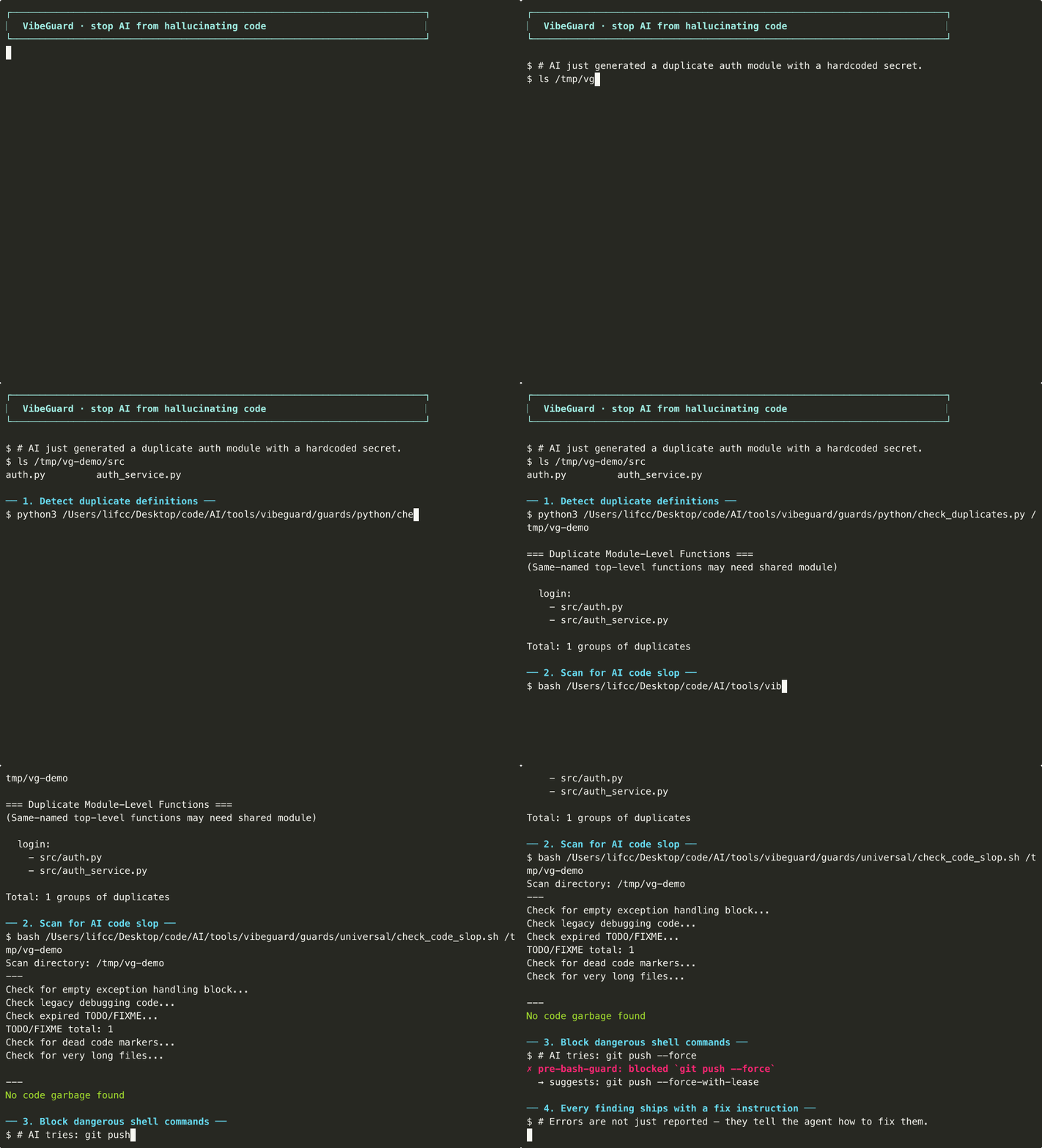
git clone https://github.com/majiayu000/vibeguard.git ~/vibeguard
bash ~/vibeguard/setup.sh --yes
bash ~/vibeguard/setup.sh verify-install
Open a new Claude Code or Codex session after install — protection is active from the first prompt. On supported macOS/Linux targets the production install/check/clean path is Python-free and uses a checksum-verified prebuilt runtime binary. Python still supports evals, docs generation, developer tools, and optional language-specific guard packs. Full install details live in Installation and Quickstart.
What it intercepts:
- Duplicate files and reinvented modules
- Invented APIs, fake libraries, and hardcoded placeholder values
- Dangerous shell/git operations (
rm -rfdangerous paths,git clean -f, non-fast-forward pushes) - Audited cleanup for intentional local discards, with exact path plans and confirmation gates
- Analysis paralysis and unverified "I'm done" claims
- Silent exception swallowing and
Any-type abuse - AI-slop patterns flagged on every commit
Every interception returns a fix instruction, not just a failure — so the agent can self-correct.
Chinese Docs · Quickstart · Team Rollout · Troubleshooting · Rule Reference · Contributing
Start Here
| Path | Use it when | Start with |
|---|---|---|
| Quickstart | You want one local install, one health check, and one real intercepted demo | docs/how/quickstart.md |
| Team rollout | You need profiles, CI policy, rollout expectations, or project bootstrap guidance | docs/how/team-rollout.md |
| Troubleshooting | Setup/check/status output is stale, degraded, broken, or confusing | docs/how/troubleshooting.md |
First 5 minutes
These commands prove the install is active before changing another project; expected outputs are documented in Quickstart:
bash ~/vibeguard/setup.sh doctor
bash ~/vibeguard/setup.sh verify-install
bash ~/vibeguard/scripts/doctors/codex-doctor.sh
bash ~/vibeguard/setup.sh demo safe-bash
bash ~/vibeguard/scripts/hook-health.sh 24
To protect another repository after VibeGuard is installed:
bash ~/vibeguard/scripts/project-init.sh /path/to/project
Current status
The current mainline is install-verified on macOS, full-CI verified on Ubuntu and macOS, and smoke-contract verified on Windows.
- Latest release train:
v1.1.x; unreleasedmainmay pin the next runtime version before its release tag exists - Health checks:
bash setup.sh doctor(interactive, alias--check) andbash setup.sh verify-install(CI gate); expected verdict isHEALTHY - Hook latency is a product contract: CI tracks a
Hook Latency (P95)report against per-hook budgets — see Hook Latency Contract
What you actually get
| Layer | What it does |
|---|---|
| Native Rules | Bias the model away from bad decisions before it acts |
| Hooks | Block dangerous or low-quality actions in real time |
| Static Guards | Scan projects for AI-slop, duplicates, and structural issues |
| Slash Commands | /vibeguard:* workflows for preflight / review / check / learn |
| Learning System | Turn repeated AI mistakes into reusable defenses |
| Observability | Metrics and health for every interception |
Coverage boundary: hooks and guards provide mechanical enforcement for the covered surfaces below. The full rule set is broader; severity labels and workflow rules also guide review, planning, and verification, and do not imply that every rule is hook-blocked.
Product Boundaries
VibeGuard has two layers:
| Surface | Scope | Canonical Source |
|---|---|---|
| VibeGuard Core | Rules, hooks, static guards, install/runtime contract, observability | rules/claude-rules/, schemas/install-modules.json, hooks/, guards/ |
| VibeGuard Workflows | Slash commands, agent prompts, planning/execution presets | skills/, workflows/, agents/ |
If these surfaces disagree, treat the Core contract as authoritative first, then update workflow/docs surfaces to match it.
For repository layout ownership, see Directory Map.
What it looks like in practice
Real Codex hook output:
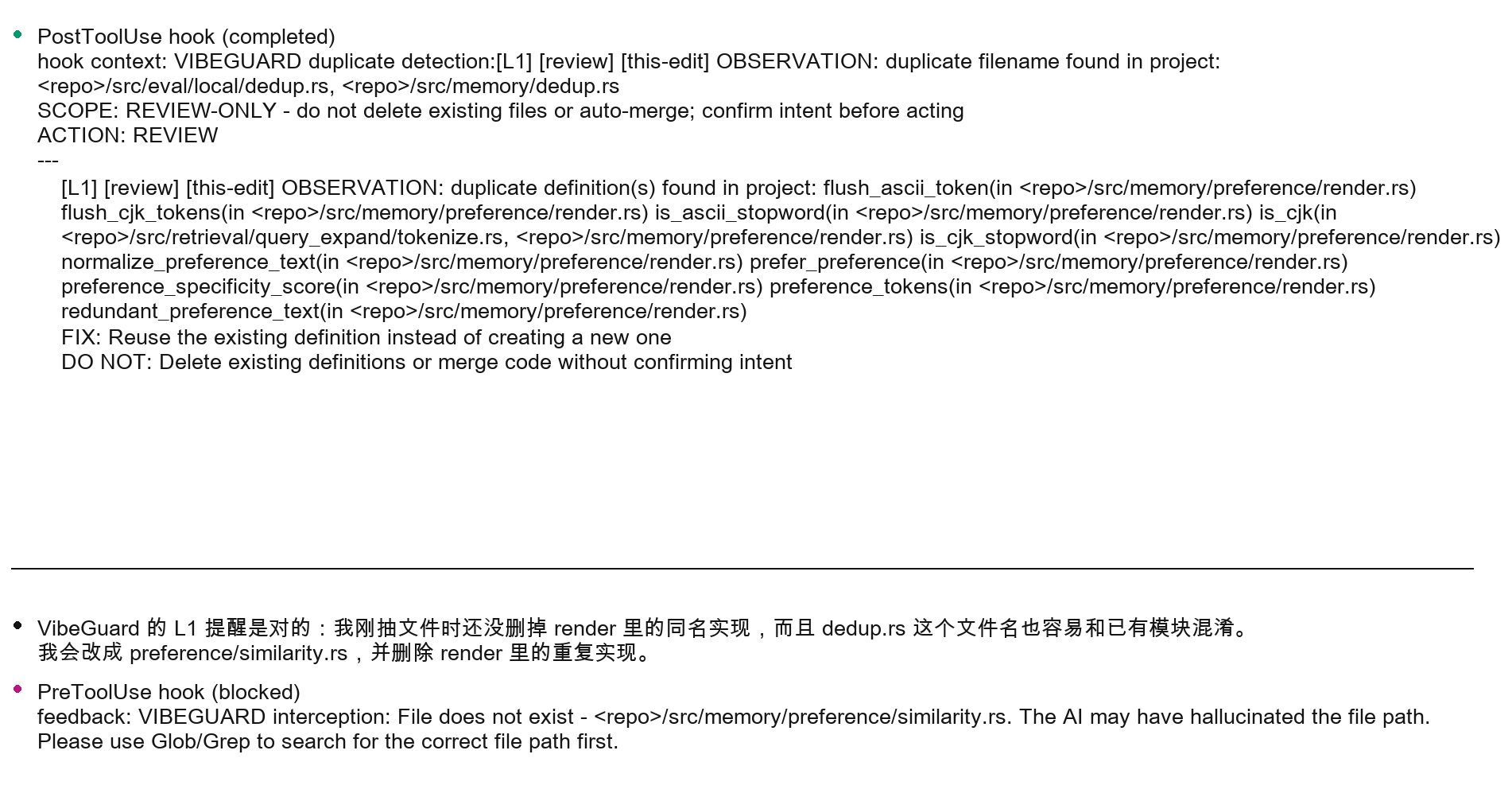
You:  "Add a login endpoint"

AI:   → tries to create auth_service.py
      ⚠ VibeGuard warns or blocks — new source files require search first

      → tries to import `flask-auth-magic`
      ⚠ VibeGuard rules/review contract — verify external libraries before adding

      → hardcodes JWT secret as "your-secret-key"
      ⚠ VibeGuard security rule — use env var or secret manager

      → runs `git push --force`
      ✗ VibeGuard git pre-push hook denies — history rewrites require explicit human approval

      → runs `git clean -fd`
      ✗ VibeGuard denies — points to an authorized discard workflow with an exact deletion plan

      → keeps reading files without acting
      ⚠ VibeGuard escalates — force a concrete next step or report blocker

      → claims done without verifying
      ⚠ VibeGuard gates — run build/test before finishing
Re-record your own demo: see docs/assets/README.md (one command via asciinema + agg).
Who this is for
Use VibeGuard if you:
- Use Claude Code or Codex regularly
- Have seen duplicate files, fake APIs, over-engineering, or unverified "done" claims
- Want mechanical enforcement for high-risk hook/guard surfaces, plus explicit rule and workflow contracts for cases that are not mechanically covered yet
It may be overkill if you only use AI occasionally or don't want hook-level interception.
Inspired by OpenAI Harness Engineering and Stripe Minions. VibeGuard maps the 5 Harness Golden Principles into repo-level rules, hooks, workflows, and observability; not every principle is a hook-level block.
How It Works
Rule Injection (active from session start)
The native rule set in rules/claude-rules/ is installed to Claude Code's native rules system (~/.claude/rules/vibeguard/), directly influencing AI reasoning. Plus a 7-layer constraint index injected into ~/.claude/CLAUDE.md:
| Layer | Constraint | Effect |
|---|---|---|
| L1 | Search before create | Must search for existing implementations before creating new files |
| L2 | Naming conventions | snake_case internally, camelCase at API boundaries, no aliases |
| L3 | Quality baseline | No silent exception swallowing, no Any types in public methods |
| L4 | Data integrity | No data = show blank, no hardcoding, no inventing APIs |
| L5 | Minimal changes | Only do what was asked, no unsolicited "improvements" |
| L6 | Process gates | Large changes require preflight, structured planning, and verification |
| L7 | Commit discipline | No AI markers, no force push, no secrets |
Rules use negative constraints ("X does not exist") to implicitly guide AI, which is often more effective than positive descriptions.
Canonical references for this contract:
- Install/runtime contract:
schemas/install-modules.json - Native rule source:
rules/claude-rules/ - Public summary of current rule surface:
docs/rule-reference.md
Hooks — Real-Time Interception
Most hooks trigger automatically during AI operations. skills-loader remains an optional manual hook. Codex deploys native Bash/apply_patch/PermissionRequest/PostToolUse/Stop hooks; read-only exploration hooks remain Claude Code or app-server-wrapper only:
| Scenario | Hook | Result |
|---|---|---|
AI creates new .py/.ts/.rs/.go/.js file |
pre-write-guard |
Warn by default — search-first reminder; set VIBEGUARD_WRITE_MODE=block or write_mode=block in ~/.vibeguard/config.json to hard-block |
| AI creates or edits production source above 400 lines | pre-write-guard, pre-edit-guard, post-write-guard, post-edit-guard |
Warn — typical-size advisory; keep the current change localized and plan a later split if growth continues |
| AI creates or edits production source above 800 lines | pre-write-guard, pre-edit-guard |
Block — split the file before writing or patching |
AI runs destructive local cleanup (rm -rf dangerous paths, git clean -f, git checkout/restore .) |
pre-bash-guard |
Block — suggests safe alternatives and audited discard flow |
| AI pushes a non-fast-forward update or branch deletion | git pre-push |
Block — protects remote history; rewrites and deletions require explicit human approval plus the repository bypass policy |
| AI edits non-existent file | pre-edit-guard |
Block — must Read file first |
AI adds unwrap(), hardcoded paths |
post-edit-guard |
Warn — with fix instructions |
AI adds console.log / print() debug statements |
post-edit-guard |
Warn — use logger instead |
| AI creates duplicate definitions after a new file write | post-write-guard |
Warn — detect duplicate symbols and same-name files |
| AI keeps reading/searching without acting | analysis-paralysis-guard |
Escalate — force a concrete next step or blocker report |
AI edits code in full / strict profile |
post-build-check |
Warn — run language-appropriate build check |
git commit |
pre-commit-guard |
Block — quality + build checks (staged files only), 10s timeout |
| AI tries to finish with unverified changes | stop-guard |
Signal — logs a Stop reminder; the Stop hook exits 0 to avoid feedback loops |
| Session ends | learn-evaluator |
Evaluate — collect metrics and detect correction signals |
U-16 file-size enforcement applies to non-test source files with .rs, .ts, .tsx, .js, .jsx, .py, or .go extensions. The default typical-size advisory starts above 400 lines (u16.warn_limit in ~/.vibeguard/config.json / VG_U16_WARN_LIMIT), while the hard limit remains 800 lines (u16.limit in ~/.vibeguard/config.json / VG_U16_LIMIT). For Codex, apply_patch Add File and apply_patch Update File are both normalized before the file hook runs. U-16 is baseline-aware: new oversized files, files crossing the hard limit, and legacy oversized files that grow are blocked; legacy oversized files that stay the same size or shrink are allowed with a U16_LEGACY_DEBT advisory until they fall below the hard limit. The git pre-commit guard and CI changed-file check call the same runtime decision so oversized imports outside AI tool hooks are caught before submission.
Static Guards — Run Anytime
Representative standalone checks you can run on any project. The complete inventory lives in docs/rule-reference.md.
# Universal
bash ~/vibeguard/guards/universal/check_code_slop.sh /path/to/project     # AI code slop
python3 ~/vibeguard/guards/universal/check_dependency_layers.py /path      # dependency direction
python3 ~/vibeguard/guards/universal/check_circular_deps.py /path          # circular deps
bash ~/vibeguard/guards/universal/check_test_integrity.sh /path            # test shadowing / integrity issues
bash ~/vibeguard/guards/universal/check_dependency_changes.sh --base origin/main --head HEAD  # SEC-11 dependency review
bash ~/vibeguard/guards/universal/check_test_weakening.sh --base origin/main --head HEAD      # SEC-11/W-12 test weakening

# Rust
bash ~/vibeguard/guards/rust/check_unwrap_in_prod.sh /path                 # unwrap/expect in prod
bash ~/vibeguard/guards/rust/check_nested_locks.sh /path                   # deadlock risk
bash ~/vibeguard/guards/rust/check_declaration_execution_gap.sh /path      # declared but not wired
bash ~/vibeguard/guards/rust/check_duplicate_types.sh /path                # duplicate type definitions
bash ~/vibeguard/guards/rust/check_semantic_effect.sh /path                # semantic side effects
bash ~/vibeguard/guards/rust/check_single_source_of_truth.sh /path         # single source of truth
bash ~/vibeguard/guards/rust/check_taste_invariants.sh /path               # taste/style invariants
bash ~/vibeguard/guards/rust/check_workspace_consistency.sh /path          # workspace dep consistency

# Go
bash ~/vibeguard/guards/go/check_error_handling.sh /path                   # unchecked errors
bash ~/vibeguard/guards/go/check_goroutine_leak.sh /path                   # goroutine leaks
bash ~/vibeguard/guards/go/check_defer_in_loop.sh /path                    # defer in loop

# TypeScript
bash ~/vibeguard/guards/typescript/check_any_abuse.sh /path                # any type abuse
bash ~/vibeguard/guards/typescript/check_console_residual.sh /path         # console.log residue
bash ~/vibeguard/guards/typescript/check_component_duplication.sh /path    # duplicated component files
bash ~/vibeguard/guards/typescript/check_duplicate_constants.sh /path      # repeated constant definitions

# Python
python3 ~/vibeguard/guards/python/check_duplicates.py /path                # duplicate functions/classes/protocols
python3 ~/vibeguard/guards/python/check_naming_convention.py /path         # camelCase mix
python3 ~/vibeguard/guards/python/check_dead_shims.py /path                # dead re-export shims
Slash Commands
12 custom commands covering the full development lifecycle. Shortcuts: /vg:pf /vg:gc /vg:ck /vg:lrn.
| Command | Purpose |
|---|---|
/vibeguard:preflight |
Generate constraint set before changes |
/vibeguard:check |
Full guard scan + compliance report |
/vibeguard:review |
Structured code review (security → logic → quality → perf) |
/vibeguard:cross-review |
Dual-model adversarial review (Claude + Codex) |
/vibeguard:build-fix |
Build error resolution |
/vibeguard:learn |
Generate guard rules from errors / extract Skills from discoveries |
/vibeguard:skill-validate |
Gate proposed skills with required format sections and repair/regression evidence before acceptance |
/vibeguard:interview |
Deep requirements interview → SPEC.md |
/vibeguard:exec-plan |
Long-running task execution plan, cross-session resume |
/vibeguard:live-truth |
Fresh evidence gates for latest, PR-ready, merged, running, deployed, and published claims |
/vibeguard:gc |
Garbage collection (logs + worktrees + rule budget + code slop scan) |
/vibeguard:stats |
Hook trigger statistics |
Delivery Contract
Clear, bounded work executes directly. Use a short plan only for major architecture, migrations, cross-system policy changes, or when the user explicitly requests one. Ambiguous work pauses for clarification instead of generating a routing packet.
- Docs-only work, small bugs, and mechanical changes do not require a spec.
- A normal spec is limited to about two files and 300 lines.
- One repository has at most one writable session; delegation is opt-in and read-only by default.
- One PR gets at most two review rounds.
Findings: 0plusPASSends review.
See delivery-base.md for the shared limits.
Optional Agent Prompts
14 built-in prompts are available when a user explicitly selects a specialist or bounded helper. They are not an automatic coordinator/reviewer pipeline:
| Agent | Purpose |
|---|---|
dispatcher |
Suggest an optional specialist without starting write lanes |
planner / architect |
Requirements analysis and system design |
tdd-guide |
RED → GREEN → IMPROVE test-driven development |
code-reviewer / security-reviewer |
Layered code review and OWASP Top 10 |
build-error-resolver |
Build error diagnosis and fix |
go-build-resolver |
Go-specific build error diagnosis |
go-reviewer / python-reviewer / database-reviewer |
Language-specific review |
refactor-cleaner / doc-updater / e2e-runner |
Refactoring, docs, and E2E tests |
Observability
bash ~/vibeguard/scripts/quality-grader.sh              # Quality grade (A/B/C/D)
bash ~/vibeguard/scripts/stats.sh                       # Project hook trigger stats (7 days)
bash ~/vibeguard/scripts/hook-health.sh 24              # Project hook health snapshot
bash ~/vibeguard/scripts/stats.sh --scope global        # Global hook trigger stats
bash ~/vibeguard/scripts/doctors/codex-doctor.sh        # Codex install + hook capability diagnosis
bash ~/vibeguard/scripts/metrics/metrics-exporter.sh    # Prometheus metrics export
bash ~/vibeguard/scripts/verify/doc-freshness-check.sh  # Rule-guard coverage check
Doctors are read-only diagnosis wrappers over the existing defense system. They summarize installation state, capability gaps, noisy hooks, recent events, and repair commands; hooks and guards remain the enforcement layer that blocks or warns during real tool execution.
Hook latency is also a product contract. See Hook Latency Contract for per-hook P95 budgets, hotspot attribution, and the static gates that block expensive hook patterns.
The local observability contract is documented in Observability Harness Contract, including project/global scope, metric labels, and the external-stack roadmap.
Tested and Evaluated
VibeGuard guards its own behavior — the test suite and eval harness ship in the repo, not as an afterthought.
- Behavior eval (CI-blocking): a zero-cost gate that runs the real guard hooks end-to-end and asserts the actual block/deny decision on both the Claude Code hook and the Codex wrapper. Enforced in CI at a 100% pass / 100% coverage threshold — removing a required platform slice fails the build (
eval/run_behavior_eval.py). - Rule-detection benchmark: a 40-sample, schema-validated, digest-pinned dataset (planted rule violations across SEC / Python / TypeScript / Go / Rust / universal rules, plus clean controls) scored on detection rate, a severity-weighted score, and per-severity Expected Calibration Error (ECE) — calibration, not just accuracy. Run manually with
python3 eval/run_eval.py(uses the Claude API; not a merge gate). - Test suite: hook/guard test scripts under
tests/and 100+ unit tests in the Rustvibeguard-runtimecrate. Full CI runs on Linux and macOS; Windows runs cross-platform contract smoke tests.
Learning System
Closed-loop learning evolves defenses from mistakes:
Mode A — Defensive
/vibeguard:learn <error description>
Analyzes root cause (5-Why) → generates a new guard/hook/rule → verifies detection → the same class of error should not recur.
Mode B — Accumulative
/vibeguard:learn extract
Extracts non-obvious solutions as structured Skill files for future reuse.
Installation
One-command no-clone install
On supported macOS and Linux targets, the hosted seed downloads one exact release payload, verifies its checksum, and delegates to the canonical no-clone bootstrap contained in that verified payload:
bash -o pipefail -c 'curl -fsSL https://raw.githubusercontent.com/majiayu000/vibeguard/main/install.sh | bash -s -- --version 1.1.13'
Require GitHub release attestation verification and forward setup.sh options
after the second --:
bash -o pipefail -c 'curl -fsSL https://raw.githubusercontent.com/majiayu000/vibeguard/main/install.sh | bash -s -- --version 1.1.13 --require-provenance -- --profile full --with-scheduler'
Then verify:
bash ~/.vibeguard/dist/current/setup.sh verify-install
Runtime prerequisites
Default setup downloads and verifies the pinned vibeguard-runtime release for
supported platforms when the pinned runtime version has published release
assets. Source builds remain available for unsupported/offline installs, for
unreleased main checkouts whose pinned runtime version has not been tagged yet,
and for users who explicitly request them.
| Platform | Default runtime path | Rust/Cargo needed? |
|---|---|---|
macOS arm64 (aarch64-apple-darwin) |
Prebuilt release binary | No |
macOS x86_64 (x86_64-apple-darwin) |
Prebuilt release binary | No |
Linux x86_64 (x86_64-unknown-linux-musl) |
Prebuilt release binary | No |
Linux arm64 (aarch64-unknown-linux-musl) |
Prebuilt release binary | No |
Other targets, offline installs, unreleased runtime pins without assets, or --build-from-source |
Local source build | Yes |
setup.sh uses gh release download when gh is available, otherwise curl.
If a supported-target download fails, it falls back to cargo build when Cargo
is available. Checksum mismatch, a missing checksum entry, or a failed available
attestation verification is fatal and does not fall back to source. When the
attestation verifier is unavailable, setup prints checksum-only after SHA-256
verification.
Reproducible benchmark
The installed release includes a self-contained benchmark over paired positive and negative cases for hallucinated edit targets, duplicate definitions, swallowed exceptions, dangerous shell/Git operations, and unverified completion claims. Reproduce the current headline result with one command:
PATH="$HOME/.vibeguard/installed/bin:$PATH" vibeguard bench
| Metric | Built-in corpus |
|---|---|
| Interception rate | 100.0% (5/5) |
| False-positive rate | 0.0% (0/5) |
| Hook latency | Per-run p50 and p95 reported by the command |
Use vibeguard bench --json for machine-readable counts, rates, per-class
decisions, latency, and embedded build provenance. Development/source builds are
explicitly marked unverified; release CI requires the exact source commit and
target embedded in the staged binary. An interception is any actual
production-surface warn or block; latency is native runtime command wall time
over five fresh-state measured runs per case after one warmup. Release CI runs
the benchmark from both the raw native binary and a fresh no-clone installation,
and derives the expected README numerators and denominators from the report.
Profiles and languages
# Profiles
bash ~/vibeguard/setup.sh                              # Install (default: core profile)
bash ~/vibeguard/setup.sh --profile minimal           # Minimal: pre-hooks only (lightweight)
bash ~/vibeguard/setup.sh --profile full              # Full: adds Stop signal + Build Check + learning
bash ~/vibeguard/setup.sh --profile strict            # Strict: full hooks + Claude Code U-32 SessionStart constraint budget

# Language selection (only install rules/guards for specified languages)
bash ~/vibeguard/setup.sh --languages rust,python
bash ~/vibeguard/setup.sh --profile full --languages rust,typescript

# Runtime / scheduler
bash ~/vibeguard/setup.sh --build-from-source          # Force local Cargo build
bash ~/vibeguard/setup.sh --with-scheduler             # Opt in to launchd/systemd scheduled GC
bash ~/vibeguard/setup.sh --yes --host gemini          # Opt in to Gemini CLI BeforeTool protection
bash ~/vibeguard/scripts/install-health-report-scheduler.sh --dry-run
bash ~/vibeguard/scripts/install-health-report-scheduler.sh --install  # Opt in to weekly health reports

# Verify / Uninstall
bash ~/vibeguard/setup.sh doctor                      # Human-friendly report, exits 0 for compatibility
bash ~/vibeguard/setup.sh --check                     # Compatibility alias for doctor
bash ~/vibeguard/setup.sh verify-install              # CI/post-install check, exits 2 on broken required state
bash ~/vibeguard/setup.sh verify-project              # Strict project check, exits 1/2 on degraded/broken
bash ~/vibeguard/setup.sh verify-dev-repo             # Strict VibeGuard repo check
bash ~/vibeguard/setup.sh verify-project --json       # Machine-readable JSON for CI
bash ~/vibeguard/setup.sh --clean                     # Uninstall
doctor / --check reports a structured rollup (OK / INFO / WARN / FAIL /
BROKEN / MISSING) plus a final Verdict line of HEALTHY, DEGRADED, or
BROKEN. It always exits 0 for backwards compatibility unless the checker
itself cannot run. CI should use verify-install for post-install health gates
or verify-project --json when it needs machine-readable strict project output.
Migration: --check --strict remains supported and maps to verify-project;
--check --json remains supported and maps to verify-project --json;
--check --install remains supported and maps to verify-install.
| Profile | Hooks Installed | Use Case |
|---|---|---|
minimal |
pre-write, pre-edit, pre-bash | Lightweight — only critical interception |
core (default) |
minimal + post-edit, post-write, analysis-paralysis | Standard development |
full |
core + stop-guard, learn-evaluator, post-build-check | Full defense + learning |
strict |
full + Claude Code count-active-constraints (SessionStart/U-32); Codex native hooks remain full | Maximum enforcement |
setup.sh also prepares the shared pre-commit wrapper at ~/.vibeguard/pre-commit and installs this repository's git pre-commit and pre-push hooks during setup. The git pre-push hook owns force-push / branch-deletion protection; pre-bash-guard does not regex-match git push --force. To attach the wrapper to another repository, use scripts/project-init.sh or that repository's own install step.
Codex Integration
VibeGuard deploys hooks and skills to both Claude Code and Codex CLI.
Codex App can also discover VibeGuard as a local plugin from this repository:
codex plugin marketplace add /path/to/vibeguard
codex plugin add vibeguard@vibeguard-local
The plugin is an observability-first operator entrypoint. Installing the plugin
does not silently rewrite ~/.codex; use the plugin observe/setup skills, or
run one of these commands from this checkout:
bash plugins/vibeguard/scripts/vibeguard-plugin.sh dashboard
bash plugins/vibeguard/scripts/vibeguard-plugin.sh health 24
bash plugins/vibeguard/scripts/vibeguard-plugin.sh stats all
bash plugins/vibeguard/scripts/vibeguard-plugin.sh install --yes
The dashboard is generated as a local HTML artifact from the existing VibeGuard diagnostic commands. It is not remote telemetry and does not replace behavior eval gates.
Hooks live in ~/.codex/hooks.json (requires [features].hooks = true in config.toml):
| Event | Hook | Function |
|---|---|---|
PreToolUse(Bash) |
pre-bash-guard.sh |
Destructive local cleanup interception + package manager correction |
PermissionRequest(Bash) |
pre-bash-guard.sh |
Fail-closed approval gate for dangerous commands |
PreToolUse(Edit/Write via apply_patch) |
pre-edit-guard.sh, pre-write-guard.sh |
File existence and search-first gates before patching |
PermissionRequest(Edit/Write via apply_patch) |
pre-edit-guard.sh, pre-write-guard.sh |
Fail-closed approval gate before privileged patching |
PostToolUse(Bash/apply_patch) |
post-build-check.sh |
Build failure detection after commands or patches |
PostToolUse(Edit/Write via apply_patch) |
post-edit-guard.sh, post-write-guard.sh |
Post-patch quality and duplicate checks |
Stop |
stop-guard.sh |
Uncommitted changes signal (logs a gate event, non-blocking Stop) |
Stop |
learn-evaluator.sh |
Session metrics collection |
This is the default enforcement layer. It talks to Codex through native hooks
and does not wrap or replace the Codex server. Codex has no native Read,
Glob, or Grep hook surface, so analysis-paralysis is not available on
the native Codex path. Use Claude Code when read-only exploration gating is
required; the optional app-server wrapper is only for external orchestrators
that already require codex app-server.
Codex hook command names are namespaced as vibeguard-*.sh to avoid collisions with other toolchains sharing ~/.codex/hooks.json. Output format differences are handled by the run-hook-codex.sh wrapper (Claude Code decision:block -> Codex deny payloads). Codex sends apply_patch as a patch command, so the wrapper normalizes that payload into Edit/Write-shaped inputs before calling the existing VibeGuard file hooks. For Update File patches, the wrapper also passes the line delta so pre-edit-guard.sh can enforce U-16 before Codex mutates the file. When a hook suggests updatedInput, the Codex CLI wrapper cannot apply it automatically, so VibeGuard emits an explicit note with the suggested replacement command instead of silently dropping it.
Hook status is a separate human diagnostics surface. Use vibeguard-runtime hook-status --mode focused inside a git repository to inspect the matching project log, or add --scope global for ~/.vibeguard/events.jsonl. --log-file PATH always wins for explicit fixtures or one-off diagnosis. The command reports recent pass, skipped, slow, timeout, and adapter-error states without adding successful hook summaries to the model context. Only actionable warn / block results should continue through hookSpecificOutput.additionalContext. See docs/reference/codex-hook-status.md.
MCP server status: the legacy mcp-server/ prototype is not installed by setup.sh and is not part of the supported runtime surface. Supported integrations are the Claude Code hooks, native Codex hooks, and the optional app-server wrapper below; any future MCP reintroduction must go through an explicit install path and hash/audit baseline.
Gemini CLI integration
Gemini CLI support is an explicit opt-in because setup updates the high-context
file ~/.gemini/settings.json:
bash ~/vibeguard/setup.sh --yes --host gemini
bash ~/vibeguard/setup.sh --check --host gemini
The adapter registers one managed synchronous BeforeTool hook for
run_shell_command, write_file, and replace. It translates Gemini's native
payload into the existing VibeGuard bash/write/edit guards and translates block
results back to Gemini's native decision: deny response. Re-running setup is
idempotent, preserves unrelated Gemini settings and hooks, and --clean removes
only VibeGuard's managed hook and wrapper.
Optional app-server wrapper (advanced orchestrators only):
Most local Codex setups do not need this path. It is not the default
protection layer; use native Codex hooks in ~/.codex/hooks.json for local
protection.
~/.vibeguard/installed/bin/vibeguard-runtime codex-app-server-wrapper --repo-dir ~/vibeguard --codex-command "codex app-server"
--strategy vibeguard(default): applies strategy-based command, file-change, analysis-loop, and post-turn gates externally--strategy noop: pure pass-through for debugging- Runtime: Rust-only via
vibeguard-runtime; there is no Python app-server wrapper fallback. - App-server wrapper is optional and mainly for external orchestrators that already speak
codex app-server - App-server wrapper scope today: Bash approval interception;
applyPatchApproval/item/fileChange/requestApprovalfile-change guards mapped topre-edit,pre-write,post-edit, andpost-write; proxy-nativeanalysis-paralysiswarnings for read-only command streaks; post-turn stop/build feedback with explicitthread/session/turnpropagation. - Guard mode:
VIBEGUARD_CODEX_GUARD_MODE=guardedby default.decline/deniedtells Codex to continue the turn with a warning;strictupgrades file changes tocancel/abort;advisoryemits warnings without blocking. - Default local protection should use native Codex hooks in
~/.codex/hooks.json - Still unsupported on native Codex path:
Read/Glob/Grephooks such asanalysis-paralysis
Use with any project
| Tool | How |
|---|---|
| OpenAI Codex | cp ~/vibeguard/templates/AGENTS.md ./AGENTS.md + bash ~/vibeguard/setup.sh (installs skills + Codex hooks) |
| Any project (rules only) | cp ~/vibeguard/docs/CLAUDE.md.example ./CLAUDE.md |
Project Bootstrap
Bootstrap another repository with project-specific guidance and the pre-commit wrapper:
bash ~/vibeguard/scripts/project-init.sh /path/to/project
Local Contract Gate (contributors)
Run stable contract checks locally before pushing, or wire them as a pre-commit hook:
bash scripts/local-contract-check.sh          # run the full local gate
bash scripts/install-pre-commit-hook.sh       # install as git pre-commit hook
See CONTRIBUTING.md for the local-vs-CI split and the --quick flag.
Custom Rules
Add your own rules to ~/.vibeguard/user-rules/. Any .md files placed there are automatically installed to ~/.claude/rules/vibeguard/custom/ on the next setup run. Format: standard Claude Code rule files with YAML frontmatter.
Design Principles
| Principle | From | Implementation |
|---|---|---|
| Automation over documentation | Harness #3 | Mechanized checks complement rules, workflows, and review |
| Error messages = fix instructions | Harness #3 | Every interception tells AI how to fix, not just what's wrong |
| Maps not manuals | Harness #5 | 7-layer index + negative constraints + lazy loading |
| Failure → capability | Harness #2 | Mistake → learn → new guard → never again |
| If agent can't see it, it doesn't exist | Harness #1 | All decisions written to repo (CLAUDE.md / ExecPlan / logs) |
| Give agent eyes | Harness #4 | Observability stack (logs + metrics + alerts) |
Known Issues
Guard scripts rely heavily on pattern matching (grep/awk or lightweight AST helpers), which means false positives can still happen in some scenarios.
- Known False Positives — identified false positive scenarios, fixes, and lessons learned
Key lessons:
- grep is not an AST parser — nested scopes and multi-block structures need language-aware tools
- Guard fix messages are consumed by AI agents — an imprecise fix hint can itself trigger unnecessary edits
- Project type awareness matters — CLI/Web/MCP/Library codebases may need different acceptable patterns for the same language rule
Documentation
| Doc | Purpose |
|---|---|
| docs/README_CN.md | Chinese overview and setup guide |
| docs/how/quickstart.md | Minimal install, verification, project bootstrap, and intercepted demo path |
| docs/how/team-rollout.md | Profiles, CI policy, scheduler rollout, and team verification expectations |
| docs/how/troubleshooting.md | Install, runtime, Codex hook, and hook-status diagnosis |
| docs/rule-reference.md | Rule layers, guard coverage, and language-specific checks |
| docs/CLAUDE.md.example | Project-level CLAUDE template without installing hooks |
| docs/linux-setup.md | Linux-specific setup notes |
| docs/known-issues/false-positives.md | Known guard false positives and mitigation notes |
| docs/assets/README.md | Demo recording script and assets |
| CONTRIBUTING.md | Contributor workflow, validation commands, and commit protocol |
The Agent Infra Stack
This project is one layer of an open-source stack for running coding agents (Claude Code, Codex) as serious infrastructure. Every piece works standalone; together they close the loop:
vibeguard is the Trust layer at runtime — rules, hooks, and guards while the agent works. Its install-time counterpart is argus.
| Layer | Project | What it does |
|---|---|---|
| Extend | claude-skill-registry | Discover and search community Claude Code skills |
| Extend | spellbook | Cross-runtime skills for Claude Code, Codex, and multi-agent workflows |
| Trust | argus | Static install-time scanner for supply-chain attacks (npm / PyPI / crates.io) |
| Trust | vibeguard ◀ you are here | Rules, hooks, and guards against hallucinated or unverified agent changes |
| Remember | remem | Local-first persistent memory for Claude Code and Codex sessions |
| Orchestrate | harness | Rust agent orchestration platform — rules, skills, GC, observability |
| Route | litellm-rs | High-performance Rust AI gateway — 100+ LLM APIs via OpenAI format |
| Keep | keepline | Session command center — monitor, recover, never lose agent work |


