

DependencyInjection.Lifetime.Analyzers
Compile-time dependency injection lifetime analyzer for .NET — a Roslyn package that catches captive dependencies, DI scope leaks, BuildServiceProvider() misuse, circular dependencies, and unresolvable services in Microsoft.Extensions.DependencyInjection before they fail at runtime.




Searchable docs site · Rule index · Problem guides · NuGet package
Stop shipping DI lifetime bugs that only show up as ObjectDisposedException, stale singletons, or production-only activation failures.
The problem
Microsoft.Extensions.DependencyInjection compiles cleanly even when lifetimes are wrong. A singleton that captures a scoped DbContext, an IServiceScope that is never disposed, BuildServiceProvider() called while registering services, a scoped service resolved from the root provider, or a missing registration often fails only at runtime — in a flaky test, under load, or on a cold production start.
Code review and runtime helpers miss what static analysis can prove from registrations, constructors, and scope usage. Teams using ASP.NET Core, worker services, and the generic host need those failures in the editor and CI, not after deploy.
What it catches
DependencyInjection.Lifetime.Analyzers reports high-confidence DI lifetime and activation bugs:
- Captive dependencies — singleton (or other long-lived) services capturing scoped or transient dependencies (
DI003,DI009) - Scope leaks and disposal — undisposed
IServiceScope/ root providers, use-after-dispose, async scope misuse (DI001,DI004,DI005,DI014) - Scope escape and root resolution — scoped services leaving their scope or resolved from the root provider (
DI002,DI019) - Registration and activation failures — unresolvable dependencies, implementation mismatches, non-instantiable types, circular graphs (
DI013,DI015,DI017,DI018) BuildServiceProvider()misuse during service composition (DI016)- Service locator drift — static provider caches and overuse of
IServiceProvider(DI006,DI007,DI011) - ASP.NET Core / host hazards — middleware scoped capture, hosted-service scope-per-iteration,
HttpClientlifetime, fire-and-forget scope/HttpContextcapture (DI020,DI023,DI024,DI029,DI034) - Concurrency and leak families — shared non-thread-safe services, event/Rx/callback subscription leaks, unbounded singleton caches (
DI021–DI022,DI025–DI028,DI030,DI035)
When the analyzer cannot prove a bug statically, it stays quiet. High-signal feedback, not noisy guesses.
Install
Install from NuGet:
dotnet add package DependencyInjection.Lifetime.Analyzers --version 3.7.7
Or add a package reference directly:
<PackageReference Include="DependencyInjection.Lifetime.Analyzers" Version="3.7.7">
  <PrivateAssets>all</PrivateAssets>
</PackageReference>
For Central Package Management (Directory.Packages.props):
<PackageVersion Include="DependencyInjection.Lifetime.Analyzers" Version="3.7.7" />
Then reference it from the project file:
<PackageReference Include="DependencyInjection.Lifetime.Analyzers" PrivateAssets="all" />
No runtime dependency is added to your app. The package is a development-time Roslyn analyzer (PrivateAssets="all").
Optional starter severities in .editorconfig:
[*.cs]
dotnet_diagnostic.DI003.severity = error
dotnet_diagnostic.DI013.severity = error
dotnet_diagnostic.DI007.severity = suggestion
dotnet_diagnostic.DI011.severity = suggestion
By default, runtime-failure and leak-oriented rules stay at Warning or Error, while broader design-smell rules such as DI007, DI010, DI011, and DI012 default to Info to reduce noise. For a rollout checklist, see docs/ADOPTION.md.
See it work
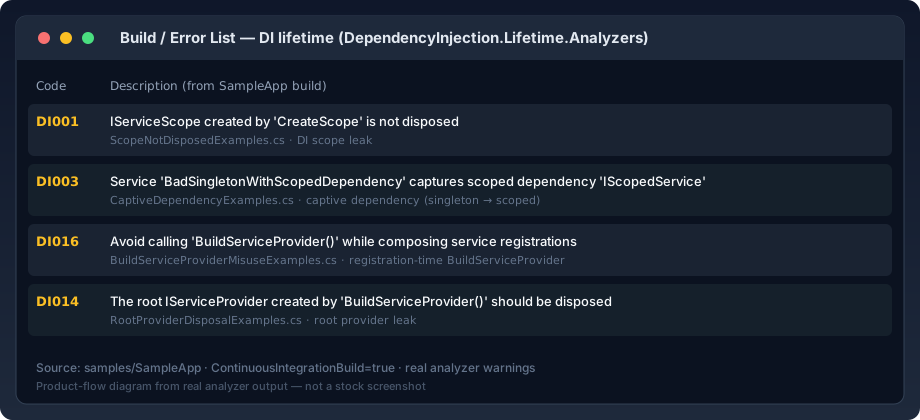
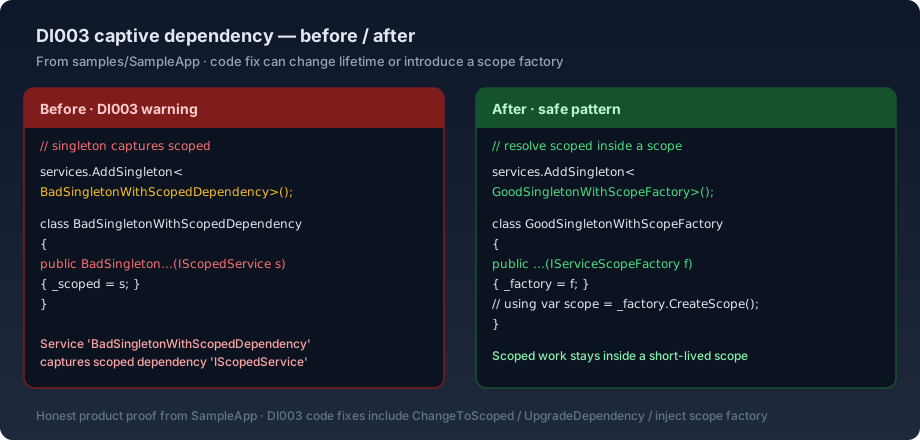
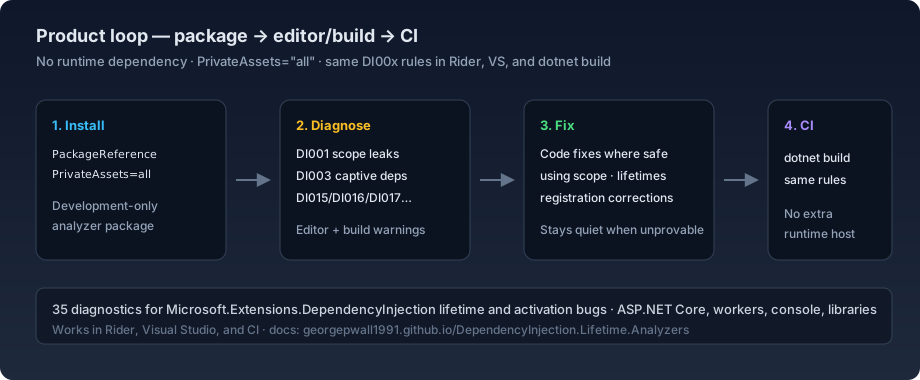
Product-flow diagrams from the real SampleApp build (DI001, DI003, DI014, DI016, and related diagnostics):
1. Build / IDE diagnostics (DI lifetime)
2. Before / after (captive dependency fix)
3. Product loop — install, diagnose, fix, CI
30-second path
- Reference the package with
PrivateAssets="all"(version3.7.0above). - Keep your existing
Microsoft.Extensions.DependencyInjectionregistrations — no runtime API changes required. - Build in the IDE or with
dotnet build(analyzers run in CI when enabled for your host). - Fix any
DI00x/DI0xxwarnings (many have code fixes for disposal and lifetime corrections). - Raise severities for the rules your team treats as ship blockers (see docs/ADOPTION.md).
Feature snapshot
| Area | What this analyzer does |
|---|---|
| Captive dependencies | Flags longer-lived services that capture shorter-lived dependencies, including open generics and high-confidence factories. |
| Scope disposal | Detects undisposed IServiceScope / root providers and use-after-dispose patterns. |
| Lifetime graph | Follows registrations, keyed services, and known framework scopes (for example EF Core / options snapshot paths) where modeled. |
| Activation validity | Reports unresolvable, non-instantiable, and circular constructor graphs when the container graph is visible. |
BuildServiceProvider |
Warns on registration-time provider builds and undisposed root providers. |
| Service locator | Surfaces static provider caches and direct IServiceProvider injection smells at low default noise. |
| ASP.NET Core / host | Middleware, hosted services, HttpClient, fire-and-forget scope/HttpContext capture. |
| Code fixes | Safe, unambiguous fixes for selected disposal and lifetime issues (see Rule Index). |
| Signal quality | Stays quiet when the bug cannot be proven statically. |
Compatibility
- Target: projects using
Microsoft.Extensions.DependencyInjection(ASP.NET Core, generic host, workers, console, libraries that wire the default container). - Analyzer host: Roslyn in Visual Studio, Rider, and
dotnet build/ CI. - Package TFM:
netstandard2.0analyzer assembly (consumes from modern .NET SDK projects). - Language: C#.
- Not claimed: third-party containers (Autofac, DryIoc, Lamar, etc.) unless they use the same registration APIs in a way this analyzer can see; FluentValidation and non-DI frameworks are out of scope.
Who this is for
- Teams using
Microsoft.Extensions.DependencyInjectionin ASP.NET Core or generic-host applications. - Libraries and internal platforms that want DI usage guarded in CI, not only at runtime.
- Codebases using factories, keyed services,
ActivatorUtilities, or manual scopes. - Maintainers reducing
IServiceProvider-driven service locator drift over time.
Table of Contents
- The problem
- What it catches
- Install
- See it work
- 30-second path
- Feature snapshot
- Compatibility
- Who this is for
- Rule Index
- DI001: Service Scope Not Disposed
- DI002: Scoped Service Escapes Scope
- DI003: Captive Dependency
- DI004: Service Used After Scope Disposed
- DI005: Use
CreateAsyncScopein Async Methods - DI006: Static
IServiceProviderCache - DI007: Service Locator Anti-Pattern
- DI008: Disposable Transient Service
- DI009: Open Generic Captive Dependency
- DI010: Constructor Over-Injection
- DI011:
IServiceProviderInjection - DI012: Conditional Registration Misuse
- DI013: Implementation Type Mismatch
- DI014: Root Service Provider Not Disposed
- DI015: Unresolvable Dependency
- DI016: BuildServiceProvider Misuse
- DI017: Circular Dependency
- DI018: Non-Instantiable Implementation Type
- DI019: Scoped Service Resolved From Root Provider
- DI020: Middleware Captures Scoped Service In Constructor
- DI021: Non-Thread-Safe Service Shared Across Concurrent Handler Invocations
- DI022: Service Instance Reused Across Handler Invocations
- DI023: Fire-and-Forget Background Work Captures a Scope
- DI024: Hosted Service Creates Scope Outside Execution Loop
- DI025: Event Subscription On Longer-Lived Publisher Without Unsubscribe
- DI026: Event Subscription On Scoped Publisher Without Unsubscribe
- DI027: Rx Subscription On Longer-Lived Observable Without Dispose
- DI028: Discarded Callback Registration On A Longer-Lived Source
- DI029: HttpClient Lifetime Misuse
- DI030: Unbounded Singleton Or Static Cache
- DI031: Shared Implementation Registered Under Several Service Types
- DI032: Service Implements Only IAsyncDisposable
- DI033: Container Will Not Dispose a Pre-Built Instance
- DI034: HttpContext Used in Fire-and-Forget Background Work
- DI035: Non-Thread-Safe Service Shared Across a Fan-Out
- DI036: Registration Added After The Provider Was Built
- DI037: Un-awaited Task Escapes The Scope That Created It
- Configuration
- Adoption Guide
- Frequently Asked Questions
Rule Index
| ID | Title | Default Severity | Code Fix |
|---|---|---|---|
| DI001 | Service scope not disposed | Warning | Yes |
| DI002 | Scoped service escapes scope | Warning | Yes |
| DI003 | Captive dependency | Warning | Yes |
| DI004 | Service used after scope disposed | Warning | Yes |
| DI005 | Use CreateAsyncScope in async methods |
Warning | Yes |
| DI006 | Static IServiceProvider cache |
Warning | Yes |
| DI007 | Service locator anti-pattern | Info | No |
| DI008 | Disposable transient service | Warning | Yes |
| DI009 | Open generic captive dependency | Warning | Yes |
| DI010 | Constructor over-injection | Info | No |
| DI011 | IServiceProvider injection |
Info | No |
| DI012 | Conditional/duplicate registration misuse | Info | Yes |
| DI013 | Implementation type mismatch | Error | Yes |
| DI014 | Root provider not disposed | Warning | Yes |
| DI015 | Unresolvable dependency | Warning | Yes |
| DI016 | BuildServiceProvider misuse during registration | Warning | No |
| DI017 | Circular dependency | Warning | No |
| DI018 | Non-instantiable implementation type | Warning | No |
| DI019 | Scoped service resolved from root provider | Warning | Yes |
| DI020 | Middleware captures scoped service in constructor | Warning | No |
| DI021 | Non-thread-safe service shared across concurrent handler invocations | Warning | Yes |
| DI022 | Service instance reused across handler invocations | Info | Yes |
| DI023 | Fire-and-forget background work captures a scope | Warning | No |
| DI024 | Hosted service creates scope outside execution loop | Warning | No |
| DI025 | Event subscription on longer-lived publisher without unsubscribe | Warning | Yes |
| DI026 | Event subscription on scoped publisher without unsubscribe | Info | Yes |
| DI027 | Rx subscription on longer-lived observable without dispose | Warning | No |
| DI028 | Discarded callback registration on a longer-lived source | Warning | No |
| DI029 | HttpClient lifetime misuse | Warning | No |
| DI030 | Unbounded singleton or static cache | Info | No |
| DI031 | Shared implementation registered under several service types | Info | No |
| DI032 | Service implements only IAsyncDisposable | Warning | No |
| DI033 | Container will not dispose a pre-built instance | Info | No |
| DI034 | HttpContext used in fire-and-forget background work | Warning | No |
| DI035 | Non-thread-safe service shared across a fan-out | Warning | No |
| DI036 | Registration added after the provider was built | Warning | No |
| DI037 | Un-awaited task escapes the scope that created it | Warning | No |
DI001: Service Scope Not Disposed
What it catches: IServiceScope instances created with CreateScope() or CreateAsyncScope() that are never disposed, including scopes whose only disposal call is hidden behind a conditional branch, or behind a switch section, loop, or catch block that does not also contain the creation, or after a branch exit that can bypass shared cleanup. Create-and-dispose within the same loop iteration, switch section, or catch clause — the per-message worker shape — stays quiet, but a continue/break that skips the dispose, or a yield return/yield break that can strand the scope in a never-resumed iterator, still reports. DI001 recognizes predeclared nullable scope locals assigned conditionally when a later conditional-access, non-null-guarded, same-branch pre-exit, or finally disposal reliably closes ownership, and it treats directly returned scopes as caller-owned even through simple casts or conditional return arms. Reassignment leaks and loop-created scopes that need per-iteration disposal still report.
Why it matters: undisposed scopes can retain scoped and transient disposable services longer than expected, causing memory and handle leaks.
Explain Like I'm Ten: If you borrow a paintbrush and never wash it, it dries out and ruins the next project.
Problem:
public void Process()
{
    var scope = _scopeFactory.CreateScope();
    var svc = scope.ServiceProvider.GetRequiredService<IMyService>();
    svc.Run();
}
Better pattern:
public void Process()
{
    using var scope = _scopeFactory.CreateScope();
    var svc = scope.ServiceProvider.GetRequiredService<IMyService>();
    svc.Run();
}
Code Fix: Yes. Adds using / await using where possible; the await using conversion also rewrites explicitly typed declarations to var, because AsyncServiceScope boxed to IServiceScope cannot be awaited-using.
DI002: Scoped Service Escapes Scope
What it catches: a service resolved from a tracked IServiceScope with a known scoped registration that is returned or stored beyond that scope. The tracked scope shapes are direct CreateScope()/CreateAsyncScope() calls and existing scope locals later disposed in the same executable boundary. The rule follows the direct provider aliases it can prove and works inside constructors, accessors, local functions, lambdas, and anonymous methods.
A report is emitted when the resolved instance reaches a proven outliving sink: a field/property, caller-owned ref/out destination, field/property-held or caller-owned collection mutation (Add, Insert, Enqueue, Push, TryAdd, ConcurrentDictionary.GetOrAdd/AddOrUpdate value or supported value-factory forms), a longer-lived event subscription, or a returned tuple/anonymous/conditional/coalesce composite. Constant-key keyed resolutions, non-generic GetService(typeof(T)), conditional access, and identity/reference-preserving casts retain this contract. A fresh parameter collection is quiet only while it remains local; once it is returned, stored, or passed by ref/out, it is an escape.
Guardrails: the analyzer stays quiet when the service is used only inside the scope, when lifetime is singleton/transient/unknown/unregistered, or when the receiver is a fresh/local holder, local collection, local publisher, or non-collection method. It does not guess through wrapped or pre-declared scope creation, casted/provider aliases, arbitrary helper/property flows, top-level/deferred executable boundaries, runtime Type values, dynamic/non-constant keys, plural service resolution, arrays/lists/constructor/Task/yield wrappers, receiver aliases/casts/indexers, or opaque factories. Method spelling alone is not enough: user-defined resolution extensions are not treated as Microsoft DI resolution. User-defined conversions are not treated as identity-preserving; direct identity/reference casts remain supported. These deliberate silent cases are the conservative boundary recorded in docs/adversarial/DI002.md.
Why it matters: once the scope is disposed, that service may point to disposed state.
Explain Like I'm Ten: It is like taking an ice cube out of the freezer for later; by the time you need it, it has melted.
Problem:
public IMyService GetService()
{
    using var scope = _scopeFactory.CreateScope();
    return scope.ServiceProvider.GetRequiredService<IMyService>();
}
Better pattern:
public void UseServiceNow()
{
    using var scope = _scopeFactory.CreateScope();
    var service = scope.ServiceProvider.GetRequiredService<IMyService>();
    service.Execute();
}
Code Fix: Yes. The fixer offers only a pragma suppression for an intentionally accepted escape; it does not rewrite ownership or move the service. It refuses diagnostics that are not contained by a statement. Use the standard severity setting, for example:
[*.cs]
dotnet_diagnostic.DI002.severity = warning
There are no DI002-specific .editorconfig guardrail options.
DI003: Captive Dependency
What it catches: singleton services capturing scoped or transient dependencies, including constructor injection, IEnumerable<T> collection captures, known scoped framework services such as IOptionsSnapshot<T>, typed HTTP clients registered with AddHttpClient<TClient>() / AddHttpClient<TClient,TImplementation>(), EF Core contexts and DbContextOptions<TContext> registrations from AddDbContext(...), AddDbContextFactory(...), AddDbContextPool(...), and AddPooledDbContextFactory(...) including service/implementation overload self-registrations, and high-confidence factory paths such as inline delegates, stable local delegate factories, method-group factories, GetServices<T>(), keyed resolutions, and ActivatorUtilities.CreateInstance(...) calls where DI still resolves a scoped or transient constructor parameter. A factory that creates and provably disposes its own scope (using var scope = sp.CreateScope();) stays quiet for resolutions through that scope when only derived values flow into the product — one-time scoped setup is not a captive — while an escaping resolved instance or an undisposed factory scope still reports.
The shared registration model also recognizes IServiceCollection.Insert(0, ServiceDescriptor...), including reordered named arguments and the concrete framework ServiceCollection implementation. It evaluates ordinary additions after prepends and reverses repeated prepend operations to match the runtime descriptor list. Nonzero or dynamic insert indexes remain deliberately silent because unmodelled descriptors make absolute positions unsafe to infer; source-defined concrete Insert bodies stay silent because an implementation can remap the interface member to arbitrary behavior.
Why it matters: lifetime mismatch can produce stale state, leaks, and thread-safety defects.
Explain Like I'm Ten: If one pupil keeps the shared class scissors all term, nobody else can use them when needed.
Problem:
services.AddScoped<IScopedService, ScopedService>();
services.AddSingleton<ISingletonService, SingletonService>();

public sealed class SingletonService : ISingletonService
{
    public SingletonService(IScopedService scoped) { }
}
Better pattern:
services.AddScoped<ISingletonService, SingletonService>();

// or keep singleton and create scopes inside operations
public sealed class SingletonService : ISingletonService
{
    private readonly IServiceScopeFactory _scopeFactory;

    public SingletonService(IServiceScopeFactory scopeFactory)
    {
        _scopeFactory = scopeFactory;
    }

    public void Run()
    {
        using var scope = _scopeFactory.CreateScope();
        var scoped = scope.ServiceProvider.GetRequiredService<IScopedService>();
        scoped.DoWork();
    }
}
DbContext-backed processors:
services.AddDbContext<AppDbContext>();
services.AddScoped<IProcessor, Processor>();
services.AddHostedService<ProcessorHostedService>();

public sealed class ProcessorHostedService : IHostedService
{
    private readonly IServiceProvider _serviceProvider;

    public ProcessorHostedService(IServiceProvider serviceProvider)
    {
        _serviceProvider = serviceProvider;
    }

    public async Task StartAsync(CancellationToken cancellationToken)
    {
        using var scope = _serviceProvider.CreateScope();
        var processor = scope.ServiceProvider.GetRequiredService<IProcessor>();
        await processor.RunAsync(cancellationToken);
    }

    public Task StopAsync(CancellationToken cancellationToken) =>
        Task.CompletedTask;
}
Repository and unit-of-work abstractions are reported when their registered lifetime is scoped or transient. DI003 does not infer DbContext-backed behavior from names like IRepository<T> or IUnitOfWork alone.
Code Fix: Yes. Rewrites explicit registration lifetimes when the registration syntax is local and unambiguous (for example AddSingleton, TryAddSingleton, keyed AddKeyedSingleton, inline factory registrations, and supported ServiceDescriptor forms). The rewrite only ever targets MEDI registration methods — user helpers whose names happen to contain a lifetime token are never renamed.
DI004: Service Used After Scope Disposed
What it catches: using a service after the scope that produced it has already ended, including scoped collections from GetServices<T>() enumerated after disposal, explicit Dispose() / DisposeAsync() (including scope?.Dispose() for scope locals), wrapped use receivers such as service!.DoWork() and ((IService)service).DoWork(), services resolved from a predeclared scope variable later disposed via using (scope), and the same patterns inside constructors, accessors, local functions, lambdas, and anonymous methods. Uses in branches mutually exclusive with the disposal — whether the dispose is explicit or a using statement/declaration — stay quiet, and out arguments are writes rather than uses (the rewritten local is fresh afterwards), while ref arguments still report.
Why it matters: leads to runtime disposal errors and brittle service behaviour.
Explain Like I'm Ten: It is like trying to turn on a torch after you removed the batteries.
Problem:
IMyService service;
using (var scope = _scopeFactory.CreateScope())
{
    service = scope.ServiceProvider.GetRequiredService<IMyService>();
}
service.DoWork();
Better pattern:
using (var scope = _scopeFactory.CreateScope())
{
    var service = scope.ServiceProvider.GetRequiredService<IMyService>();
    service.DoWork();
}
Code Fix: Yes. Moves simple immediate invocation-style uses back into the owning scope only when the diagnostic local was assigned in that scope, or adds a narrow pragma suppression for context-dependent cases. The pragma suppression always lands on a line-starting statement, so embedded unbraced statements compile.
DI005: Use CreateAsyncScope in Async Methods
What it catches: CreateScope() used in async flows where async disposal is needed and CreateAsyncScope() is available, including async methods, lambdas, local functions, anonymous methods, and top-level programs that use await. Detection covers regular member access (_scopeFactory.CreateScope()), parameterless IServiceScope CreateScope() methods on concrete IServiceScopeFactory implementations, and conditional-access receivers (_scopeFactory?.CreateScope(), _provider?.CreateScope()) alike.
Why it matters: async disposables (IAsyncDisposable) may not be cleaned up correctly with sync disposal patterns.
Explain Like I'm Ten: If a machine needs a proper shutdown button, pulling the plug is not enough.
Problem:
public async Task RunAsync()
{
    using var scope = _scopeFactory.CreateScope();
    var service = scope.ServiceProvider.GetRequiredService<IMyService>();
    await service.ExecuteAsync();
}
Better pattern:
public async Task RunAsync()
{
    await using var scope = _scopeFactory.CreateAsyncScope();
    var service = scope.ServiceProvider.GetRequiredService<IMyService>();
    await service.ExecuteAsync();
}
Code Fix: Yes. Rewrites safe using scope creation/disposal patterns to await using plus CreateAsyncScope(), including explicit IServiceScope declarations that must become var for AsyncServiceScope.
DI006: Static IServiceProvider Cache
What it catches: IServiceProvider / IServiceScopeFactory / keyed provider stored in static fields or properties, including common wrappers (Lazy<T>, Task<T>, ValueTask<T>, Func<T>, AsyncLocal<T>, ThreadLocal<T>), mutable/immutable/frozen dictionary value caches, recursive dictionary values such as Dictionary<string, Lazy<IServiceProvider>>, and simple holder types that only wrap a provider.
Why it matters: global provider state encourages service locator use and muddles lifetime boundaries.
Explain Like I'm Ten: Leaving the school master key in the corridor means anybody can open any door at any time.
Problem:
public static class Locator
{
    public static IServiceProvider Provider { get; set; } = null!;
    private static readonly Lazy<IServiceProvider> LazyProvider = new(() => Provider);
    private static readonly Dictionary<string, Lazy<IServiceProvider>> LazyTenantProviders = new();
    private static readonly Dictionary<string, IServiceProvider> TenantProviders = new();
    private static readonly ImmutableDictionary<string, IServiceProvider> SnapshotProviders = ImmutableDictionary<string, IServiceProvider>.Empty;
    private static ProviderHolder Holder = null!;
}
public sealed class ProviderHolder
{
    private readonly IServiceProvider _provider;

    public ProviderHolder(IServiceProvider provider)
    {
        _provider = provider;
    }
}
Better pattern:
public sealed class Locator
{
    private readonly IServiceProvider _provider;

    public Locator(IServiceProvider provider)
    {
        _provider = provider;
    }
}
Code Fix: Yes. Removes static modifier in common private-member cases where existing references stay valid; it is suppressed for nested-type references, type-qualified references, and instance field/property initializers that would become invalid instance-member access.
Options: dotnet_code_quality.DI006.detect_holder_pattern = false disables the simple holder-type detector if a codebase intentionally uses provider-wrapper types.
DI007: Service Locator Anti-Pattern
What it catches: resolving dependencies via IServiceProvider inside app logic, including non-generic resolution calls that pass a local Type alias initialized from typeof(...).
Why it matters: hides real dependencies, makes tests harder, and weakens architecture boundaries.
Explain Like I'm Ten: If every meal starts with "search the kitchen and see what turns up", dinner becomes chaos.
Problem:
public sealed class MyService
{
    private readonly IServiceProvider _provider;

    public MyService(IServiceProvider provider)
    {
        _provider = provider;
    }

    public void Run()
    {
        var dep = _provider.GetRequiredService<IDependency>();
        dep.Execute();
    }
}
Better pattern:
public sealed class MyService
{
    private readonly IDependency _dependency;

    public MyService(IDependency dependency)
    {
        _dependency = dependency;
    }

    public void Run() => _dependency.Execute();
}
Code Fix: No. This is usually architectural refactoring.
DI007 stays quiet in recognized composition/factory boundaries: DI registration factories, value-returning Create*/Build* factory methods, ASP.NET Core middleware Invoke/InvokeAsync methods whose first parameter is HttpContext, BackgroundService.ExecuteAsync, exact hosted-service lifecycle implementations, options configure/validate implementations, and provider-aware options/factory delegates.
DI008: Disposable Transient Service
What it catches: transient services implementing IDisposable/IAsyncDisposable in risky patterns.
Why it matters: disposal ownership can become unclear and resources may be leaked.
Explain Like I'm Ten: Borrowing a bike every minute without returning the old one fills the whole bike shed.
Problem:
services.AddTransient<IMyService, DisposableService>();

public sealed class DisposableService : IMyService, IDisposable
{
    public void Dispose() { }
}
Better pattern:
services.AddScoped<IMyService, DisposableService>();
// or ensure explicit disposal ownership if transient is intentional
DI008 follows generic, typeof(...), keyed, named-argument, typed HTTP client (AddHttpClient<TClient>() / AddHttpClient<TClient,TImplementation>()), ServiceDescriptor.Transient(...), conditional services?.Add(ServiceDescriptor.Transient(...)), ServiceDescriptor.KeyedTransient(...), ServiceDescriptor.Describe(..., ServiceLifetime.Transient), ServiceDescriptor.DescribeKeyed(..., ServiceLifetime.Transient), new ServiceDescriptor(..., ServiceLifetime.Transient), TryAddTransient, plain TryAdd(ServiceDescriptor...), Replace(ServiceDescriptor...), and TryAddEnumerable registration shapes, including descriptor arrays, lists, and C# collection expressions. Descriptor argument binding uses Roslyn parameters, so keyed descriptor calls whose serviceKey is itself a typeof(...) expression still report the disposable implementation rather than misreading the key as the implementation. Factory registrations stay quiet because disposal ownership is explicit in user code.
Code Fix: Yes. Suggests safer lifetime alternatives and rewrites local descriptor lifetime arguments where the registration is unambiguous.
Options: dotnet_code_quality.DI008.allowed_disposable_types = MyType, My.Namespace.OtherType suppresses known intentional disposable transients by simple or full type name.
DI009: Open Generic Captive Dependency
What it catches: open generic singleton registrations that depend on shorter-lived services, including common registration-shape variants such as TryAddSingleton(...), ServiceDescriptor.Singleton(...), keyed open-generic singleton registrations, and IEnumerable<T> constructor captures where the element service is shorter-lived.
Why it matters: every closed generic instance inherits the lifetime mismatch.
Explain Like I'm Ten: If the recipe is wrong at the top of the cookbook, every dish made from it comes out wrong.
Problem:
services.AddScoped<IScopedService, ScopedService>();
services.AddSingleton(typeof(IRepository<>), typeof(Repository<>));

public sealed class Repository<T> : IRepository<T>
{
    public Repository(IScopedService scoped) { }
}
Better pattern:
services.AddScoped(typeof(IRepository<>), typeof(Repository<>));
DI009 follows the single likely activation constructor the container can actually use. Optional/default-value parameters are treated as activatable during that selection, and ambiguous equally-greedy constructor sets stay silent instead of guessing.
Dependency lifetimes are looked up against user registrations first and then fall back to the shared known-framework classifier, so open-generic singletons that capture IOptionsSnapshot<T> are reported as scoped captures even when the application does not register Options manually. IOptions<T> and IOptionsMonitor<T> keep their singleton lifetime and stay quiet. For a direct generic dependency, an open registration is considered only when its implementation constraints can overlap the consumer's type-parameter constraints; impossible class/struct or incompatible-base closures stay quiet. Unknown keyed expressions are not treated as null or as equal to one another; DI009 reports keyed captures only when key equality (or the explicit KeyedService.AnyKey fallback) is proven. These boundaries and their opposition review are recorded in docs/adversarial/DI009.md.
For IEnumerable<T>, the container includes every matching exact closed and applicable open-generic
registration. DI009 therefore takes the worst lifetime across both sets: an exact closed singleton
element cannot hide an additional scoped or transient open-generic element. Matching keyed
registrations use the same rule. A concrete-key enumerable uses only registrations for that exact
key; KeyedService.AnyKey descriptors do not participate. The final effective
AnyKey-registered consumer with parameterless [FromKeyedServices] runs constructor selection
and lifetime evaluation against every concrete key where an exact registration for the same
service does not shadow it, reporting each constructor parameter once at its worst
lifetime across those keys and again without including the AnyKey descriptor. The unknown-key
fallback keeps an empty enumerable rather than reaggregating concrete keys already shadowed for
that consumer. Ordinary single-service resolution still uses
AnyKey as a fallback only when no exact-key registration exists. Constructor-resolvability
analysis follows the same precedence, so a broken exact-key registration cannot be bypassed by a
resolvable AnyKey registration when selecting the activation constructor. Within the selected
exact or AnyKey tier, the final effective descriptor wins, so an earlier resolvable registration
cannot bypass a later broken registration. Open-generic
implementations whose runtime generic constraints
reject the requested element type are excluded, while an unconstrained consumer type parameter
remains a potential match unless its class, struct, base-type, interface, constructor, dependent, or
composite constraints prove the sets disjoint. Nested service and implementation types include
containing-type arguments or parameters in runtime closure order, and nested invariant generic constraints keep their concrete
generic shape instead of treating an entire composite argument as a wildcard. Concrete base-class
constraints are disjoint from struct constraints except for CLR value-type bases such as Enum.
Ordinary single-service resolution is unchanged and
selects the final effective descriptor from the first available runtime tier: closed exact key,
closed AnyKey, open-generic exact key, then open-generic AnyKey.
Code Fix: Yes. Can adjust lifetime for open generic registrations.
DI010: Constructor Over-Injection
What it catches: constructors with too many meaningful dependencies.
Why it matters: often signals a class with too many responsibilities.
Explain Like I'm Ten: If one backpack needs ten straps to carry, it is probably trying to hold too much at once.
Problem:
public sealed class ReportingService
{
    public ReportingService(
        IDep1 dep1,
        IDep2 dep2,
        IDep3 dep3,
        IDep4 dep4,
        IDep5 dep5)
    {
    }
}
Better pattern: split into focused collaborators and inject smaller abstractions.
For normal type registrations, DI010 evaluates the public constructor(s) the container could realistically activate instead of every declared constructor — including C# 12 primary constructors and original type definitions registered through open-generic typeof(...) calls. Tied equally-greedy activation constructors report only once at the registration using the highest meaningful dependency count. It also covers straightforward factory registrations that directly return new MyService(...), final-return factory blocks that set up locals before return new MyService(...), and ActivatorUtilities.CreateInstance<MyService>(sp), while staying conservative on branching or dynamic factories. Method-group factories work across files: services.AddScoped<IMyService>(Factories.Create) is analyzed through the factory body even when Factories is declared in another file.
By default, DI010 reports when a constructor has more than 4 meaningful dependencies. It ignores primitives/value types, optional parameters, provider-plumbing types already covered by DI011, and common framework abstractions such as ILogger<T>, IOptions<T>, and IConfiguration.
Configure the threshold in .editorconfig:
[*.cs]
dotnet_code_quality.DI010.max_dependencies = 5
Code Fix: No. Design decision required.
DI011: IServiceProvider Injection
What it catches: constructor injection of IServiceProvider, IServiceScopeFactory, or IKeyedServiceProvider in normal services.
Why it matters: this commonly enables hidden runtime resolution and service locator behaviour.
Explain Like I'm Ten: Asking for a giant "surprise box" each time instead of a known tool means no one knows what you actually need.
Problem:
public sealed class MyService
{
    public MyService(IServiceProvider provider) { }
}
Better pattern: inject concrete dependencies directly.
Code Fix: No. Replacing provider plumbing with explicit dependencies is a design decision.
Known exceptions in this rule: factory-style types with value-returning factory members, singleton services that use IServiceScopeFactory to create scopes deliberately, ASP.NET Core middleware Invoke/InvokeAsync methods whose first parameter is HttpContext, hosted services, endpoint filter factories, abstract/non-instantiable implementations (DI018 owns that invalid registration), and provider parameters on non-public constructors the container cannot activate. The conservative boundary and opposition review are recorded in docs/adversarial/DI011.md.
Registrations that are definitely removed by a later unconditional RemoveAll or Replace call
in the same straight-line service-collection flow are also ignored. Conditional or otherwise
bypassable removals do not suppress the diagnostic because the registration can still be active.
Fluent Add*().RemoveAll() chains follow nested-call execution order, and TryAdd fallbacks after
an unconditional removal are analyzed when they become effective. Reassigning a collection
receiver starts a separate flow, and companion descriptors emitted by one framework registration
call retain independent effective-state identities. Top-level statements participate in the same
proof, captured aliases retain their assignment-time collection identity, and Insert(0) ordering
is honored when replaying Replace. A conditional RemoveAll can make a later TryAdd candidate
effective, but exiting and mutually exclusive branch shapes do not.
Only straight-line alias assignments determine collection identity; conditional assignments
invalidate earlier aliases. Non-terminating branches cannot activate an unreachable fallback, while
reachable same-branch, switch, loop, try/catch, and goto paths remain part of the
effective-registration flow. TryAddEnumerable retains its service-and-implementation
deduplication semantics during replay. Alternate-branch registrations cannot erase a pending
removal path, while an unconditional replacement or finally restoration can. Reachable
try/catch paths and nested exhaustive switches are included; nested-container,
throw-expression, and constant-true exits remain unreachable, and activation
constructors are selected using dependencies still effective after replay. Mutations and alias
assignments in short-circuited right operands stay conditional, while catch-all handlers can resume
an explicitly thrown removal path at a later fallback. Exactly matching typed catches also resume;
other typed catches remain conservative. Alias candidates are indexed once per syntax tree.
DI012: Conditional Registration Misuse
What it catches:
TryAdd*calls after anAdd*already registered that service.- Duplicate
Add*registrations where later entries override earlier ones.
DI012 also follows the same IServiceCollection flow across local aliases and source-defined helper/local-function wrappers, while treating opaque helper boundaries conservatively instead of guessing at registration order. Common framework registration helpers such as AddLogging(), AddOptions(), Configure<T>(), AddMemoryCache(), AddHttpClient(), and AddHttpContextAccessor() are transparent rather than opaque barriers, so later user registrations remain visible. It stays quiet for intentional branch-dependent fallbacks such as guarded Add* plus unconditional TryAdd*, applies TryAddEnumerable's service-and-implementation pair semantics, reports later TryAdd* calls when every reachable branch has already registered the service even through wrapped branch exits, and keeps mutually exclusive if/else if/else alternative registrations quiet.
When a Replace(...) still leaves a duplicate descriptor behind, DI012 reports the active registration that survives the single-descriptor replacement, ignoring inactive TryAdd* calls when choosing the message location.
Why it matters: registration intent becomes unclear and behaviour differs from what readers expect.
Explain Like I'm Ten: Writing your name on the same seat twice does not get you two seats; one note just replaces the other.
Problem:
services.AddSingleton<IMyService, ServiceA>();
services.TryAddSingleton<IMyService, ServiceB>(); // ignored

services.AddSingleton<IMyService, ServiceA>();
services.AddSingleton<IMyService, ServiceB>(); // overrides A
Better pattern: decide and signal intent clearly: TryAdd* first, or explicit override with comments/tests.
Code Fix: Yes for ignored TryAdd* and TryAddKeyed* calls that are block-contained standalone statements; the fixer removes the redundant ignored registration. Duplicate override cases and embedded single-line statement bodies remain manual.
DI013: Implementation Type Mismatch
What it catches: invalid service/implementation pairs that compile but fail at runtime, including generic, typeof(...), keyed, named-argument, and ServiceDescriptor registrations.
Why it matters: service activation throws at runtime (ArgumentException/InvalidOperationException depending on path).
Explain Like I'm Ten: A round plug will not fit a square socket just because both are on your desk.
Problem:
public interface IRepository { }
public sealed class WrongType { }

services.AddSingleton(typeof(IRepository), typeof(WrongType));
Better pattern:
public sealed class SqlRepository : IRepository { }
services.AddSingleton(typeof(IRepository), typeof(SqlRepository));
For instance-backed registrations (AddSingleton(typeof(IService), instance) and the ServiceDescriptor equivalents), DI013 only reports when the instance's runtime type is provably known: the argument is an object creation (even through parentheses or upcasts), or its static type is sealed or a value type. A local declared as a base type or interface stays silent — its static type says nothing about the runtime type, and DI013 is the package's only Error-severity rule, so it never reports on code that could be correct.
Code Fix: Yes. Offers broad assists where the syntax and symbols are local enough to rewrite safely: remove the invalid block-contained standalone registration, replace the implementation type with a compatible candidate, or retarget the service type to an interface/base type implemented by the current implementation, including invalid implementation-instance registrations. Embedded single-line statement bodies stay manual unless a symbol-backed type rewrite is available. Candidate suggestions never include generic type definitions or structs — both produce registrations that fail to compile or crash at resolution.
DI014: Root Service Provider Not Disposed
What it catches: root providers from BuildServiceProvider() that are never disposed, including local providers whose only manual disposal is conditional, catch-only, after reassignment to another provider, or after repeated creation inside a loop. Straight-line explicit disposal, standard Dispose() to Dispose(true) cleanup, and caller-owned return flows are accepted even when the BuildServiceProvider() result is parenthesized, same-instance cast, null-forgiven, selected by a ternary arm, or supplied by a null-coalescing operand — including a provider stored in a local and returned later (ownership transfer), and create-and-dispose within the same loop iteration, switch section, or catch clause (a continue/break that skips the dispose still reports). A using declaration or statement proves cleanup only when that same provider instance reaches its resource expression. User-defined conversions remain reportable because they may produce a different instance, including a disposable wrapper selected by a coalesce inside using.
Why it matters: singleton disposables at root scope may never be cleaned up.
Explain Like I'm Ten: Locking the front door but leaving all the taps running still wastes the whole house.
Problem:
var services = new ServiceCollection();
var provider = services.BuildServiceProvider();
var service = provider.GetRequiredService<IMyService>();
Better pattern:
using var provider = services.BuildServiceProvider();
var service = provider.GetRequiredService<IMyService>();
Code Fix: Yes. Adds disposal pattern for simple local declarations with no existing manual disposal code; declared types that do not implement the required disposal interface (e.g. IServiceProvider) are rewritten to var so the emitted using compiles. Conditional or otherwise partial manual-disposal flows stay diagnostic-only so the ownership rewrite remains deliberate.
DI015: Unresolvable Dependency
What it catches: registered services with direct or transitive constructor/factory dependencies that are not registered (including keyed and open-generic paths).
Why it matters: runtime activation fails when DI tries to create the service.
Explain Like I'm Ten: Planning to build a kite without string means the build fails when you start.
Problem:
public interface IMissingDependency { }
public interface IMyService { }

public sealed class MyService : IMyService
{
    public MyService(IMissingDependency missing) { }
}

services.AddSingleton<IMyService, MyService>();
Better pattern:
public sealed class MissingDependency : IMissingDependency { }

services.AddScoped<IMissingDependency, MissingDependency>();
services.AddSingleton<IMyService, MyService>();
Code Fix: Yes. Adds a missing self-binding registration when DI015 can prove a single direct concrete class dependency is safe to register. Supports local constructor diagnostics, TryAdd* registration sites, local IServiceCollection aliases, direct GetRequiredService<TConcrete>() factory diagnostics, and keyed self-bindings when the key can be emitted as a C# literal.
DI015 strict mode
By default, DI015 assumes common host-provided framework services are available, including logging/options/configuration, ILoggerFactory, IHostApplicationLifetime, and the Generic Host's singleton IHostLifetime. Strict mode still requires explicit registrations, keyed framework-service requests are never satisfied by this unkeyed ambient assumption, and explicit registrations override ambient lifetime classification so scoped framework-service replacements remain visible to lifetime rules. Explicit framework extension calls such as AddHttpClient(), AddMemoryCache(), and AddHttpContextAccessor() are modeled as registrations for IHttpClientFactory, IMemoryCache, and IHttpContextAccessor; those services still report as missing when the matching extension is absent. TimeProvider also reports as missing unless registered explicitly. Typed HTTP client registrations treat one constructor HttpClient parameter as factory-provided while still checking repeated HttpClient parameters and other typed-client constructor dependencies. EF Core contexts registered through AddDbContext(...), AddDbContextFactory(...), AddDbContextPool(...), or AddPooledDbContextFactory(...) are also modeled as registrations, including service/implementation overload self-registrations and the DbContextOptions<TContext> and IDbContextFactory<TContext> dependencies those patterns require.
Disable that assumption for stricter analysis:
[*.cs]
dotnet_code_quality.DI015.assume_framework_services_registered = false
DI015 is intentionally conservative to keep false positives low:
- Source-visible
IServiceCollectionwrappers are expanded before DI015 reports missing registrations. - Stable local delegate factories are inspected, including inherited keyed factory parameters, later definite simple reassignments, exhaustive local-function branch rewrites, and method-group delegate aliases to local functions that rewrite the factory, while unrelated assignment left-hand-side uses and opaque delegate-local writes such as direct delegate calls, delegate
.Invoke()calls, andref/outwrites stay conservative. [ServiceKey]parameters,IEnumerable<T>,IServiceProviderIsService, andIServiceProviderIsKeyedServiceare treated as container-provided.- Parameterless
[FromKeyedServices]inherits the containing keyed registration key when that key is known. KeyedService.AnyKeykeyed registrations satisfy exact keyed dependency requests.- Definite same-flow
RemoveAll(...)andReplace(...)mutations suppress diagnostics for registrations they remove. - Dependency cycles are treated as resolvable.
- Factory registrations without inspectable dependency paths are treated as resolvable.
GetService(...)and dynamic keyed resolutions are treated as optional/unknown.- If an earlier opaque or external wrapper could have registered services on the same
IServiceCollectionflow, DI015 stays silent instead of speculating. - If any effective candidate registration is backed by an opaque factory, DI015 stays silent instead of speculating.
- Two-Type registrations with a non-extractable implementation argument are treated as registered-but-unknown, suppressing downstream missing-registration guesses without inventing an implementation shape.
DI016: BuildServiceProvider Misuse
What it catches: BuildServiceProvider() calls while composing registrations (for example in ConfigureServices, IServiceCollection extension registration methods, registration lambdas, or builder-style .Services helper flows), whether written as reduced extension syntax (services.BuildServiceProvider()) or as a direct static call (ServiceCollectionContainerBuilderExtensions.BuildServiceProvider(builder.Services)).
Why it matters: building a second provider during registration can duplicate singleton instances and produce lifetime inconsistencies.
Explain Like I'm Ten: If you set up a second classroom register halfway through, children can end up counted twice and rules become muddled.
Problem:
public static IServiceCollection AddFeature(this IServiceCollection services)
{
    var provider = services.BuildServiceProvider();
    var options = provider.GetRequiredService<IMyOptions>();
    return services;
}
Better pattern:
public static IServiceCollection AddFeature(this IServiceCollection services, IMyOptions options)
{
    // Use provided dependencies/options without creating a second container
    return services;
}
Code Fix: No.
DI016 is intentionally conservative to reduce false positives:
- It only reports symbol-confirmed DI
BuildServiceProvider()calls in registration contexts. - It does not report provider-factory methods that intentionally return
IServiceProvider, concrete provider implementations, or awaited provider results. - It recognizes assignable
IServiceCollectionabstractions and same-boundary helper/alias flows from.Services, but it does not warn on standalone top-levelnew ServiceCollection()composition roots. - It recognizes metadata-defined
IServiceCollectionfluent chains, sobuilder.Services.AddSingleton<...>().BuildServiceProvider()is treated as the same registration source asbuilder.Services.BuildServiceProvider(). - Direct static extension calls recover the receiver from the Roslyn-bound
IServiceCollectionparameter, so named and reordered arguments retain the same registration-context proof; provider-factory return guardrails still apply. - Builder
.Servicesflows wrapped in the null-forgiving operator (builder.Services!) or a same-type cast ((IServiceCollection)builder.Services) at the call site, in helper return expressions, or in local-variable initializers are still recognized as registration contexts, while provider-factory methods that wrap the same expression stay silent because they returnIServiceProvider. - Identity-preserving null guards such as
(builder.Services ?? throw new InvalidOperationException()).BuildServiceProvider()retain the builder.Servicesproof; a coalesce with an arbitrary fallback collection stays silent because the actual source is not provable. - Conditional-access invocations and aliases such as
builder.Services?.BuildServiceProvider(),builder?.Services.BuildServiceProvider(), andvar services = builder?.Services; services.BuildServiceProvider();are recognized through the enclosingConditionalAccessExpressionand theMemberBindingExpression-shaped.Servicesaccess, so null-safe builder flows participate in detection the same way as direct member access. Provider-factory methods wrapping the same shape stay quiet.
DI017: Circular Dependency
What it catches: high-confidence activation cycles such as A -> B -> A, including longer transitive loops through constructors, explicit GetRequiredService / GetRequiredKeyedService factory calls, ActivatorUtilities factory construction, keyed-service inheritance, open-generic registrations, exact closed registrations that override open-generic fallbacks, and registered IEnumerable<T> elements. It analyzes only reachable service-registration flows and mirrors the default container's constructor-set rule: equivalent reordered greedy constructors expose the same cycle, while a greediest constructor whose resolved service identifiers (type plus key) are not a superset of every other resolvable constructor stays silent as ambiguous.
Why it matters: the default DI container cannot resolve circular constructor graphs and will fail at runtime when the service is activated.
Explain Like I'm Ten: If two people each wait for the other to hand over the key first, the door never opens.
Problem:
services.AddScoped<IOrderService, OrderService>();
services.AddScoped<IPaymentService, PaymentService>();

public sealed class OrderService : IOrderService
{
    public OrderService(IPaymentService payment) { }
}

public sealed class PaymentService : IPaymentService
{
    public PaymentService(IOrderService order) { }
}
Better pattern: break the cycle by moving shared logic into a third collaborator or by changing the dependency direction so each service has an acyclic constructor graph.
DI017 intentionally remains conservative:
- It honors source-ordered effective registrations, including duplicate overrides,
TryAdd,RemoveAll, andReplaceremoval semantics. - It does not report cycles from uninvoked registration helpers, unrelated
IServiceCollectioninstances, opaque factory bodies, unregistered optional/default constructor parameters, implementation instances, or resolvable constructor sets with no service-identifier superset. IEnumerable<T>parameters are treated as cycle edges only when matching element registrations exist; empty collections stay silent.
Code Fix: No. Breaking dependency cycles is a design change.
DI018: Non-Instantiable Implementation Type
What it catches: registrations whose implementation type cannot be constructed by the DI container, such as abstract classes, interfaces, static classes, delegate types registered without a factory, default structs and enums, or concrete classes with no public constructors.
Why it matters: these registrations compile, but fail at runtime when the container tries to activate the service.
Explain Like I'm Ten: Writing a ghost on the class register does not mean someone can actually show up for class.
Problem:
public interface IMyService { }
public sealed class BadPrivateCtorService : IMyService
{
    private BadPrivateCtorService() { }
}

services.AddSingleton<IMyService, BadPrivateCtorService>();
DI018 also reports abstract classes, interfaces, static classes, delegate types (such as services.AddSingleton<MyHandler>() where MyHandler is a delegate), default structs, and enums used as implementation types without a factory expression, including through ServiceDescriptor factories, target-typed descriptor construction, stable descriptor locals, and TryAddEnumerable(ServiceDescriptor...). The default container activates implementation types through public constructors returned by reflection: Roslyn's synthetic value-type constructor is not emitted as constructor metadata, so a default struct or enum fails at first resolution. A struct with an explicitly declared public constructor remains valid. Factory arguments are recognized from the bound delegate parameter even when the expression is an invocation, conditional, coalesce expression, or delegate object creation, so valid factory registrations do not self-bind the service type. Delegates carry only implicit (object, IntPtr) and (object, UIntPtr) constructors that the default DI container cannot populate, so the registration fails at activation. DI018 evaluates the effective registration set after definite same-flow Clear, RemoveAll, and Replace mutations: removed descriptors are silent, while reactivated registrations remain checked; conditional or otherwise unproven mutations stay conservative.
Better pattern:
public sealed class GoodConcreteService : IMyService { }
public readonly struct MyValueService { }

services.AddSingleton<IMyService, GoodConcreteService>();

// For delegate types, register with a factory expression:
services.AddSingleton<MyHandler>(sp => (msg) => Console.WriteLine(msg));

// Supply value types explicitly instead of asking the container to activate them:
services.AddSingleton(typeof(MyValueService), _ => new MyValueService());
Code Fix: No.
DI019: Scoped Service Resolved From Root Provider
What it catches: scoped services, known scoped framework services such as IOptionsSnapshot<T>, EF Core contexts from AddDbContext(...), AddDbContextFactory(...), AddDbContextPool(...), and AddPooledDbContextFactory(...) including service/implementation overload self-registrations, or services whose activation graph reaches a scoped service, resolved from a root IServiceProvider such as ASP.NET Core app.Services, ASP.NET test-host factory.Services / server.Services, Generic Host host.Services, nullable root-provider surfaces such as app.Services!, or a provider returned by BuildServiceProvider(). Root-provider aliases also stay classified through ?? throw guards and conditional expressions whose two result arms are proven root through path-stable declarations or straight-line writes. Provider declarations and assignments are collected in source order, path stability propagates through copied aliases, later unclassified, ??=, deconstruction, and ref/out writes invalidate older provider facts. Write facts become visible only after right-hand-side, initializer, or argument evaluation, and nested mutation events are processed before their enclosing write, so resolutions and alias copies observe the provider state at that runtime point. Assignments in the always-evaluated left operand of &&, ||, or ??, in a ternary's always-evaluated condition, and in the governing expression of a switch statement or switch expression retain path stability; matching right-operand writes, ternary result-arm writes, and writes in switch sections or result arms stay conservative because execution can skip them. Nested ternary-arm, short-circuit-right, and null-conditional WhenNotNull writes remain conditional even inside a switch governing expression, while a write in the null-conditional receiver remains definite. Merely binding or retargeting a ref local preserves the referents' facts; source-positioned mappings ensure later writes follow every possible storage active at that point across conditional or unconditional retargeting and ref-conditional local, by-reference argument, or lvalue targets, while reads use only the mapping active at their position and classify the alias only when every possible storage agrees. Writes through aliases with multiple possible referents invalidate every candidate storage rather than claiming each one definitely received the new value. Forward or backward goto edges cannot make path-dependent facts stable. Field/property facts never qualify because source position cannot prove cross-method execution; deferred lambda, LINQ-query, and local-function hazards remain conservative for captured outer storage, while locals and parameters owned by the deferred boundary retain ordinary path stability for declarations and straight-line writes. Control flow outside that owning boundary does not alter the path executed inside it. Other control-flow-dependent, mixed root/scoped, and unknown arms stay conservative. Both ordinary extension syntax and direct static calls through the exact framework ServiceProviderServiceExtensions and ServiceProviderKeyedServiceExtensions types are analyzed, including reordered named arguments; same-named user extensions stay silent.
Explicit registration precedence: an effective explicit registration wins over an ambient known-lifetime fallback. For example, an explicit singleton IOptionsSnapshot<T> override is safe at the root; the analyzer does not report it merely because the framework normally models IOptionsSnapshot<T> as scoped. See docs/adversarial/DI019.md for the adversarial contract and opposition review.
Why it matters: the default container's scope validation is designed to prevent scoped services from being resolved directly or indirectly from the root provider. Resolving them from root can fail at runtime or accidentally stretch scoped state to application lifetime.
Explain Like I'm Ten: A classroom pass only works for one lesson. Taking it home for the whole year breaks the rules.
Problem:
var app = builder.Build();
var db = app.Services.GetRequiredService<MyDbContext>();
Better pattern:
var app = builder.Build();
using var scope = app.Services.CreateScope();
var db = scope.ServiceProvider.GetRequiredService<MyDbContext>();
DI019 also reports singleton and hosted-service methods that resolve scoped services from an injected root provider.
Shows the full resolution path. When a scoped service is reached indirectly, DI019 names every hop on the way down, so you never have to trace the graph by hand to find out why an innocent-looking resolution is unsafe:
DI019: Service 'OrderProcessor' resolves scoped dependency from the root provider:
       OrderProcessor -> IInvoiceBuilder -> IRepository -> AppDbContext
That is strictly more actionable than the container's own ValidateOnBuild exception, which reports only the two endpoints and leaves the chain in between for you to reconstruct.
Code Fix: Yes. Offers to wrap ordinary extension-form resolutions in a using declaration or block with a new scope. Direct static-call syntax reports without a code fix because rewriting the declaring type as a provider receiver would not compile.
DI020: Middleware Captures Scoped Service In Constructor
What it catches: Scoped services captured by the constructor of a conventional middleware class — both directly (a scoped parameter) and transitively (a parameter whose activation graph reaches a scoped service). Middleware registrations are recognized in reduced extension form (app.UseMiddleware<T>()) and in direct framework static form (UseMiddlewareExtensions.UseMiddleware<T>(app) / UseMiddlewareExtensions.UseMiddleware(app, typeof(T))), with explicit activation arguments matched to constructor parameters. A stable local reference-type array (such as object[] or string[]) initialized by a fixed array creation is expanded positionally just like the framework's params object[] call; reassigned, external, uninitialized, and otherwise dynamic arrays remain unproven and silent. The adversarial boundary is recorded in docs/adversarial/DI020.md.
Why it matters: Conventional middleware (used via app.UseMiddleware<T>()) is instantiated once per application lifetime. Injecting a scoped service into the constructor will cause that specific scoped instance to be captured for the entire application lifetime, which often leads to "captive dependency" bugs or runtime errors (e.g., if the service is a DbContext).
Problem:
public class MyMiddleware
{
    private readonly RequestDelegate _next;
    private readonly IMyScopedService _scoped;

    public MyMiddleware(RequestDelegate next, IMyScopedService scoped)
    {
        _next = next;
        _scoped = scoped; // Scoped service captured in singleton middleware!
    }

    public Task InvokeAsync(HttpContext context) => _next(context);
}
Better pattern:
public class MyMiddleware
{
    private readonly RequestDelegate _next;

    public MyMiddleware(RequestDelegate next)
    {
        _next = next;
    }

    // Resolve scoped services from InvokeAsync parameters
    public Task InvokeAsync(HttpContext context, IMyScopedService scoped)
    {
        return _next(context);
    }
}
Code Fix: No. Moving dependencies to the InvokeAsync method may require significant architectural changes.
DI021: Non-Thread-Safe Service Shared Across Concurrent Handler Invocations
What it catches: A documented non-thread-safe service (EF Core DbContext and derived contexts, DbConnection/DbCommand/DbTransaction/DbDataReader and their interfaces, IDbContextTransaction, HttpContext) created or resolved once and then captured — through a field, a closure over an outer local, or an enclosing method parameter — into a handler that a framework invokes concurrently: ServiceBusProcessor/ServiceBusSessionProcessor message and error handlers, EventProcessorClient event handlers, RabbitMQ EventingBasicConsumer.Received/AsyncEventingBasicConsumer.Received/ReceivedAsync consumer handlers (instance-correlated through the consumer's own factory/connection/channel chain: proven ConsumerDispatchConcurrency above 1 warns, proven 1 or a fresh default factory stays silent, untraceable chains stay config-gated; fallback constants must bind to the real RabbitMQ property), System.Threading.Timer callbacks with a finite period, System.Timers.Timer.Elapsed, Parallel.For/ForEach/ForEachAsync/Invoke bodies, PLINQ ForAll bodies (sequential only when WithDegreeOfParallelism(1) is proven on the query chain), TPL Dataflow ActionBlock/TransformBlock/TransformManyBlock delegates (sequential by default; reported when MaxDegreeOfParallelism is provably above 1, config-gated DI022 when the options are unprovable), and EventProcessor<TPartition> batch/error overrides (the override body is the handler; partitions run concurrently). Resolving from a long-lived scope captured from outside the handler is reported too — it hands the same instance to every concurrent invocation. Both generic requests and exact framework non-generic IServiceProvider.GetService(typeof(T)) / GetRequiredService(typeof(T)) requests participate; direct-static calls bind the provider by declared parameter only for exact framework extension containers, and concrete provider implementations bind the System.Type contract parameter regardless of its source name. Generic service-looking calls must bind to the exact framework extension symbol; same-named user-defined generic helpers remain silent. The adversarial boundary is recorded in docs/adversarial/DI021.md. Built-in identity, reference, and boxing conversions remain transparent while tracing provider origins, preserving coverage for captured value-type and IServiceProvider-constrained providers; cyclic constraint graphs in temporarily invalid source are bounded by symbol identity. Runtime Type values, user-defined conversions on the requested type or provider receiver, and user-defined same-named helpers remain conservative and silent.
Why it matters: This is the deferred form of the captive dependency. The lifetimes can look correct, but one instance is shared across overlapping invocations and fails at runtime ("A second operation was started on this context instance before a previous operation completed"). It works in development with one message at a time and fails under production load.
Explain Like I'm Ten: One pencil shared by the whole class works fine while pupils write one at a time. The moment everyone writes at once, the pencil snaps.
Problem:
public class OrderProcessor : BackgroundService
{
    private readonly AppDbContext _db; // resolved once

    protected override async Task ExecuteAsync(CancellationToken stoppingToken)
    {
        _processor.ProcessMessageAsync += HandleAsync; // invoked concurrently
        await _processor.StartProcessingAsync(stoppingToken);
    }

    private async Task HandleAsync(ProcessSessionMessageEventArgs args)
    {
        _db.Add(args);                // one DbContext, N concurrent handlers
        await _db.SaveChangesAsync();
    }
}
Better pattern:
private async Task HandleAsync(ProcessSessionMessageEventArgs args)
{
    await using var scope = _scopeFactory.CreateAsyncScope();
    var db = scope.ServiceProvider.GetRequiredService<AppDbContext>();
    db.Add(args);
    await db.SaveChangesAsync();
}
DI021 stays quiet for scopes created inside the handler, IDbContextFactory<TContext> usage, instances created inline, proven-sequential configurations (MaxConcurrentCalls = 1, MaxConcurrentSessions = 1, MaxDegreeOfParallelism = 1, one-shot timers, AutoReset = false), and handlers that explicitly serialize themselves (lock on a stable monitor shared from outside the handler, SemaphoreSlim wait/release in try/finally, Interlocked/Monitor.TryEnter reentrancy guards, timer re-arm). Locking the handler's own parameter, an object created inside the handler, or a shared monitor reassigned by the handler does not serialize separate invocations and still reports. Frameworks that already create a scope per message (MassTransit, NServiceBus, Quartz, Hangfire, SignalR, Azure Functions) are deliberately not sinks.
Code Fix: Yes. Rewrites the handler to resolve the service from a new scope per invocation, plumbs IServiceScopeFactory through the constructor when needed, and removes the now-dead captured field. The plumbing stays deliberate where a rewrite could break the build or runtime: partial types (a constructor or field reference may live in another part), multiple or expression-bodied constructors, and constructors whose parameters or locals already use the scopeFactory name are left diagnostic-only.
DI022: Service Instance Reused Across Handler Invocations
What it catches: Two tiers. First, the same capture shape as DI021 on a sink whose concurrency is controlled by a configuration knob that cannot be proven at compile time — canonically ServiceBusProcessor where MaxConcurrentCalls comes from configuration or is left at its default of 1, and RabbitMQ consumers (EventingBasicConsumer/AsyncEventingBasicConsumer) where ConsumerDispatchConcurrency lives on the ConnectionFactory several hops from the consumer; a constant above 1 on the actual SDK property upgrades the report to DI021, while unrelated same-named user properties do not. Second, the scoped-lifetime tier: a service outside the non-thread-safe catalog whose effective registration is scoped, captured into any concurrently-invoked handler — the capture itself is the lifetime violation, so the report stays Info regardless of the sink's knob. Singleton-registered and unregistered captures stay silent.
Why it matters: If the knob is ever raised above 1 this becomes the DI021 concurrency crash. Even with sequential dispatch, one instance accumulates state across all messages: an EF Core change tracker grows without bound, and a failed SaveChanges poisons every subsequent message. DI022 reports at Info severity because the concurrency claim is conditional; raise it per team policy with dotnet_diagnostic.DI022.severity = warning. When MaxConcurrentCalls is a compile-time constant above 1 the diagnostic upgrades to DI021; when it is provably 1, both rules stay silent. Knob proofs follow same-file non-virtual helper methods that return a fresh options creation (var options = CreateOptions();), so concurrency configured in a sibling factory method is proven too; virtual helpers, parameter-driven values, and shared-instance returns stay unproven.
Manually constructed instances are never reported by the scoped tier — the single-origin scan covers field initializers, assignments, and property initializers (private EmailSender Email { get; } = new EmailSender();).
Code Fix: Yes. Same scope-per-invocation rewrite as DI021.
DI023: Fire-and-Forget Background Work Captures a Scope
What it catches: a using scope, a local bound to its ServiceProvider, or any local resolved from it, captured by background work started with Task.Run or TaskFactory.StartNew whose task is thrown away — an expression statement, a _ = discard, or a finite/cancelable Wait(...) whose Boolean result is stored or returned while the task may continue.
Why it matters: using disposes the scope the instant the starting method returns, which for a discarded task is almost always before the work has finished. The background work then resolves from, or calls into, a disposed scope: ObjectDisposedException at best, and at worst a service that quietly operates on torn-down state such as a closed DbContext connection. The failure is timing-dependent, so it passes locally and fails under load.
Problem:
public void Handle(int orderId)
{
    using var scope = _scopeFactory.CreateScope();
    var archiver = scope.ServiceProvider.GetRequiredService<IOrderArchiver>();

    _ = Task.Run(async () => await archiver.ArchiveAsync(orderId));  // DI023
}   // <- scope disposed here, while ArchiveAsync is still running
Better pattern: give the background work a scope of its own, or await it before leaving.
public void Handle(int orderId)
{
    _ = Task.Run(async () =>
    {
        using var scope = _scopeFactory.CreateScope();
        var archiver = scope.ServiceProvider.GetRequiredService<IOrderArchiver>();
        await archiver.ArchiveAsync(orderId);
    });
}
Guardrails: capture tracking follows any number of hops (scope → provider → service) and covers method groups and delegate locals, not just inline lambdas. Values that cannot hold the scope's graph stay quiet: primitives, enums, and strings derived from it (scope.GetHashCode()), a local proved to be reassigned to something not scope-derived before the capture (same-block dominance; a branch-only or conditionally evaluated overwrite still reports), assignment targets, and nameof(service). The scope must be disposed by a using in the same method — an undisposed scope has no proven teardown point here and is DI001's finding instead. A task that is awaited, returned, stored in a local, or waited on to guaranteed completion (parameterless .Wait(), infinite timeout with a non-cancelable token, .GetAwaiter().GetResult()) keeps the frame alive and stays silent. A framework Task.Wait with a finite timeout or cancelable token does not, even when its Boolean result is stored or returned, since either exit can leave the task running; arguments are bound to their parameters, so named and reordered forms classify correctly. User-defined extension methods named Wait and background work that captures nothing scope-derived stay silent.
Code Fix: No — the repair is a design choice between awaiting the task and moving scope creation inside the background work, and the two produce different execution semantics.
DI024: Hosted Service Creates Scope Outside Execution Loop
What it catches: Two tiers. First, a BackgroundService.ExecuteAsync override or IHostedService/IHostedLifecycleService start method that creates an IServiceScope once before its long-running execution loop (while (!token.IsCancellationRequested), compound cancellation conditions, while (true), for (;;), System.Threading.PeriodicTimer.WaitForNextTickAsync loops (same-named custom timer methods do not qualify), and channel-consumer loops — await foreach over ChannelReader<T>.ReadAllAsync(...) or while (await reader.WaitToReadAsync(...)), including channel loops nested inside an outer cancellation loop when the scope is created per outer iteration but spans the unbounded inner drain; ConfigureAwait(...)/WithCancellation(...) wrappers on any of the awaited shapes are peeled before gating) and uses it inside the loop — directly, through a service resolved from it before the loop, or through a provider alias local (var sp = scope.ServiceProvider;) used inside the loop. The same helper-local analysis follows one-hop, directly invoked private helpers declared on the same type; field candidates stay confined to true hosted entry points. Generic resolutions and the framework's direct-typeof(T) non-generic GetService/GetRequiredService forms participate, including keyed GetKeyedService/GetRequiredKeyedService calls whose service key is compile-time known, plus casted and null-forgiving results; runtime Type values, dynamic keys, and user-defined same-named methods remain unproven. Compound conditions are evaluated conservatively: nested ! operators are reduced by polarity, every && operand must be long-running because any operand can bound the loop, while one long-running || operand is sufficient; negated cancellation combinations use De Morgan semantics. Declare-then-assign locals (IServiceScope? scope = null; try { scope = factory.CreateScope(); while (...) ... } finally { scope?.Dispose(); } — the try/finally ownership pattern) qualify via their pre-loop assignment: the last direct pre-loop write wins, so a creation makes the candidate and a null/default clear (or an unrecognized value) kills it. Second, a service whose effective registration is provably scoped, resolved once before the loop from any provider and reused across iterations. Both tiers also cover fields: a scope (or resolved service) stored in a field qualifies when every assignment to the field is the expected shape and every assignment site is a field initializer, a constructor, or a hosted execution method (BackgroundService.StartAsync overrides included); partial types are analyzed across all declarations. Reported at the CreateScope/CreateAsyncScope or service-resolution call with the loop as an additional location.
Why it matters: The hosted-service idiom is scope per iteration. A hoisted scope keeps the same scoped instances alive for the process lifetime: an EF Core DbContext serves stale data and its change tracker grows without bound, and one failed iteration poisons all subsequent ones.
Problem:
public class PollingService : BackgroundService
{
    private readonly IServiceScopeFactory _scopeFactory;

    public PollingService(IServiceScopeFactory scopeFactory) => _scopeFactory = scopeFactory;

    protected override async Task ExecuteAsync(CancellationToken stoppingToken)
    {
        await using var scope = _scopeFactory.CreateAsyncScope(); // DI024: one scope for the process lifetime
        while (!stoppingToken.IsCancellationRequested)
        {
            var processor = scope.ServiceProvider.GetRequiredService<IOrderProcessor>();
            await processor.ProcessPendingAsync(stoppingToken);
        }
    }
}
Better pattern: create the scope inside the loop body so each iteration gets fresh scoped services.
protected override async Task ExecuteAsync(CancellationToken stoppingToken)
{
    while (!stoppingToken.IsCancellationRequested)
    {
        await using var scope = _scopeFactory.CreateAsyncScope();
        var processor = scope.ServiceProvider.GetRequiredService<IOrderProcessor>();
        await processor.ProcessPendingAsync(stoppingToken);
    }
}
Guardrails: Scopes created inside the loop (including inner batch loops reusing the outer iteration's scope), startup scopes consumed entirely before the loop, dispose-and-recreate scopes reassigned inside the loop, hoisted scopes whose every resolution is provably singleton (including keyed singletons matched by compile-time key), bounded loops (including cancellation-plus-counter conjunctions, plain foreach batches, and await foreach over non-channel sources — a repository-style ReadAllAsync is a bounded enumeration, so only System.Threading.Channels.ChannelReader<T> sources qualify), shutdown paths (StopAsync and the stopping/stopped lifecycle callbacks), hoisted services with unprovable lifetimes, fields assigned anywhere outside field initializers/constructors/execution methods (a helper method may reassign per iteration), locals whose closest pre-loop write is a null/default clear, dynamic keyed resolutions, uncalled or deferred helpers, transitive and cross-declaration helpers, helper parameter/field flow, and provider aliases repointed inside the loop all stay silent.
Code Fix: No. The exact timer-type boundary and manual-repair contract are recorded in docs/adversarial/DI024.md. Moving the scope into the loop body is a statement-level rewrite with disposal implications; apply it manually.
DI025: Event Subscription On Longer-Lived Publisher Without Unsubscribe
What it catches: A transient- or scoped-registered service that subscribes (+=) an instance-capturing handler — an instance method group, a this-capturing lambda, or a stored instance-bound delegate field — to an event on a longer-lived publisher and never unsubscribes. Subscriber lifetime is evaluated per effective service slot: a shorter-lived slot keeps the leak report even when the same implementation also has a singleton slot, while an overridden same-slot transient descriptor does not. Longer-lived publishers are injected dependencies whose registration is provably singleton — closed registrations preferred, open-generic singleton registrations matched for constructed injections — via a constructor parameter or a field/property assigned only from a constructor parameter, and static events. Identity and reference casts preserve that proof, so ((IBaseBus)_bus).Changed += H reports for direct injected receivers and already-proven stable chains. Chained receivers (_host.Bus.Changed += H) report when the publisher is a stable projection of an injected root: the lifetime proof anchors on the chain root's registration, and every intermediate segment must be a readonly field, a get-only auto-property, or a getter returning one, with interface segments proven through the root's registered implementation types. Because C# forbids assigning another type's field-like event, the cross-type delegate leak lives on a delegate-typed field or property of the publisher instead: _bus.Handlers += OnMessage and the equivalent self-assignment _bus.Handlers = (EventHandler)Delegate.Combine(_bus.Handlers, OnMessage) report identically to an event +=, with a mirrored Delegate.Remove self-assignment recognized as the matching unsubscription. A -= written with a different lambda instance is recognized as the classic no-op unsubscribe bug: the subscription still reports and the diagnostic points at the ineffective -=.
Why it matters: the publisher's delegate list holds a strong reference to every handler target, so a singleton publisher roots every subscriber instance the container ever creates — the most common managed memory leak in .NET, plus stale handlers executing against released state on every event raise.
Explain Like I'm Ten: If every visitor ties a balloon to the school gate and nobody ever unties one, the gate ends up dragging a thousand balloons.
Problem:
services.AddSingleton<IMessageBus, MessageBus>();
services.AddTransient<OrderHandler>();

public class OrderHandler
{
    private readonly IMessageBus _bus;

    public OrderHandler(IMessageBus bus)
    {
        _bus = bus;
        _bus.MessageReceived += OnMessage; // every OrderHandler instance stays rooted
    }

    private void OnMessage(object sender, EventArgs e) { }
}
Better pattern:
public class OrderHandler : IDisposable
{
    private readonly IMessageBus _bus;

    public OrderHandler(IMessageBus bus)
    {
        _bus = bus;
        _bus.MessageReceived += OnMessage;
    }

    public void Dispose() => _bus.MessageReceived -= OnMessage;

    private void OnMessage(object sender, EventArgs e) { }
}
Guardrails: singleton subscribers stay silent (a population of one cannot grow the delegate list — hosted services subscribing to singleton buses are the canonical safe shape), as do transient publishers (scoped publishers report the DI026 Info tier instead), any matching -= anywhere in the type (Dispose, StopAsync, teardown methods, the unsubscribe-then-resubscribe idiom) with the same method group — override chains normalized — or the same stored delegate field/local, static handlers and this-free lambdas, publishers assigned from new or ordinary method parameters, user-defined or value-changing receiver conversions, chained receivers whose projection is not provably stable (settable or computed segments, metadata-only or virtual segments), unregistered subscriber or publisher types, keyed-only publisher registrations, EventSource-derived publishers, and factory registrations with unknown implementation types. Casted and uncast receiver syntax canonicalize to the same publisher identity when matching += with -=. Removals are recorded structurally, so a branch-conditional -= (if (_attached) { _bus.E -= H; }) suppresses unconditionally — a deliberate, documented FN that favours FP-safety over proving the guard always runs.
Code Fix: Yes, in three tiers, all gated on a method-group handler whose receiver (a field/property, a field/property-rooted chain, or a static event) still resolves inside Dispose. (1) Insert into an existing Dispose — when the type already declares a block-bodied Dispose(), Dispose(bool), or DisposeAsync() and implements the matching disposal interface (IDisposable/IAsyncDisposable), the fix inserts the mirrored -= at the top of that method. (2) Create the Dispose path when the contract is inherited — when disposability comes from a base type that follows the standard virtual Dispose(bool) pattern, the fix adds a protected override void Dispose(bool disposing) that unsubscribes and chains to base.Dispose(disposing); overriding the pattern is what guarantees the unsubscribe actually runs (through the base's Dispose() → Dispose(true) dispatch). Inherited shapes with no such hook — a non-virtual or explicitly-implemented base Dispose — are refused, because an added method the container never calls would be a fake repair. (3) Implement IDisposable outright for scoped subscribers — a subscriber registered scoped that implements neither disposal interface gets IDisposable added to its base list plus a public void Dispose() that unsubscribes; its owning scope disposes it deterministically, so no leak is introduced. Introducing IDisposable on a transient subscriber is refused — that is exactly the DI008 disposable-transient-capture shape, so the fix must never trade a DI025 for a DI008 — and hoisting a lambda into a field stays refused because it changes capture semantics.
DI026: Event Subscription On Scoped Publisher Without Unsubscribe
What it catches: The scope-bounded tier of DI025: a transient-registered service subscribes an instance-capturing handler to an event on a scoped registered publisher — the receiver, identity/reference-cast, handler, and unsubscription proofs are exactly DI025's — and never unsubscribes. Publisher lifetime resolution follows the same rules (most conservative registration wins, closed registrations preferred over open-generic fallbacks, keyed-only registrations excluded), so a publisher registered both scoped and singleton reports DI026: only the scope-bounded claim is provable.
Why it matters: A transient injected with a scoped publisher is resolved from that same scope, so every transient instance the scope creates stays rooted in the publisher's delegate list until the scope is disposed, and the event keeps invoking handlers on instances the container has already released. Per-request scopes make this mostly benign; long-lived scopes — SignalR connections, Blazor circuits, hosted-service loop scopes — make it a real accumulation. DI026 reports at Info because the impact depends on scope longevity; raise it per team policy:
[*.cs]
dotnet_diagnostic.DI026.severity = warning
Explain Like I'm Ten: Balloons tied to the classroom door instead of the school gate — they all pop when the classroom closes for the day, but a classroom that stays open all year still ends up dragging a lot of balloons.
Problem:
services.AddScoped<IMessageBus, MessageBus>();
services.AddTransient<OrderHandler>();

public class OrderHandler
{
    public OrderHandler(IMessageBus bus)
    {
        bus.MessageReceived += OnMessage; // rooted by the scoped bus until the scope is disposed
    }

    private void OnMessage(object sender, EventArgs e) { }
}
Better pattern: identical to DI025 — store the subscription and remove it with -= when the subscriber is released (for example in Dispose).
Guardrails: every DI025 guardrail applies unchanged. Additionally, scoped subscribers on scoped publishers stay silent — equal lifetimes resolve from the same scope and are torn down together.
Code Fix: Yes — the same tier-1 (insert into existing Dispose) and tier-2 (override an inherited virtual Dispose(bool)) repairs as DI025, with the same gates. The tier-3 implement-IDisposable assist is never offered here: DI026 only fires for transient subscribers, and making a transient IDisposable is precisely the DI008 shape the fixer refuses.
DI027: Rx Subscription On Longer-Lived Observable Without Dispose
What it catches: The Rx twin of DI025. IObservable<T>.Subscribe(...) returns an IDisposable token that unsubscribes the observer when disposed, so there is no -= to prove missing — the leak proof inverts to a discarded token. A transient or scoped registered service subscribes an instance-capturing handler (method group, this-capturing lambda, or stored delegate) to an observable exposed by a longer-lived publisher — an injected singleton dependency, or a scoped publisher shared by a transient subscriber — and discards the returned token. The observable is reached through DI025's classified receivers (an injected member proven ctor-assigned, a constructor parameter, or a stable chained projection such as _source.Ticks), and publisher lifetime resolution follows the same rules (most conservative registration wins, closed registrations preferred over open-generic fallbacks, keyed-only registrations excluded). Matching is FQN-light: any method named Subscribe returning System.IDisposable, invoked on a System.IObservable<T> receiver, so System.Reactive, community Rx, and hand-rolled extensions all bind.
Why it matters: A discarded subscription is a live one. The observable holds the observer, the observer captures the subscriber, and nothing releases it, so the longer-lived publisher roots every subscriber instance the container creates — leaking memory on each resolution and firing stale observers against released state. Unlike the DI025/DI026 Info split, DI027 is a single Warning tier: a token that outlives its subscriber is a definite leak whether the publisher is singleton or a scope-shared scoped.
Explain Like I'm Ten: Subscribing hands you a "cancel" ticket. If you drop the ticket in the bin instead of keeping it, you can never cancel — and the newsletter keeps piling up in your mailbox forever.
Problem:
services.AddSingleton<ITicker, Ticker>();   // Ticker : IObservable<int>
services.AddTransient<TickHandler>();

public class TickHandler
{
    public TickHandler(ITicker ticker)
    {
        ticker.Subscribe(OnTick); // the IDisposable is discarded; every TickHandler stays rooted
    }

    private void OnTick(int value) { }
}
Better pattern: store the token and dispose it when the subscriber is released (for example in Dispose, or via a CompositeDisposable).
public class TickHandler : IDisposable
{
    private readonly IDisposable _subscription;

    public TickHandler(ITicker ticker) => _subscription = ticker.Subscribe(OnTick);

    public void Dispose() => _subscription.Dispose();

    private void OnTick(int value) { }
}
DI027 recognizes both idiomatic receiver syntax (source.Subscribe(handler)) and direct static extension syntax (ObservableExtensions.Subscribe(source, handler)). Static calls must bind to a real extension method; bound parameter mapping identifies the observable even when named arguments are reordered, and the source argument is excluded from handler capture analysis.
The BCL observer overload is also covered when the subscriber passes itself directly (source.Subscribe(this)): the argument must bind to IObserver<T> and reduce semantically to the containing instance. Separate observer objects remain silent because they do not prove subscriber capture.
Guardrails: DI027 fires only on the highest-confidence discard shapes — an ignored expression statement, a discard assignment (_ = obs.Subscribe(H)), a local initialized with the token or assigned it in a standalone statement and never otherwise referenced (and not a using declaration), or a simple assignment to a private field declared on the subscriber when that field has no other symbol-bound reference across any partial declaration. An assignment expression consumed by return, using, an argument, or another expression stays silent, as does a later disposal, return, argument pass, reassignment, or other field access; inherited and public/internal/protected fields also stay silent because external handling cannot be ruled out. A direct static readonly reference-type observable field counts as a process-lifetime publisher only when its declaration initializes it exactly once with an object creation through an identity or implicit reference conversion; mutating a member of that publisher or creating a ref readonly local alias does not change its identity. Mutable, value-type, null-initialized, static-constructor-assigned or reassigned fields—including deconstruction, compound, and increment/decrement writes—writable ref/out argument or ref-local escapes, null-producing conversions, and static properties remain conservative. using/using var, CompositeDisposable/DisposeWith/AddTo/SerialDisposable, and more complex field flows remain conservative. DI025's silence-on-unknown legs all apply: singleton subscribers, transient publishers, scoped-on-scoped pairs, static or this-free lambdas, separate observer objects, unregistered subscriber/publisher types, keyed-only publishers, unstable chained projections, non-extension static helpers named Subscribe, and non-observer Subscribe(this) overloads.
Code Fix: No — planned. The safe repair (introduce IDisposable, store the token, dispose it) depends on the subscriber's registered lifetime exactly like the DI025 tier-3 assist, and is deferred to a follow-up.
DI028: Discarded Callback Registration On A Longer-Lived Source
What it catches: The third member of the DI025/DI027 family. Where DI025 proves a missing -= and DI027 proves a discarded Subscribe token, DI028 covers every remaining way .NET hands out a callback registration: IOptionsMonitor<T>.OnChange, CancellationToken.Register / UnsafeRegister, ChangeToken.OnChange, IChangeToken.RegisterChangeCallback, and CancellationTokenSource.CreateLinkedTokenSource. A transient or scoped registered service registers a callback on a longer-lived source — an injected singleton options monitor, IHostApplicationLifetime.ApplicationStopping, a token from a singleton-held CancellationTokenSource, a configuration reload token — and discards the registration that would detach it.
Why it matters: A discarded registration is a live one. The callback must provably capture the subscriber, either through the handler (method group, this-capturing lambda, stored delegate) or through the object? state argument, so the source roots every subscriber instance the container creates along with everything it holds — for a typical service, a DbContext and its change tracker. ApplicationStopping lives for the whole process, so the leak grows once per resolution and is never reclaimed.
Problem:
services.AddScoped<OrderProcessor>();

public class OrderProcessor
{
    public OrderProcessor(IHostApplicationLifetime lifetime, AppDbContext db)
    {
        // DI028: the registration is discarded; every OrderProcessor stays rooted
        lifetime.ApplicationStopping.Register(() => Flush(db));
    }

    private void Flush(AppDbContext db) { }
}
Better pattern: store the registration and dispose it when the subscriber is released.
public class OrderProcessor : IDisposable
{
    private readonly CancellationTokenRegistration _registration;

    public OrderProcessor(IHostApplicationLifetime lifetime, AppDbContext db) =>
        _registration = lifetime.ApplicationStopping.Register(() => Flush(db));

    public void Dispose() => _registration.Dispose();

    private void Flush(AppDbContext db) { }
}
Both the instance form (monitor.OnChange(h)) and the static extension form (OptionsMonitorExtensions.OnChange(monitor, h)) are recognized, with the source bound through Roslyn's parameter mapping so reordered named arguments resolve correctly. The state overloads are covered too: token.Register(static s => ((Worker)s!).Run(), this) has a static callback yet still pins the subscriber.
Guardrails: the subscriber must be registered and shorter-lived than the source, so a singleton or hosted-service subscriber registering on ApplicationStopping — the idiomatic, correct pattern — never fires. Method-parameter tokens stay silent (an ASP.NET RequestAborted registration is request-scoped and correct), as do locally created CancellationTokenSource tokens, IOptionsSnapshot sources above scoped subscribers, and any scoped-on-scoped or equal-lifetime pair. A static source qualifies only when the receiver is the exact framework Token property on an exact private static readonly CancellationTokenSource field initialized inline by the exact parameterless framework constructor and every compilation-visible use is either a direct Register/UnsafeRegister receiver read or a provably infinite CancelAfter; timed, already-canceled, factory-created, reassigned, canceled, disposed, mutable, public, aliased, and stored-token sources remain silent, while Timeout.Infinite, -1, and Timeout.InfiniteTimeSpan preserve the process-lifetime proof. Discard proof mirrors DI027 for callback registrations: an ignored expression statement, a _ = discard, a never-referenced non-using local, or an otherwise-unused private field reports. Linked token sources also report when a declaration initializer or assignment to a predeclared local—including an assignment expression used as the Token receiver—is consumed through ordinary or conditional-access Token reads and is not reliably disposed. A conditional read remains visible when another operation such as Register is chained after Token; disposing that later operation does not dispose the linked source. Direct .Token or ?.Token extraction reports too because it loses the only handle through which the linked source can be disposed. The ownership proof is shared with DI014: using, reachable straight-line or finally disposal, and unconditional return to the caller stay silent; conditional or bypassed cleanup and reassignment before disposal report. Parentheses, null-forgiving operators, and identity casts cannot hide a Token read or wrapped initializer, and real cleanup through the same wrappers remains recognized; extension methods merely named Dispose or DisposeAsync do not establish cleanup. References before the current assignment belong to the older local value and are ignored; capture by a nested local function or lambda stays conservative because execution order is not proven. Unknown transfer calls—including fluent calls before a later .Token read—stay conservative and silent. Chained sources are followed only through provably stable projections; the metadata-only framework projections CancellationTokenSource.Token and IHostApplicationLifetime.ApplicationStopping/ApplicationStarted/ApplicationStopped are accepted only as a contiguous suffix, so nothing can be laundered through them. Known false negatives: IChangeToken reached through a field or local and non-trivial ChangeToken.OnChange producer lambdas are silent.
Code Fix: No — planned. Introducing IDisposable on a transient subscriber recreates the DI008 disposable-transient shape, the linked-source arm needs a different repair from the registration arm, and CancellationTokenRegistration is a struct with defensive-copy pitfalls.
DI029: HttpClient Lifetime Misuse
What it catches: Two opposite lifetime errors on the same connection pool. Socket exhaustion — a registered service constructs new HttpClient(...) on a per-invocation path (a method, accessor, lambda, any loop body, or the constructor of a transient service). Stale DNS — an HttpClient is handed to the container as a singleton (AddSingleton<HttpClient>, AddSingleton(new HttpClient()), a singleton ServiceDescriptor, or a keyed singleton) or held in a static field or property.
Why it matters: Each per-call client opens its own connection pool, and disposing it does not free the socket — the connection sits in TIME_WAIT for minutes, so under load the ephemeral port range runs out and the application fails with SocketException. Wrapping the construction in using makes it worse, not better, because disposal is exactly what strands the socket. The usual fix — make it a singleton — trades the problem for its mirror image: one handler holds its connections for the life of the process and never re-resolves DNS, so after a failover or deployment the client keeps routing to an endpoint that has moved. IHttpClientFactory is the only shape that gets both connection reuse and DNS freshness.
Problem:
services.AddScoped<ApiClient>();

public class ApiClient
{
    public async Task<Order> GetAsync(int id)
    {
        using var http = new HttpClient();  // DI029: one socket per call
        return await http.GetFromJsonAsync<Order>($"/orders/{id}");
    }
}

services.AddSingleton<HttpClient>();  // DI029: handler never rotates
services.AddScoped<HttpClient>();     // DI029: one handler pool per scope
Better pattern: let the container own the handler pool.
services.AddHttpClient<ApiClient>(c => c.BaseAddress = new Uri("https://api.example.com"));

public class ApiClient
{
    private readonly HttpClient _http;

    public ApiClient(HttpClient http) => _http = http;

    public Task<Order> GetAsync(int id) => _http.GetFromJsonAsync<Order>($"/orders/{id}");
}
Guardrails: the socket-exhaustion tier fires only when the containing type is provably a registered implementation in the same compilation, so tests, Program/top-level statements, and unregistered helpers stay silent — a compilation with no registrations reports nothing at all. It also requires IHttpClientFactory to be available, so a diagnostic is never raised where the fix is unavailable. A handler supplied by the caller transfers pool ownership and stays silent, as does disposeHandler: false and any non-constant disposeHandler; handler arguments are bound by parameter symbol rather than position. A client stored in a member is judged against the owner's lifetime, since one pool shared by a singleton is correct while a transient owner rebuilds it per resolution. A bare handler construction stays silent: constructing HttpClientHandler or SocketsHttpHandler opens no connection until something sends through it, and the leak shape that matters — new HttpClient(new SocketsHttpHandler()) — is already reported through the client. A client whose handler sets PooledConnectionLifetime is also silent at both stale-DNS tiers: that handler retires pooled connections on an interval and re-resolves DNS with them, which is the documented way to run a long-lived client without the factory. Exact type-backed scoped self-bindings now report when IHttpClientFactory is available because each scope creates and disposes an independent handler pool; direct, keyed, and ServiceDescriptor forms share that boundary. Factory-backed scoped registrations, scoped HttpClient subclasses, and projects without the factory API remain conservative and silent. AddTransient<HttpClient> remains DI008's finding and is deliberately not double-reported. HttpClient subclasses are excluded at the singleton and static gates, Lazy<HttpClient> and dictionary-of-clients static wrappers are accepted false negatives, and a singleton factory that provably delegates to IHttpClientFactory.CreateClient stays silent. A single construction never yields two findings: static initializers belong to the static-member tier and an argument-position construction to the registration tier.
Code Fix: No — planned. Rewriting new HttpClient() into an injected IHttpClientFactory requires adding services.AddHttpClient() at a registration site that may be in another document or project, and possibly a PackageReference — which a code fix cannot do. Applying only the constructor and call-site half produces code that compiles and then throws InvalidOperationException: No service for type 'IHttpClientFactory'.
DI030: Unbounded Singleton Or Static Cache
What it catches: Two shapes of a store that never shrinks. Unbounded growth — a private field of a concrete mutable collection (ConcurrentDictionary<,>, Dictionary<,>, List<>, HashSet<>, Queue<>, ConcurrentBag<>, ConcurrentQueue<>) that is static or owned by a singleton-registered service, written on a per-invocation path with a key derived from request input, where nothing in the declaring type ever removes, clears, drains, or size-checks it. Unbounded cache entries — an IMemoryCache.Set / GetOrCreate / CreateEntry call with an unbounded key and neither an expiration nor a Size, in a compilation whose cache has no SizeLimit.
Why it matters: A store held by a singleton or a static field lives as long as the process. Keyed by a user id, tenant id, or correlation id, it accumulates one entry per distinct caller forever: memory climbs monotonically and the process eventually dies of OutOfMemoryException, typically days into a deployment — which makes it one of the hardest leaks to attribute. IMemoryCache is not automatically safer: with no expiration, no entry size, and no configured SizeLimit it is an unbounded dictionary with extra steps.
Problem:
services.AddSingleton<PriceService>();

public class PriceService
{
    private readonly ConcurrentDictionary<string, Quote> _cache = new();

    public Quote Get(string userId) =>
        _cache.GetOrAdd(userId, id => Load(id));  // DI030: unbounded, never evicted

    private Quote Load(string id) => new();
}
Better pattern: bound the store — an expiration, a size limit, or an explicit eviction path.
public class PriceService
{
    private readonly IMemoryCache _cache;

    public PriceService(IMemoryCache cache) => _cache = cache;

    public Quote Get(string userId) =>
        _cache.GetOrCreate(userId, entry =>
        {
            entry.SlidingExpiration = TimeSpan.FromMinutes(10);
            return Load(userId);
        })!;

    private Quote Load(string id) => new();
}
Guardrails: reported at Info, because a key space that is unbounded in the type system may be bounded in production. The "never evicted" proof is sound rather than heuristic: the field must be private, so every reference to it lives inside the declaring type and a complete scan of that type is a complete proof. Anything not recognized as a write or a pure read makes the candidate silent — a Remove/TryRemove/Clear/Dequeue/Pop, any read of Count or Length (a size cap), the field passed as an argument, reassigned, iterated with foreach, used in LINQ, or captured into a lambda (a background eviction timer). Bounded keys are excluded up front: any compile-time constant, and any enum, bool, System.Type, or char key. One-time initialization is excluded too — constructor, static-constructor and initializer writes, assembly and Enum.GetValues scans, Lazy<> factories, and one-shot flag guards. Interface-typed fields (IDictionary<,>) stay silent because the backing type may be frozen or capped, as do ImmutableDictionary/FrozenDictionary, lock registries (SemaphoreSlim, Lazy<>, Task, Mutex-shaped value types), non-private fields, and types registered both singleton and scoped. Shapes owned by other rules are excluded rather than duplicated: a scope-resolved value stored into a collection is DI002, a scoped service cached by a singleton is DI003, and a static dictionary of providers is DI006. For IMemoryCache, options built anywhere other than inline at the call site stay silent, and a compilation-wide MemoryCacheOptions.SizeLimit disables the tier entirely. Two editorconfig knobs are available: dotnet_code_quality.DI030.allowed_cache_types and dotnet_code_quality.DI030.detect_memory_cache_bounds. Accepted false negatives: a key reached through a local alias, non-private and static-property caches, multi-level nested dictionaries, and collection types outside the seven recognized generics.
Code Fix: No — and none planned. There is no single correct eviction policy: LRU, a TTL, a size cap, or a documented decision that the key space really is bounded are all valid answers, and a fixer that silently picks one would be worse than the diagnostic.
DI031: Shared Implementation Registered Under Several Service Types
What it catches: one implementation type registered under two or more different service types with the same singleton or scoped lifetime, as plain type registrations on the same service-collection flow.
Why it matters: each registration is its own descriptor, and the container builds one instance per descriptor. AddSingleton<IReader, Store>() followed by AddSingleton<IWriter, Store>() reads like one shared Store but produces two: state written through one interface is invisible through the other, and anything the implementation owns — a timer, a connection, a cache — exists twice. The bug is silent, because both resolutions succeed and return a perfectly valid object.
Problem:
services.AddSingleton<IFeatureReader, FeatureStore>();
services.AddSingleton<IFeatureWriter, FeatureStore>();  // DI031: a second FeatureStore
Better pattern: register the implementation once, then forward.
services.AddSingleton<FeatureStore>();
services.AddSingleton<IFeatureReader>(sp => sp.GetRequiredService<FeatureStore>());
services.AddSingleton<IFeatureWriter>(sp => sp.GetRequiredService<FeatureStore>());
Guardrails: transient registrations are exempt — a fresh instance per resolution is the contract, so there is no shared instance to lose. Registrations with different lifetimes, keyed registrations, factory registrations, pre-built instances, and registrations on different service-collection flows are all left alone, as is the same service type registered twice (that is DI012's duplicate registration). Registrations guarded by an if, switch, loop, or try never both run, so no two-instance claim is made, and neither do registrations in different executable bodies. Grouping is by constructed type, so GenericStore<int> and GenericStore<string> are distinct, and a RemoveAll or Replace that runs after the registration it removes withdraws the claim (a removal earlier in the method does not). Known false negatives: an open-generic registration paired with a closed one, and a fluent chain that removes a service type and then re-registers it in the same expression. Reported at Info: separate instances are occasionally deliberate, and the forwarding fix is a design decision.
Code Fix: No — the repair chooses which service type keeps the concrete registration and rewrites the rest as factories, which changes registration order and is better made deliberately.
DI032: Service Implements Only IAsyncDisposable
What it catches: a service the container creates — a plain type registration at any lifetime — whose implementation implements IAsyncDisposable but not IDisposable.
Why it matters: the container tracks everything it creates so it can dispose it, but a synchronous Dispose() on the provider or a scope has no synchronous disposal method to call. Rather than skipping the service, ServiceProvider throws InvalidOperationException: "'X' type only implements IAsyncDisposable. Use DisposeAsync to dispose the container." The failure surfaces at shutdown or at the end of a scope, which is exactly where it is hardest to notice in testing.
Problem:
public sealed class UploadQueue : IUploadQueue, IAsyncDisposable
{
    public ValueTask DisposeAsync() => default;
}

services.AddSingleton<IUploadQueue, UploadQueue>();  // DI032
using var provider = services.BuildServiceProvider();  // throws on Dispose()
Better pattern: implement both, so every disposal path has something to call.
public sealed class UploadQueue : IUploadQueue, IDisposable, IAsyncDisposable
{
    public void Dispose() { }
    public ValueTask DisposeAsync() => default;
}
The alternative is to guarantee every disposal is asynchronous — await provider.DisposeAsync(), CreateAsyncScope, await using — which the generic host does for you but a hand-built provider does not.
Guardrails: the rule covers singleton and scoped registrations — a transient disposable is DI008's finding, and a second diagnostic on the same registration would be noise. Pre-built instances are exempt because the container never disposes them at all (that is DI033). Factory registrations do count — the container creates and tracks a factory's result — when the lambda body is a single object creation; an opaque factory proves nothing and stays quiet. A descriptor that is definitely removed or replaced after it was added never reaches the provider; replay is limited to the same service-collection flow and matching keyed slot, while keyed and unkeyed descriptors remain distinct. The diagnostic is conditional on the service being resolved at least once, since that is what puts it in the container's disposal list.
Code Fix: No — adding a synchronous Dispose means deciding what synchronous teardown of an inherently asynchronous resource should do, which the analyzer cannot answer.
DI033: Container Will Not Dispose a Pre-Built Instance
What it catches: a disposable instance handed to the container as an existing object — AddSingleton<TService>(new Thing()) or a descriptor carrying an implementation instance.
Why it matters: the container disposes only the instances it creates. An instance built by the caller is registered as-is, and disposing the provider does not touch it, so its file handles, sockets, or timers live until the process ends. The registration reads exactly like the type-registration form that is disposed, which is what makes it easy to miss.
Problem:
services.AddSingleton<IMetricsSink>(new MetricsSink()); // DI033: never disposed by the container
Better pattern: hand the type over instead, and the container owns creation and disposal together.
services.AddSingleton<IMetricsSink, MetricsSink>();
If the instance must be pre-built — it is shared with code outside the container, or its construction needs values the container does not have — dispose it deliberately at shutdown and treat the registration as a loan.
Guardrails: non-disposable instances raise no ownership question, and factory registrations are exempt because the container does create and therefore dispose what a factory returns, as is a descriptor removed or replaced after it was added. Reported at Info: caller-owned disposal is a legitimate choice, just one worth making explicitly.
Code Fix: No — rewriting to a type registration changes construction, and disposing at shutdown is a lifecycle decision.
DI034: HttpContext Used in Fire-and-Forget Background Work
What it catches: an HttpContext value — a parameter, local, or field of that type — or a read of IHttpContextAccessor.HttpContext, inside background work started with Task.Run or TaskFactory.StartNew whose task is thrown away or observed only through a finite/cancelable Wait(...) Boolean result.
Why it matters: ASP.NET Core pools HttpContext and resets it as soon as the response has been written, and the accessor's backing AsyncLocal is cleared or reassigned to the next request. Work that outlives the request therefore reads a context whose request, response, features, and RequestServices have already been torn down. The usual symptom is a NullReferenceException or ObjectDisposedException under load, and the worst one is reading another user's request data from a recycled context.
Problem:
public void Handle(HttpContext context)
{
    _ = Task.Run(() => _audit.Write(context.TraceIdentifier));  // DI034
}
Better pattern: take what the work needs out of the context first — plain values survive the request.
public void Handle(HttpContext context)
{
    var traceId = context.TraceIdentifier;
    _ = Task.Run(() => _audit.Write(traceId));
}
Guardrails: a task that is awaited, returned, stored in a local, or waited on to guaranteed completion keeps the request alive until the work completes and stays silent. A framework Task.Wait with a finite timeout or cancelable token can return while work continues, so storing or returning its Boolean result still reports; user-defined extension methods named Wait stay conservative and silent. Background work that touches no context also stays silent. Reading the accessor inside the work is reported too, since by then the AsyncLocal has already moved on.
Code Fix: No — which values to hoist out of the context is a decision about what the background work actually needs.
DI035: Non-Thread-Safe Service Shared Across a Fan-Out
What it catches: a documented non-thread-safe service — an EF Core DbContext or a derived context, IDbContextTransaction, or an ADO.NET connection, command, transaction, or reader — declared outside a Task.WhenAll projection and used inside every one of its tasks. This includes a service created once per outer SelectMany group and then shared by the inner tasks flattened into the same WhenAll.
Why it matters: Task.WhenAll starts every task before awaiting any of them, so the projection's lambda runs concurrently on one shared instance. DbContext detects it and throws "A second operation was started on this context before a previous operation completed"; the ADO.NET types are less forgiving and can corrupt connection state instead. The code reads like a clean parallel speed-up, which is exactly why it survives review.
Problem:
await Task.WhenAll(orderIds.Select(id => _db.LoadAsync(id))); // DI035
Better pattern: give each task its own scope, and therefore its own context.
await Task.WhenAll(orderIds.Select(async id =>
{
    await using var scope = _scopeFactory.CreateAsyncScope();
    var db = scope.ServiceProvider.GetRequiredService<AppDbContext>();
    await db.LoadAsync(id);
}));
Processing the work sequentially with a foreach and await is equally correct when the parallelism is not worth a scope per item.
Guardrails: only the selector of a Select/SelectMany, or a lambda handed to WhenAll directly, counts as a concurrent body — a Where predicate runs one element at a time during enumeration, and an unrelated lambda nested inside a selector is part of that selector's single task. The exception is an inner task-returning selector directly returned by an exact System.Linq.Enumerable.SelectMany collection selector: those tasks are flattened into the outer WhenAll, so a value declared in the outer selector is shared by the inner fan-out. Exact LINQ binding, exact Task return, and return ownership are required; returns inside nested lambdas or local functions do not qualify. Properties are excluded, since a computed property can return a fresh instance per access. Only values declared outside the concurrent body count — a context created or resolved inside the actual task lambda belongs to that one task. Thread-safe services are untouched, nameof is not a use, and a sequential foreach never fans out. Parallel.For/ForEach/ForEachAsync bodies and framework message handlers are DI021's territory; this rule covers the Task.WhenAll leg it documented as out of scope.
Code Fix: No — the repair is a choice between a scope per task and sequential processing, with different throughput consequences.
DI036: Registration Added After The Provider Was Built
What it catches: a call that mutates an IServiceCollection — AddSingleton, TryAddScoped, Configure, Replace, Add(descriptor), any AddXxx/TryAddXxx extension — executed after a provider was already built from that same collection in the same method. The build is either BuildServiceProvider() on the collection or Build() on a host or web-application builder whose Services property is that collection, which covers the minimal-API shape var app = builder.Build(); builder.Services.AddSingleton<...>();.
Why it matters: BuildServiceProvider copies the descriptor list into the provider it returns, and a host builder does the same when it builds. Every mutation after that point writes into a collection nothing reads again. There is no error and no warning at run time — the service either fails to resolve with InvalidOperationException: No service for type 'X' has been registered, or silently resolves to the registration the build did capture, so a Replace or a test-time override appears to be ignored. It is a favourite failure of integration-test fixtures and of Program.cs files where a late builder.Services line drifts below builder.Build().
Explain Like I'm Ten: The photo was already taken. Waving after the shutter clicks does not put you in the picture.
Problem:
var builder = WebApplication.CreateBuilder(args);
builder.Services.AddScoped<IReporting, Reporting>();

var app = builder.Build();

builder.Services.AddSingleton<IAudit, Audit>();  // DI036: the app never sees this
Better pattern: finish registering, then build.
var builder = WebApplication.CreateBuilder(args);
builder.Services.AddScoped<IReporting, Reporting>();
builder.Services.AddSingleton<IAudit, Audit>();

var app = builder.Build();
Guardrails: the rule reports only what it can prove, and the proof is execution order inside one code block rather than source order alone. The build must be unconditional relative to the registration — a build nested in an if, a ternary arm, the right side of &&/||/??, or a switch arm may never have run, so it proves nothing — and it must come first in the shared statement list. A later build on the same collection cancels the finding outright, because that provider does see the registration; that keeps the probe-then-rebuild idiom silent, including when the rebuild is chained onto the registration itself (services.AddSingleton<T>().BuildServiceProvider()). A build inside a lambda, a local function, or a query clause cancels too, since a deferred context can run whenever its consumer chooses. A build and a registration that share an enclosing loop are skipped, because the next iteration builds again, and any goto in the code block disables the rule there.
The collection has to be one this rule can account for from end to end. It must be rooted in a local of the block — a parameter belongs to the caller, and a field or property is reachable from every other member of the type, so either can be built again elsewhere — and never reassigned, passed by ref/out, or published to a second storage location as it is declared. It must be a collection the framework itself implements, or a framework host builder's own Services: a custom IServiceCollection is free to forward a descriptor straight into a container that is already running, in which case nothing is lost. Collections are matched by symbol path (services, builder.Services), so two different collections never pair, and a collection reached through a method call is not keyed at all — except a framework registration extension, which provably answers with the collection it was given.
Anything that lets the collection out cancels the rule on it, wherever it appears in the block: reading it into a variable, passing it as an argument, returning it, capturing it, storing it in a field, or handing on the host builder that carries it. The same applies to a registration's own result, which is the collection again, unless it flows straight into another framework registration or build. Registration extensions written in the codebase are followed into their bodies — and into the calls they make on the collection in turn — and are trusted only when nothing there builds a provider or lets the collection escape; a method group counts as building, since it defers the call without writing one. Extensions with no source here are trusted by namespace. Clear(), Remove, and RemoveAll are deliberately not reported mutations: clearing after a build is the reuse idiom of test fixtures, not a lost registration.
Accepted false negatives, all of them deliberate: a build and a registration in different methods; IHostBuilder.ConfigureServices callbacks, whose registrations run inside Build, not after it; collections rooted in a parameter, field, or property; custom IServiceCollection implementations; helper extensions that build internally or hand the collection on; and any block where the collection or its builder escapes.
Code Fix: No — the repair is a choice between moving the registration above the build and moving the build below it, and only the author knows whether anything between the two depends on the provider already existing.
DI037: Un-awaited Task Escapes The Scope That Created It
What it catches: a task started on a service resolved from a using service scope and then allowed to leave that scope without being awaited — returned to the caller, discarded with _ = or as a bare statement, assigned to a field or property, or collected into a list declared outside the scope to be awaited after it ends.
Why it matters: disposing a scope disposes every scoped service it created. A task still running when the scope ends is work operating on services that have already been torn down: an ObjectDisposedException from a DbContext whose connection was closed underneath it, a half-written unit of work, or — worst of all — a silent partial success. The failure is timing-dependent, so short work passes locally and long work fails under load.
Explain Like I'm Ten: You cannot hand someone a cake and then take the oven away while it is still baking.
Problem:
public Task Dispatch(int orderId)
{
    using var scope = _scopeFactory.CreateScope();
    var archiver = scope.ServiceProvider.GetRequiredService<IOrderArchiver>();

    return archiver.ArchiveAsync(orderId);  // DI037: scope disposed as this returns
}
Better pattern: await inside the scope, so the scope outlives the work.
public async Task Dispatch(int orderId)
{
    using var scope = _scopeFactory.CreateScope();
    var archiver = scope.ServiceProvider.GetRequiredService<IOrderArchiver>();

    await archiver.ArchiveAsync(orderId);
}
Guardrails: the scope must be disposed by the body that starts the work — a using declaration or a using statement — because that is what fixes the moment of teardown; a scope without one has no proven disposal point here and is DI001's finding instead. The receiver must be scope-derived: the scope's ServiceProvider, a service resolved through it, or a local that holds either, grown transitively and dropped entirely if any of those locals is reassigned or passed by ref/out. The call must hand back a Task or ValueTask; a synchronous call finishes inside the scope by definition. A task consumed where it stands is not reported — await, await ... .ConfigureAwait(false), .GetAwaiter().GetResult(), .Wait(), an await of the Task.WhenAll it was passed to, or a wait on anything reached from the service, such as a completion property it exposes — and neither is one whose fate this rule cannot name, such as a local declared inside the scope. Work that finishes before it is handed back is not reported either: a body with no await on the path taken, or whose awaits are all of work already over — Task.CompletedTask, Task.FromResult, Task.Delay(0), Task.WhenAll of finished tasks, Task.WhenAny where one is finished, a local or readonly field holding any of those, or an await a preceding IsCompleted check has already settled — because such a call is done before the scope closes. A true or false argument counts here too: a guard clause the call site's own literal sends the body out of is a path with no await on it. Work started inside a lambda, a local function, or a query clause is skipped: a delegate runs when its consumer chooses, and background work started with Task.Run is DI023's finding rather than this rule's. Accepted false negatives: a task whose escape route runs through a helper method, a service resolved from a scope created in another method, and a scope-resolved singleton, which the scope does not own and therefore does not dispose. Accepted false positives: a token cancelled before the call, which leaves the work faulted at its first check but reads here as ordinary escaping work; and a join signalled through something this rule cannot connect back to the task, such as a ManualResetEventSlim the service sets when its work ends, still reads as an escape — waiting on an unrelated handle is far commoner than hand-rolled completion signalling, and treating every later wait as the join would silence real findings.
Code Fix: No — the repair is a choice between awaiting inside the scope, making the caller own the scope, and giving the background work a scope of its own, and only the author knows which of the three the surrounding code can support.
Samples
samples/SampleApp: diagnostic examples forDI001toDI037.samples/DI015InAction: runnable unresolved-dependency demonstration.
Configuration
Suppress one diagnostic in code:
#pragma warning disable DI007
var service = _provider.GetRequiredService<IMyService>();
#pragma warning restore DI007
Or in .editorconfig:
[*.cs]
dotnet_diagnostic.DI007.severity = none
Adoption Guide
- Start with docs/ADOPTION.md if you are evaluating the package for a team or shared platform.
- Use docs/RULES.md if you want a rule-by-rule reference you can link from issues, pull requests, or internal docs.
Requirements
.NET Standard 2.0consumer compatibility.Microsoft.Extensions.DependencyInjection.
Known Limitations
- Compile-time analysis only; runtime registrations cannot be analysed.
- Cross-assembly registration graphs are not fully tracked.
- Lifetime inference follows single-service resolution paths and may not model every
IEnumerable<T>multi-registration activation path.
Frequently Asked Questions
What is a dependency injection lifetime analyser for C#?
It is a Roslyn analyser package that checks your DI registrations and DI usage during compilation, so lifetime and scope mistakes are found before production.
Can this analyser prevent ASP.NET Core runtime DI failures?
It helps prevent a large class of runtime failures, including captive dependencies, scope disposal mistakes, and unregistered direct/transitive dependencies in constructor and factory activation paths.
Does this work in Rider, Visual Studio, and CI builds?
Yes. It runs in IDE diagnostics and standard dotnet build / CI workflows because it is delivered as a standard .NET analyser package.
Does this replace ValidateScopes and ValidateOnBuild?
No — it moves the same class of failure earlier. ValidateScopes and ValidateOnBuild are runtime checks: they need the host to start, and ValidateScopes only reports a scoped service resolved from the root provider at the moment that resolution actually executes. This analyzer reports lifetime and registration faults while you type and during dotnet build, including paths a given test run never exercises. Use both: the analyzer for the compile-time pass, the runtime validation as the backstop.
Does it add a runtime dependency to my application?
No. It is a development-time Roslyn analyzer, referenced with PrivateAssets="all". Nothing is added to your published output, and nothing flows to consumers of your library.
Does it work with Autofac, DryIoc, Lamar, or other containers?
Only where they are configured through the Microsoft.Extensions.DependencyInjection registration APIs this analyzer can see — the IServiceCollection calls in your composition code. Registrations made in a third-party container's own API are out of scope, and this project does not claim to analyse them.
Will it flood an existing codebase with warnings?
The rules that report provable runtime failures and leaks default to Warning or Error; broader design-smell rules such as DI007, DI010, DI011, and DI012 default to Info so they stay out of your build log until you opt in. Every rule is a standard diagnostic ID, so you can raise, lower, or silence each one per project or per folder in .editorconfig. docs/ADOPTION.md sets out a staged rollout.
How do I turn a single rule off?
Set its severity to none in .editorconfig:
[*.cs]
dotnet_diagnostic.DI010.severity = none
Scope it to a folder by placing the setting in an .editorconfig closer to those files, or suppress one occurrence with #pragma warning disable DI010.
Why does it stay silent on a bug I know is there?
By design. Each rule reports only what it can prove from the registrations, constructors, and scope usage visible to it; where the proof is not available it reports nothing rather than guessing. The rules with the most conditional analysis carry a Guardrails section that names their accepted false negatives, so you can see which shapes are deliberately not reported — for example work that escapes through a helper method, or a scope created in a different method than the one that uses it.
Contributing
See CONTRIBUTING.md.
Licence
MIT Licence - see LICENSE.


