

Flockion AI Engineering
Lazy means efficient, not careless.
A family of Claude Code skills that turn the model into a lazy senior engineer — one who writes the least code that safely solves the real problem, and refuses to build architecture for imaginary requirements.



Why this exists
LLMs love to build. Ask for a cache and you get a CacheManagerFactoryProvider. Ask for a tab toggle and you get a global store. Ask for one endpoint and you get a hexagonal monolith.
Flockion is the antidote. It installs one belief into the model:
The best code is code not written. The second-best code is boring, small, obvious, typed, tested where it matters, and easy to delete.
It is never lazy about understanding the task, root-cause analysis, security, validation, data safety, or your explicit requirements. It is lazy about boilerplate, fake abstractions, dependency bloat, and oversized files.
🪜 The Ladder
Every Flockion skill runs the same reflex before writing code. Stop at the first rung that holds.
1. Does this need to exist at all?      → speculative? skip it, say so in one line
2. Does the codebase already have it?   → reuse the existing helper/type/service
3. Does the language / stdlib do it?    → use it before custom code
4. Does the native platform do it?      → browser / db / cloud / framework / OS
5. Does an installed dependency do it?  → don't add a new dep for a few lines
6. Can it be one line?                  → if it stays readable and correct
7. Only then write new code.            → the minimum that solves the real need
The ladder runs after it understands the problem, not instead of it: it reads the code the change touches and traces the real flow before picking a rung. Lazy about the solution, never about reading.
Lazy, not negligent. Trust-boundary validation, data-loss handling, security, and accessibility are never on the chopping block. The code ends up small because it is necessary, not golfed.
🧩 The Skills
Flockion works on two layers. The lifecycle modes pick the right mindset for the phase you're in; the implementation flavors decide how code actually gets written for a given stack. Every skill shares the same DNA — the Ladder, intensity levels, and three-line output style.
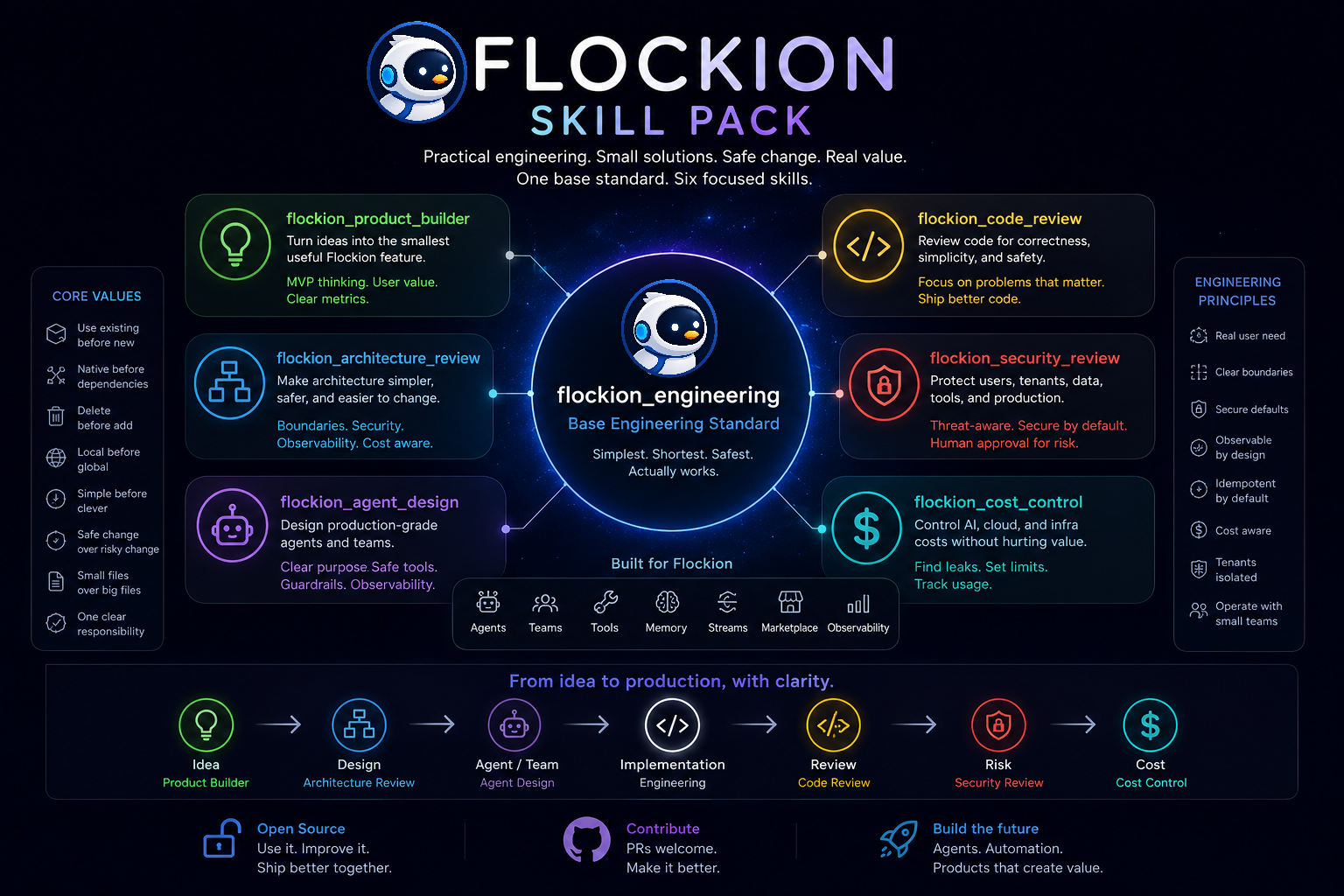
🔁 Lifecycle modes — the Skill Pack
The phase-by-phase decision modes, catalogued in docs/skill-pack.md. engineering is the base standard; the rest are sharper modes for a specific phase. Plugin invocation is /flockion:<name>.
| Phase | Skill | Use it to… |
|---|---|---|
| 💡 Idea | product-builder | cut an idea down to the smallest shippable feature with a clear success metric |
| 📐 Design | architecture-review | make a design smaller, safer, and cheaper to change — not bigger |
| 🤖 Agents | agent-design | spec a trustworthy agent/team: narrow tools, contracts, guardrails, approval |
| 🛠️ Build | engineering | write the shortest safe code (the base coding standard) |
| 🔍 Review | code-review | catch what matters: correctness, security, data loss, bloat |
| 🛡️ Risk | security-review | block unsafe shortcuts before they reach production |
| 💸 Cost | cost-control | kill token/cloud cost leaks without hurting product value |
⚙️ Implementation flavors — stack-specific engineering
Specializations of the Build phase. Each takes the base standard and sharpens the Ladder and rules for its stack.
| Skill | Stack | File |
|---|---|---|
| engineering-python | Python · backend · APIs · serverless | skills/engineering-python/ |
| engineering-react | TypeScript · React · frontend · forms · state | skills/engineering-react/ |
| engineering-infra | DevOps · IaC · CI/CD · containers | skills/engineering-infra/ |
| engineering-data | SQL · databases · migrations · pipelines | skills/engineering-data/ |
| engineering-ai | Agents · RAG · LLM · tool-calling · prompts | skills/engineering-ai/ |
🧭 Specialized modes
Sharper modes for specific, high-risk jobs — beyond the core pack pictured above.
| Skill | Use it to… |
|---|---|
| decomposition | break a monolith into services the lazy, safe way — only under real pressure, one reversible seam at a time, via strangler fig / branch by abstraction / parallel run / expand–migrate–contract. Defaults to "extract a module, not a service." |
| cloud-patterns | pick the smallest cloud design pattern that solves a named problem — the full 43-pattern Well-Architected catalog (Circuit Breaker, Retry, Bulkhead, CQRS, Saga, Sidecar, Gateway*, Quarantine, Valet Key, …) mapped to the five pillars, with the over-reach traps called out. |
| iso-27001 | map a feature, change, or system to ISO/IEC 27001:2022 Annex A controls — the smallest set of controls that actually holds, plus the evidence an auditor would ask for. Risk-based, not checklist bureaucracy. |
🗺️ How they fit together
        ┌─ product-builder ──── what is the smallest useful feature?
 idea   │
        └─ architecture-review ─ what is the simplest safe design?
                     │
                     ├─ agent-design ─── (if it involves agents/teams)
                     ▼
 build   engineering ──────────── the base standard
                     │   specialized by stack ↓
                     ├─ engineering-python   (backend/apis)
                     ├─ engineering-react    (frontend)
                     ├─ engineering-infra    (devops/iac/ci-cd)
                     ├─ engineering-data     (sql/db/pipelines)
                     └─ engineering-ai       (llm/rag/agents)
                     ▼
 ship    code-review → security-review → cost-control
🎚️ Intensity Levels
Every skill supports three intensities. Default is full.
| Level | Behavior |
|---|---|
lite |
Build what was asked, but name the simpler alternative in one line. |
full |
Apply the Ladder strictly. Shortest safe diff. Short explanation only. |
ultra |
YAGNI extremist. Challenge the requirement. Prefer deletion before addition. |
/flockion:engineering lite
/flockion:engineering full
/flockion:engineering ultra
Disable with: stop flockion · normal mode
⚡ What it looks like
You: Add a cache for these API responses.
Flockion (full):
from functools import lru_cache

@lru_cache(maxsize=1000)
def fetch_config(key: str) -> Config:
    ...
…then three short lines, never an essay:
skipped: custom cache class
add when: TTL, invalidation, or multi-instance consistency is required
Flockion (ultra):
No cache until profiling shows this is slow. Then start with @lru_cache.
A custom TTL cache is a bug farm until proven necessary.
📊 What it optimizes for
The rule was never "fewest tokens." It is: write only what the task needs, and never cut validation, error handling, security, or accessibility. The code ends up small because it is necessary, not golfed. Lower diff size — and, on models that follow the ladder cleanly, lower cost and latency — are a side effect of stopping at the first rung that holds, not the goal.
The win is largest where there is a real over-build trap and near zero on code that is already minimal. These are measured code sizes of the minimal answer vs a representative hand-rolled one — run npm run bench:loc to reproduce them from benchmarks/reference/:
| Trap | Naïve over-build | naive SLOC | Flockion | min SLOC |
|---|---|---|---|---|
| Date input | a date-picker popover component | 135 | native <input type="date"> |
21 |
| Color input | a hand-rolled HSV picker | 134 | native <input type="color"> |
17 |
| Response cache | a CacheManager + TTL + eviction |
56 | functools.lru_cache |
5 |
| Total | 325 | 43 (−87%) |
Honesty note — what these numbers are and aren't. The table above is real and reproducible, but it measures code size: a Flockion-minimal solution vs a representative hand-rolled one for each trap (full method + limitations). It is not proof the skill changes an agent's behavior. That claim needs the agentic A/B study — a real agent doing real work on a real repo, the same tickets with and without the skill, scored on the git diff it leaves behind (LOC, tokens, cost, time) plus a separate adversarial safety tier. That harness is scaffolded in
benchmarks/and is not yet collected — this README will not invent those numbers.
📦 Install
Claude Code — plugin
The repo ships a Claude Code plugin manifest (.claude-plugin/), so you can install all the skills from the marketplace:
/plugin marketplace add error505/Flockion_AI_Engineering
/plugin install flockion@Flockion_AI_Engineering
Claude Code — copy the skill files
The skills are plain Markdown — you can also just drop them in:
# Per-project (recommended for team-shared standards)
mkdir -p .claude/skills && cp -r skills/* .claude/skills/

# Global (every project) — macOS / Linux
mkdir -p ~/.claude/skills && cp -r skills/* ~/.claude/skills/
# Global — Windows (PowerShell)
New-Item -ItemType Directory -Force $env:USERPROFILE\.claude\skills | Out-Null
Copy-Item -Recurse skills\* $env:USERPROFILE\.claude\skills\
Copied as personal skills, invoke by the folder name (/engineering, /code-review, …); installed as the plugin, they are namespaced (/flockion:engineering). Or just say "flockion", "be lazy", "simplest solution", or "YAGNI" in any message.
Other agents — always-on ruleset
For agents that read a project rules / instructions file, Flockion ships a compact always-on ruleset, generated from one source into each harness's format. Use the file your agent reads:
| Agent | File |
|---|---|
| Codex · OpenCode · Gemini · Zed · Aider (and most "AGENTS.md" readers) | AGENTS.md |
| Cursor | .cursor/rules/flockion.mdc |
| Windsurf | .windsurf/rules/flockion.md |
| Cline | .clinerules/flockion.md |
| GitHub Copilot | .github/copilot-instructions.md |
| Kiro | .kiro/steering/flockion.md |
Run Flockion from a checkout of this repo and these are picked up automatically; to use one elsewhere, copy it into the matching path in your project. All six are generated from rules/flockion.md — edit that one file and run npm run build:adapters. This always-on path carries the ruleset; the named /flockion:* skills above need a skill-capable host (Claude Code).
🧰 Commands & skills
In a skill-capable host (Claude Code), invoke a skill by name. Names below use the plugin form /flockion:<name>; a personal-skills copy drops the prefix (/engineering). The engineering skills take an optional intensity argument; the mode skills run at their default.
| Invoke | What it does |
|---|---|
/flockion:engineering [lite|full|ultra] |
The base standard. Set the intensity, or run at the default (full). |
/flockion:engineering-python · -react · -infra · -data · -ai |
Stack-specialized engineering — same ladder, sharpened rules. |
/flockion:product-builder |
Cut an idea down to the smallest shippable feature with a clear success metric. |
/flockion:architecture-review |
Make a design smaller, safer, and cheaper to change. |
/flockion:agent-design |
Spec a trustworthy agent/team: narrow tools, contracts, guardrails, approval. |
/flockion:code-review |
Review the current diff for over-engineering — hands back a delete-list. |
/flockion:security-review |
Confirm the smaller diff never dropped a security or validation control. |
/flockion:cost-control |
Find token/cloud cost leaks without hurting product value. |
/flockion:decomposition |
Break a monolith into services safely — smallest reversible seam, strangler fig / branch by abstraction, expand–migrate–contract. |
/flockion:cloud-patterns |
Pick the smallest cloud design pattern for a named problem — 43-pattern WAF catalog, with the over-reach traps flagged. |
/flockion:iso-27001 |
Map a feature or system to ISO/IEC 27001:2022 Annex A controls — smallest controls that hold, plus the evidence an auditor would ask for. |
Intensity is per skill: lite names the simpler alternative, full (default) applies the ladder strictly, ultra is the YAGNI extremist for when the codebase has wronged you personally. Disable with stop flockion or normal mode.
🗣️ Trigger phrases
Flockion activates when you say any of:
flockion·be lazy·lazy mode·simplest solution·minimal solution·YAGNI·do less·shortest path·avoid overengineering·clean but simple
…or when you complain about bloat, boilerplate, unnecessary dependencies, oversized files, or architecture for imaginary requirements.
🧱 Shared principles
Pulled directly from the skills, applied across the whole family:
- Single Responsibility — if the name needs "and", it does too much.
- Simplicity before patterns — no architecture cosplay.
- No fake abstractions — no interface with one implementation, no factory for one object.
- Make invalid states impossible — discriminated unions and typed models over loose dicts.
- One source of truth — a rule lives in exactly one place.
- Side effects at the edges — pure logic stays pure.
- DRY, but late — write it, notice it, then extract it. Wrong abstraction is worse than temporary duplication.
- File Size Rule —
100–300good ·300–500review ·500+refactor ·800–1000design warning. - Leave one small check — non-trivial logic ships with its smallest useful test.
🛠️ Development
The skills are plain Markdown. The one build step keeps the harness adapters in sync:
npm run build:adapters   # regenerate AGENTS.md, .cursor, .windsurf, .clinerules, .github, .kiro
npm run check            # fail if any adapter drifted from rules/flockion.md  (also: npm test)
A few conventions keep the set coherent:
- One source for the ruleset.
rules/flockion.mdis canonical; the six harness adapters are generated from it. Edit the source, never the generated files —npm run checkenforces it. - Skill layout. Each skill is
skills/<name>/SKILL.md(exactly one level deep — Claude Code does not recurse). The folder name is the invocation (/flockion:<name>as a plugin,/<name>as a personal skill). Frontmatter uses valid YAML:name,description(block scalar),argument-hint;applyTo/licenseare kept for the other adapters but ignored by Claude Code. - Keep the catalog in sync.
docs/skill-pack.mdis the routing index — it points at the real skill files, it does not define skills. When you add or rename a skill, update the catalog and this README's tables. - One skill, one folder. Each skill lives in its own folder under
skills/. Don't merge skills back into a single doc. - Benchmarks are honest or absent. See
benchmarks/. Ship numbers only from real runs written up inbenchmarks/results/; the example records are synthetic and labelled as such. - The file-size rule applies to skills too. A skill that sprawls into a mega-standard is over-built — split it by responsibility, the same way the rules say to split code.
📄 License
MIT © 2026 Igor Iric
Build less. Delete more. Keep the code boring. Leave one small check where it matters.


