
ghpending
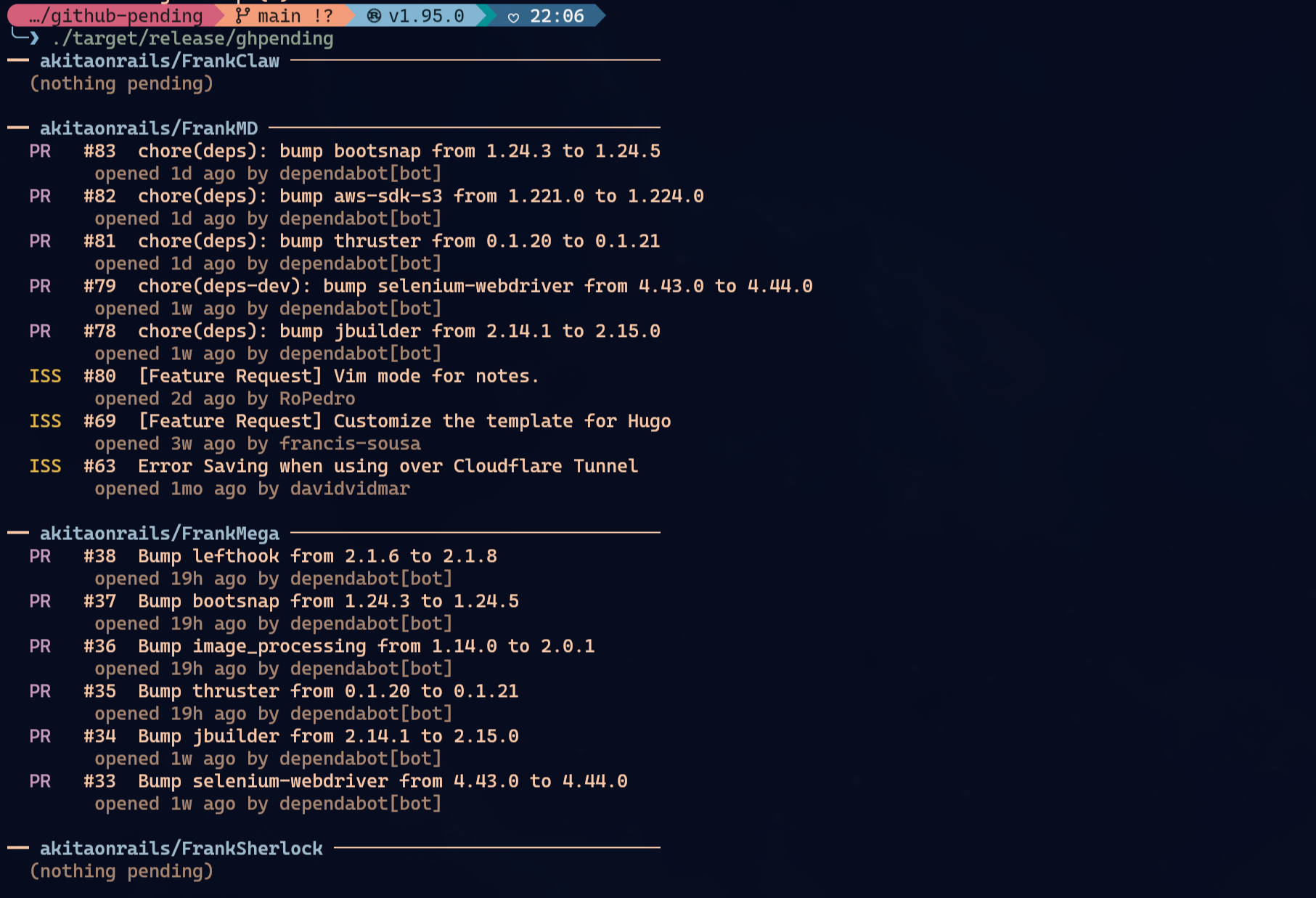
See open issues and pull requests across the GitHub repos you care about, at a glance.
Install
Homebrew (macOS / Linux)
brew tap akitaonrails/tap && brew install ghpending
Arch Linux (AUR)
yay -S ghpending-bin    # prebuilt x86_64 binary, fastest
yay -S ghpending        # builds from source, x86_64/aarch64
Cargo
cargo install ghpending
mise
mise use -g github:akitaonrails/ghpending
From source
git clone https://github.com/akitaonrails/ghpending
cargo install --path ghpending
Upgrading
# Homebrew
brew upgrade ghpending

# AUR (any helper that respects upstream changes)
yay -Syu ghpending-bin

# Cargo
cargo install ghpending --force

# mise
mise upgrade ghpending

# From source
cd ghpending && git pull && cargo install --path .
Usage
ghpending add                # pick repos from the saved user/org to track
ghpending add --user <name>  # switch to a different user/org (replaces the saved one)
ghpending add --all          # pick from every repo your token can reach (private included)
ghpending        # print the digest
ghpending --limit 20  # cap the digest at 20 items, distributed proportionally per repo
ghpending --subscribed  # show only issues and PRs you are subscribed to
ghpending --sort count  # order repos by open item count instead of activity
ghpending list   # show tracked repos
ghpending rm     # remove repos from the list
ghpending add— lists repos and lets you select which to track. The username is saved so subsequentaddruns skip the prompt. Pass--user <name>to switch to a different user/org without editing the config; it replaces the saved one.- Private repos: with a
GITHUB_TOKENthat has thereposcope,addincludes private repos automatically when the target is your own account or an org you belong to. For a third-party user only their public repos are visible. --alllists every repo your token can reach — owned, collaborator and organization-member, private included — in a single picker, ignoring the saved user. Use it to grab private repos you collaborate on across different owners.
- Private repos: with a
ghpending— fetches tracked repos concurrently and prints their open issues and pull requests. Pass--subscribedto show only items that the authenticated user is subscribed to. Pass--limit <count>to cap the total number of displayed items; each repository receives a proportional share while preserving its existing item order. Pass--sort <mode>to control repo order:activity(default, most recently updated open item first),name(alphabetical, the config-file order),count(most open items first) orstale(most neglected repo — oldest-updated open item — first).ghpending list— prints the repos currently in your watch list.ghpending rm— opens an interactive menu to select repos to remove from tracking.
Authentication
GITHUB_TOKEN is optional. Without one, public repository access is subject to GitHub's 60 requests/hour limit. Set a token for a 5,000 requests/hour limit and access to private repositories:
GITHUB_TOKEN=$(gh auth token) ghpending
The --subscribed filter requires a token because GitHub subscriptions are user-specific:
GITHUB_TOKEN=$(gh auth token) ghpending --subscribed
To include private repos, the token needs the repo scope (classic) or read access to the repo's Contents, Issues and Pull requests (fine-grained). The token is read silently at startup.
GitHub API proxy (optional)
If a SOCKS proxy is already listening at 127.0.0.1:9050, ghpending uses it for GitHub API calls and falls back to direct API access when it is not available. You can also force a SOCKS proxy with GHPENDING_GITHUB_PROXY=socks5h://host:port; existing HTTPS_PROXY / ALL_PROXY values are honored when they use socks5 or socks5h.
Config
The config file lives at:
- Linux:
~/.config/ghpending/config.toml - macOS:
~/Library/Application Support/ghpending/config.toml
Example:
user = "akitaonrails"
repos = ["ratatui-org/ratatui", "tokio-rs/tokio"]
sort = "name"
Run ghpending add --user <name> to change the user field, or edit the file directly to reorder repos. Set sort to activity, name, count or stale to change the default repo order without passing --sort each time.
Themes
Pass --theme nerv on the command line (any subcommand) or set theme = "nerv" in the config file to switch to the NERV interface palette. The older purple-accent Evangelion palette is still available as evangelion.
user = "akitaonrails"
repos = ["ratatui-org/ratatui"]
theme = "nerv"
The environment variables GHPENDING_THEME (specific) and TCLOCK_WIDGET_THEME (generic, set by tclock for its widget subprocesses) are also honored, so running ghpending as a tclock widget follows the clock's theme cycling automatically.
Precedence: --theme flag, then GHPENDING_THEME, then TCLOCK_WIDGET_THEME, then the config file, then default. An unknown name in an env var is skipped with a warning; an unknown name in the flag is an error.
License
MIT


