
RepoProof
Deterministic, local-first CLI that audits repository-quality risks
in AI-generated and rapidly built software projects.




npx repoproof scan .
Verified on RepoProof itself
RepoProof's CI-controlled self-audit scores 90/A with zero errors:
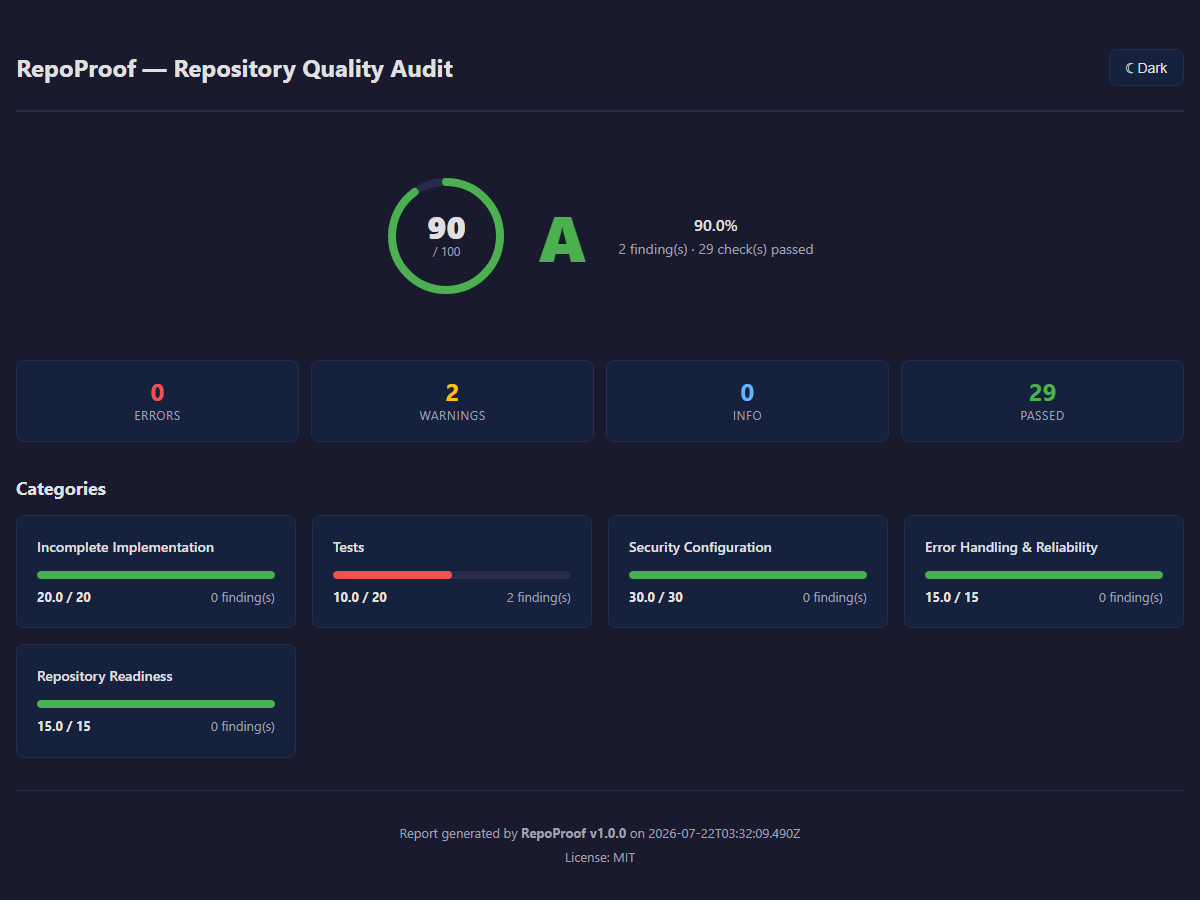
RepoProof checks for:
- exposed secrets, private keys, and API tokens in source code
- unfinished implementations and TODO/FIXME markers
- disabled or empty tests
- unsafe
eval()and wildcard CORS configurations - empty catch blocks and missing HTTP timeouts
- missing CI workflows, license, gitignore, and lockfiles
Why RepoProof
AI coding assistants generate code faster than ever, but they also introduce systematic patterns that degrade repository quality: stub implementations, hardcoded secrets, disabled tests, empty catch blocks, commented-out code, missing documentation, and insecure configurations.
Manually reviewing for these patterns is tedious and inconsistent. RepoProof makes it deterministic and repeatable — scanning a full repository in under a second with zero external dependencies.
Features
- 31 deterministic rules — covers incomplete implementations, test gaps, security configuration, error-handling reliability, and repository readiness
- 100% local — all analysis runs on your machine. No data leaves your network
- No AI API key — pure static analysis, no prompts, no cloud calls
- Does not execute your code — source text is parsed, scripts are never run
- No telemetry — zero data collection, zero tracking, no analytics
- Multiple report formats — text, JSON, Markdown, HTML, SARIF
- CI-native — single CLI command with
--min-scoreand--fail-ongates - Fast — scans tens of thousands of files in under a second
- Node 20, 22, 24 — verified on every CI run
- 291 tests — full regression suite passes before every release
Installation
# Install globally
npm install -g repoproof

# Or run without installation
npx repoproof scan .
Quick Start
# Scan the current directory
npx repoproof scan .

# Scan a specific project
npx repoproof scan ./path/to/project

# Generate an HTML report
npx repoproof scan . --format html --output report.html

# Generate a SARIF report for GitHub Code Scanning
npx repoproof scan . --format sarif --output results.sarif

# Explain a specific rule
npx repoproof explain hardcoded-secrets

# List all available rules
npx repoproof list-rules

# Initialize a configuration file
npx repoproof init

# Fetch metadata for a public GitHub repository
npx repoproof github MadB0i/RepoProof

# The same, using a full GitHub URL
npx repoproof github https://github.com/MadB0i/RepoProof
Example Findings
// ❌ not-implemented: Code path not implemented
function processData() {
  throw new Error("not implemented");
}

// ❌ empty-function: Empty function body
function handleClick() {}

// ❌ hardcoded-secrets: API key in source
const apiKey = "YOUR_API_KEY_HERE"; // [REDACTED]

// ❌ empty-catch: Silently swallowed error
try {
  await fetch("/api/data", { signal: AbortSignal.timeout(5000) });
} catch (e) {} // empty catch
Report Formats
| Format | Command | Use Case |
|---|---|---|
| Text | --format text (default) |
Terminal output |
| JSON | --format json |
Programmatic consumption |
| Markdown | --format markdown |
PR comments, issues |
| HTML | --format html |
Visual browsing, sharing |
| SARIF | --format sarif |
GitHub Code Scanning |
Configuration
Create a .repoproof.json or .repoproof.jsonc file in your project root:
{
  "$schema": "https://raw.githubusercontent.com/MadB0i/RepoProof/main/schema.json",
  "minScore": 75,
  "failOn": "warning",
  "disabledRules": ["mock-data"],
  "severityOverrides": {
    "empty-function": "error",
  },
  "penaltyOverrides": {
    "empty-function": 1,
  },
  "excludedPaths": ["dist", "generated"],
}
GitHub Integration
Fetch public metadata about any GitHub repository — stars, forks, language breakdown, license, and more — directly from your terminal:
npx repoproof github owner/repo
npx repoproof github https://github.com/owner/repo
The github command is the only RepoProof operation that touches the network. It makes two read-only calls to the GitHub REST API and prints a compact summary. It never clones the repository, and it never modifies anything.
Private or rate-limited repositories can be queried by exporting a personal access token, which is optional but recommended to avoid GitHub's unauthenticated rate limits:
export GITHUB_TOKEN=github_pat_...
npx repoproof github some-org/private-project
The token is only sent in the Authorization header of the API request and is never printed.
GitHub Actions
- name: Scan with RepoProof
  run: npx repoproof scan . --format sarif --output results.sarif --min-score 90 --fail-on error

- name: Upload SARIF to GitHub
  uses: github/codeql-action/upload-sarif@v3
  with:
    sarif_file: results.sarif
Supported Languages
RepoProof detects and scans projects written in:
- JavaScript (
.js,.jsx,.mjs,.cjs) - TypeScript (
.ts,.tsx,.mts,.cts) - Python (
.py) - Rust (
.rs) - Go (
.go) - Java (
.java) - Ruby (
.rb) - PHP (
.php) - C# (
.cs) - Kotlin (
.kt) - Swift (
.swift) - Shell (
.sh,.bash,.zsh)
Safety and Privacy
- No data exfiltration. All scanning is performed locally. RepoProof never sends source code, file contents, or findings to any remote service.
- No AI API key needed. There is no AI component. Every rule is deterministic pattern matching.
- No telemetry. The CLI contains zero analytics, tracking, or usage reporting.
- Does not execute scripts. RepoProof parses source files as text only. It never runs
npm install,pip install,make, or any build command found in the repository. - Secret redaction. When secrets are detected, the matching values are redacted in all report outputs with
[REDACTED].
Limitations
- RepoProof is a static analysis tool. It cannot prove whether code was written by AI or by a human.
- It is not a security certification. It flags patterns that are commonly associated with risk, but passing a scan does not guarantee a secure or production-ready repository.
- Rules are intentionally conservative to minimise false positives. Some issues may require manual review.
- Language support is file-extension based. RepoProof does not parse or understand language semantics — it scans source text for patterns.
Rules Overview
| Category | Rule IDs | What It Detects |
|---|---|---|
| Incomplete Implementation | stubs, dead code, work-in-progress markers, mock data, coverage gaps | Stubs, dead code, TODO markers, mock data |
| Tests | disabled-tests, empty-test-files, missing-tests |
Skipped tests, empty test bodies, files without corresponding tests |
| Security Configuration | hardcoded-secrets, unsafe-eval, wildcard-cors, debug-enabled, env-tracked, env-documented, broken-scripts |
Secrets, eval, CORS misconfiguration, debug modes left enabled |
| Error Handling & Reliability | empty-catch, no-http-timeout, unbounded-retries, process-exit |
Silent error swallowing, hanging HTTP requests, infinite retries |
| Repository Readiness | readme-exists, license-exists, contributing-exists, code-of-conduct, changelog-exists, ci-workflow, missing-gitignore, lockfile-exists, package-metadata, test-echo-command |
Missing project files, metadata, lockfiles, CI configuration |
Contributing
Contributions are welcome. Please see CONTRIBUTING.md for guidelines.
Support
Questions, bug reports, and feature requests are welcome at [email protected].


